
If you have ever killed a plant, the ZZ plant is the one that will restore your confidence. It forgives forgotten waterings, shrugs off dim corners and keeps its glossy, sculptural leaves looking fresh while other plants sulk. I have walked away from mine for two weeks over a holiday, with zero care and a hopeful goodbye. When I came home, it looked better than when I left.
That is the magic of this plant. It thrives on neglect, suits offices and dark hallways, and quietly teaches nervous beginners that they can keep something alive after all. Many people I know started with a single ZZ and ended up with a jungle.
At Plant Style Home we help plant lovers at every level grow beautiful thriving plants, so explore our complete plant and flower guides here. In this guide I will share what the ZZ plant truly needs, how to fix the odd problem, how to multiply it, and why the black Raven ZZ might become your favorite plant ever.
What is a ZZ Plant?
The ZZ plant goes by the botanical name Zamioculcas zamiifolia, and the nickname simply comes from the first two letters of that mouthful. It is native to Eastern Africa, where it grows in dry, drought-prone regions with long stretches between rains.
That origin story explains everything about its toughness. Under the soil, a ZZ grows thick, potato-like rhizomes that store water the way a camel stores fat. When the soil runs dry, the plant draws on those reserves and carries on without complaint.
A few quick facts worth knowing:
- Size: Slow growing, usually 2 to 4 feet tall indoors.
- Look: Upright, arching stems lined with waxy, oval leaflets that look polished.
- Lifespan: Decades with basic care.
- Habit: Grows a handful of new stems each year rather than racing upward.
So why did it become so popular? Offices and shopping malls adopted it first because it tolerates low light, dry air and irregular watering. Homeowners noticed, and now it sits in living rooms, bedrooms and bathrooms around the world.
⚠️ TOXICITY WARNING: PLEASE READ
The ZZ plant is toxic to cats, dogs and humans if chewed or swallowed. All parts of the plant contain calcium oxalate crystals. These can cause mouth and throat irritation, drooling, vomiting and stomach upset if eaten.
The sap can also irritate skin and eyes. Wear gloves when pruning, dividing or repotting, and wash your hands afterwards.
Keep it out of reach of pets and small children. If you think a pet or child has eaten some, contact your vet, a poison control center or a doctor straight away.
None of this means you must avoid the plant. It simply means placing it sensibly, on a high shelf or in a room your curious pets cannot reach, and handling it with respect.
ZZ Plant Varieties
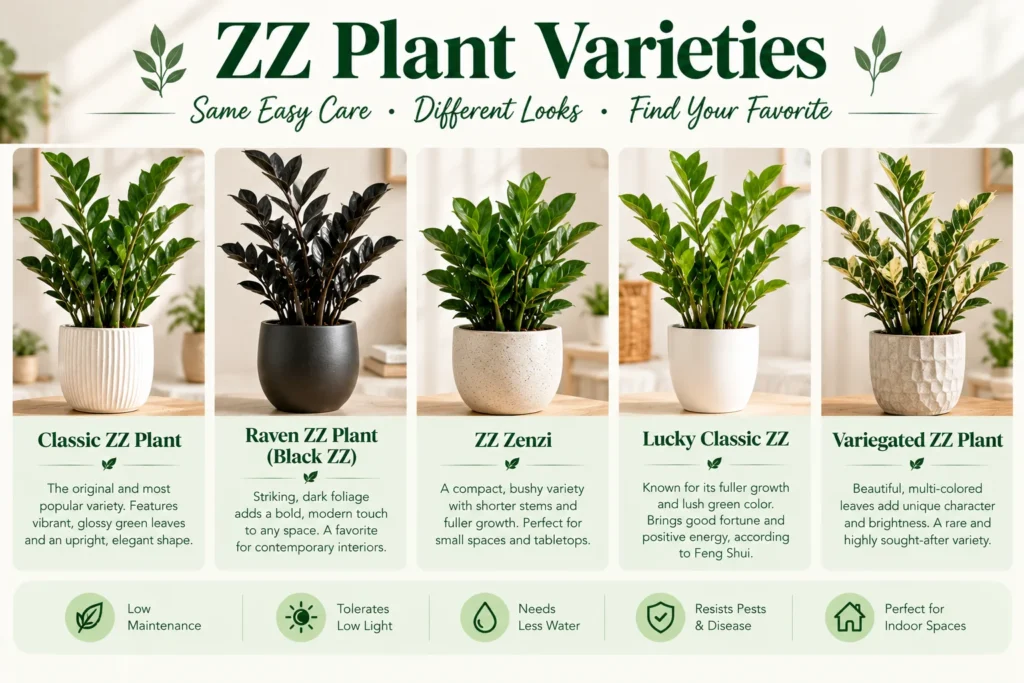
The classic is wonderful, yet there are several lovely options. Here is how they compare.
Classic ZZ Plant
This is the dark green, glossy beauty you see in most shops. It is the most widely available, the most affordable and the most forgiving. If you are brand new to houseplants, start here.
Raven ZZ Plant (Black ZZ)
Raven ZZ is one of the most dramatic plants you can own. The leaves look almost black, with a deep sheen that catches the light like polished stone.
Here is the fascinating part. New growth emerges bright green and slowly darkens over several weeks until it turns that moody, inky shade. Watching a fresh stem make the journey is a small daily thrill.
A black ZZ is also slightly pricier and sometimes a touch slower, but care is identical to the classic. It looks fantastic against pale walls, in white or cream pots and beside brass or wooden accents.
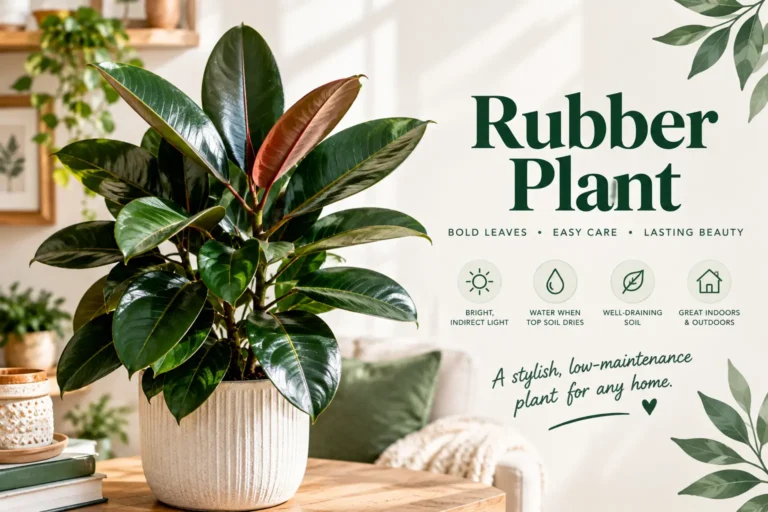
If you love Raven ZZ’s dark drama, our guide on Rubber Plant covers another stunning dark-leaved statement plant for your collection. And the near-black leaves echo the dramatic beauty of dark blooms too, so explore our guide on Black Flowers for more dark and dramatic plant inspiration.
ZZ Zenzi
Zenzi is a compact dwarf selection with shorter, curling, tightly packed leaves. It stays small and bushy, which makes it perfect for desks, shelves and tiny apartments.
Lucky Classic ZZ
Lucky Classic has a slightly different leaf shape, a little rounder and fuller, while care stays exactly the same. Choose it if you like a neat, sturdy look.
Variegated ZZ Plant
Variegated ZZ is very rare, with creamy and green patches that look hand painted. It is also extremely expensive. Care is similar, but it needs more bright, indirect light to keep its markings, and it grows even more slowly.
Which variety is best for you?
- Total beginner or tight budget: Classic ZZ.
- Wanting a statement piece: Raven ZZ.
- Small desk or shelf: ZZ Zenzi.
- Love a compact, tidy shape: Lucky Classic.
- Collector with patience and savings: Variegated ZZ.
ZZ Plant Care Guide
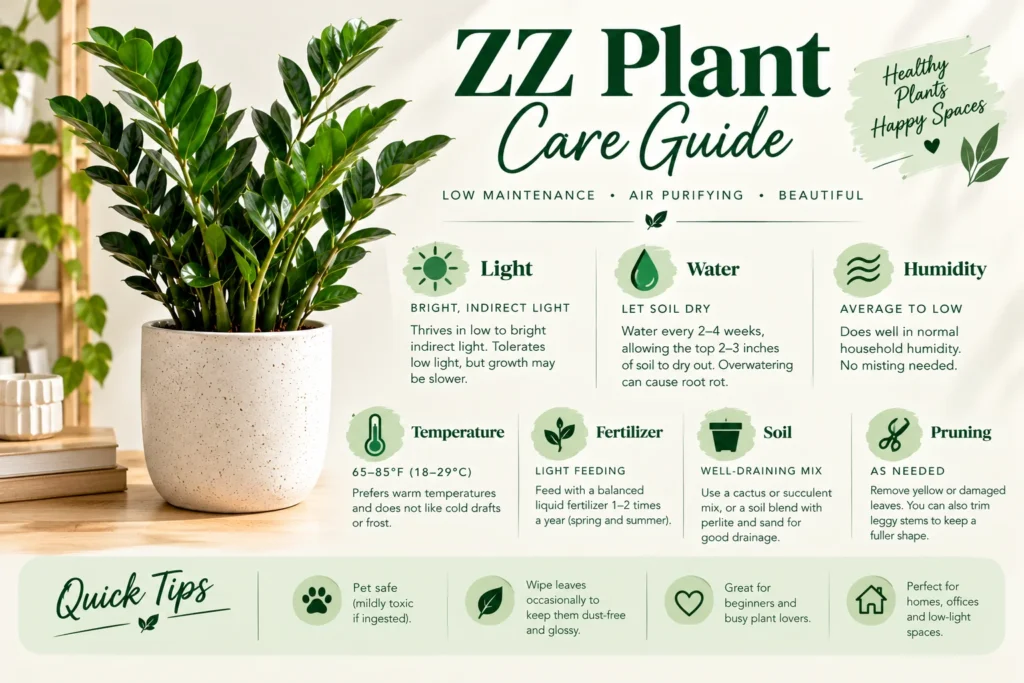
Good news: ZZ plant care is simple. A few habits matter more than anything else, and watering tops the list.
Light Requirements
The ZZ plant is the most forgiving houseplant I know when it comes to light. It tolerates low light better than almost any other, which is why you see it in offices and dim lobbies.
The honest truth is that tolerating is different from thriving. Bright, indirect light produces faster, fuller growth. Low light keeps the plant alive, but it will grow at a snail’s pace.
- Avoid direct sun. Harsh afternoon rays scorch the leaves and cause yellowing.
- North facing room: Place it within a few feet of the window and it will be perfectly happy.
- East facing window: Ideal, with gentle morning light.
- Office with no windows: A ZZ can survive for a while under steady fluorescent or LED lighting. For long term health, rotate it near a window occasionally or add a small grow light for a few hours a day.
Watering ZZ Plant
This is the most important section of the whole guide. The ZZ plant needs less water than almost any other houseplant, because those rhizomes already hold a reserve.
Let the soil dry out completely between waterings. Then water deeply until it runs from the drainage holes, and let the pot drain fully.
To check the soil properly, push a finger two to three inches down, or slide a wooden skewer to the bottom of the pot. If it comes out clean and dry, it is time. If you feel any damp, wait a few more days.
Seasons change the rhythm:
- Spring and summer: Roughly every 2 to 3 weeks.
- Autumn and winter: Every 4 to 6 weeks, sometimes even less.
Underwatering is far safer than overwatering. A thirsty ZZ recovers easily, but a rotten one often does not.
Signs of overwatering:
- Yellowing leaves and soft, mushy stems
- A sour smell from the soil
- Rhizomes that feel squishy
Signs of underwatering:
- Wrinkled stems
- Leaflets that droop or curl slightly
- Dry, crispy leaf edges
Soil Requirements
Drainage is everything. Use a well draining mix, such as a ready-made cactus mix, or blend regular potting soil with about one third perlite or coarse sand.
Always pick a pot with drainage holes. A decorative cache pot is fine, as long as you never leave water sitting in the bottom. Terracotta is a great choice because the clay breathes and helps the soil dry faster, which suits anyone who tends to be generous with the watering can.
Temperature and Humidity
The ZZ plant is wonderfully adaptable. It is happiest between 65 and 85°F (18 to 29°C), which is comfortable room temperature for most people.
Average to low humidity suits it fine and no misting is needed. Dry air does not bother it at all, so it copes well in centrally heated homes where other plants crisp up. What it does dislike is cold. Keep it away from icy drafts, open winter windows and frost, and avoid letting it sit below about 45°F (7°C).
Fertilizing ZZ Plant
This plant is slow growing, so it needs very little food. Feed it once or twice a year, in spring and summer, using a balanced houseplant fertilizer diluted to half strength.
Skip feeding in autumn and winter, when growth slows down. Too much fertilizer does more harm than good and can burn the roots.
Common ZZ Plant Problems
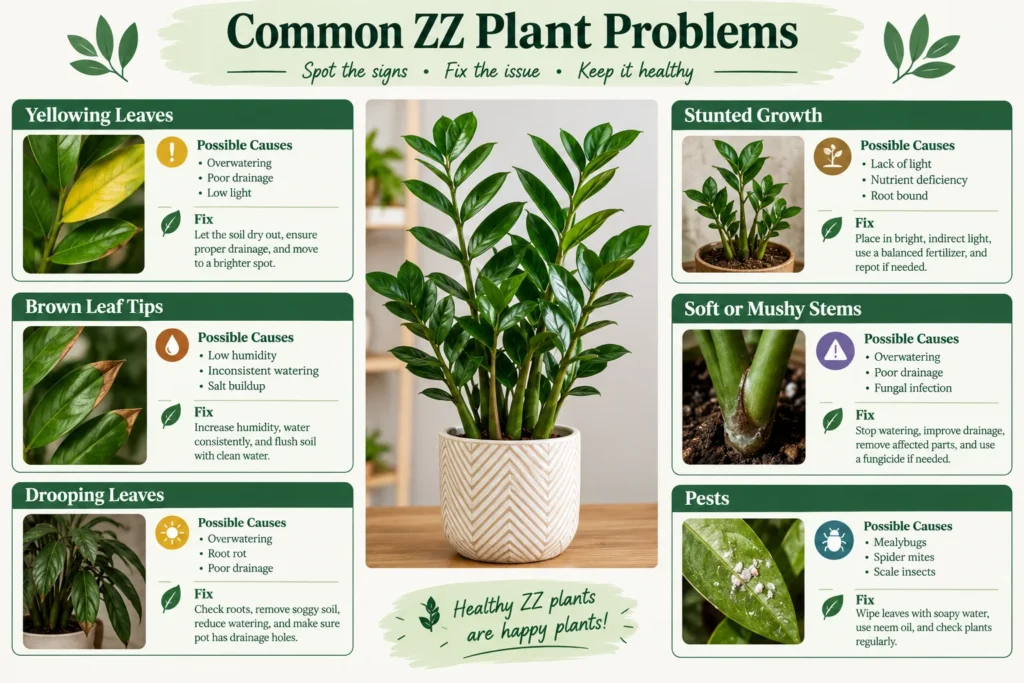
Even the toughest plant has an off day. The good news is that most issues have simple fixes.
ZZ Plant Yellow Leaves
Yellow leaves are the number one question I hear. Here are the usual causes, with a way to tell them apart.
- Overwatering (most common): Several leaves turn yellow at once and the soil is damp. Let it dry fully and water less often.
- Root rot: Stems feel soft, the soil smells sour and the rhizomes are mushy. Unpot the plant, cut away black or squishy parts with clean scissors, dust the cut surfaces and repot in fresh dry mix.
- Natural leaf drop: One lower stem yellows occasionally while the rest looks healthy. This is normal aging, so just trim it off.
- Too much direct sun: Yellow or bleached patches on the side facing the window. Move it back a little.
A simple trick is to check the soil first. If it is wet, think water. If it is dry and the yellowing sits on one side, think sun.
ZZ Plant Not Growing
Take a breath, because this one often has a happy answer. The ZZ plant is naturally slow growing. It may produce just a few new stems a year, and that is completely normal.
Possible reasons for a standstill:
- Winter dormancy: Growth pauses in the cold, darker months and resumes in spring.
- Not enough light: Very dim spots keep the plant alive but barely moving. Try a brighter location.
- Needing a repot: If the rhizomes have filled the pot, growth may stall.
Be patient and give it brighter light, and you will soon spot a fresh green shoot pushing up through the soil.
ZZ Plant Dropping Leaves
When leaves fall, ask what changed recently.
- Overwatering: Soft, yellowing leaves that drop. Dry the plant out.
- Severe underwatering: Wrinkled stems and dropping leaflets. Give a deep soak.
- Temperature shock: Cold drafts or sudden heat. Move it somewhere stable.
- Moving stress: A new home can trigger a little leaf loss. Leave it alone and it usually settles within a few weeks.
ZZ Plant Brown Tips
Brown tips are uncommon on a ZZ, but they do happen.
- Underwatering: Dry soil for far too long. Water thoroughly.
- Fertilizer burn: Salt build up from too much feeding. Flush the soil with plenty of water and pause feeding.
- Very low humidity: Rarely a cause for this plant, but extremely dry air can contribute.
Trim the damaged tips with clean scissors, and the new growth should stay clean.
ZZ Plant Pests
Here is another bonus. Pests rarely bother a ZZ plant. Occasionally you might meet mealybugs, which look like tiny cotton fluffs, or scale, which look like small brown bumps.
Wipe them off with a cotton swab dipped in rubbing alcohol, then spray with insecticidal soap every week until they are gone. Remember your gloves.
ZZ Plant Propagation
Propagating a ZZ takes patience, and I will be honest about that. It is slower than pothos or monstera because the plant has to grow a brand new rhizome before it can produce proper new stems. The best time to start is spring, when the plant naturally wants to grow.
Once you master ZZ plant, why not try our guide on Monstera Plants, the next step up for growing confidence as a plant parent.
Leaf Cutting in Water
It is the slowest method, but it works, and it is satisfying to watch roots form.
- Wearing gloves, cut a healthy stem with leaflets attached, or snip a single leaflet cleanly at its base.
- Place the cut end in a clear jar of room temperature water.
- Set it in bright, indirect light.
- Change the water every week to keep it fresh.
- Wait for roots, then a small rhizome, to form. This can take 4 to 9 months.
- Once the rhizome and roots are established, pot it up in well draining soil.
Leaf Cutting in Soil
This method follows a similar path, with fewer steps in between.
- Take a healthy stem or leaflet cutting and let the cut end dry for a day.
- Push it into a small pot of damp cactus mix, burying the lower third.
- Keep the soil lightly moist, never soggy.
- Place the pot in warm, bright, indirect light.
- Wait several months for a rhizome to develop underground.
Stem Cutting and Division
Division is the fastest method and my personal favorite, because you get an instant, established plant.
- Remove the plant from its pot during spring repotting and shake off the loose soil.
- Look for natural clumps of stems, each with its own rhizome.
- Gently pull apart or cut the rhizomes with a clean knife, making sure each section keeps stems and roots.
- Let any cut surfaces dry for a day.
- Plant each division in its own pot of fresh, well draining mix.
- Water lightly and place in bright, indirect light.
Repotting ZZ Plant
You will not need to repot often, usually every 2 to 3 years at most. In fact, a snug pot suits this plant perfectly.
Signs it actually needs more room:
- Roots growing out of the drainage holes
- The pot bulging or cracking, as the rhizomes can be surprisingly strong
- Water running straight through because there is more root than soil
Do not panic if you see rhizomes poking above the soil. This is normal and does not automatically mean it needs a bigger pot.
Choose a new pot just one or two inches wider than the current one. Anything larger holds extra wet soil and invites rot.
- Put on your gloves.
- Water lightly a day before to ease the plant out.
- Tip the pot sideways and slide the plant out gently.
- Loosen the roots and check for any soft or mushy parts.
- Add fresh, well draining mix to the new pot.
- Set the plant at the same depth as before and fill around it.
- Wait about a week before watering to let any damaged roots heal.
ZZ Plant in the Home and Office
Where can a ZZ live? Almost anywhere, which is part of the charm.
- Dark office corners: A reliable green touch in forgotten spots.
- North facing rooms: Good light for steady, healthy growth.
- Bathrooms: Fine for low light, though it does not need the steam.
- Bedrooms: A calm, tidy plant that looks lovely on a dresser.
- Hallways and corridors: It brightens up narrow, shaded spaces without fuss.
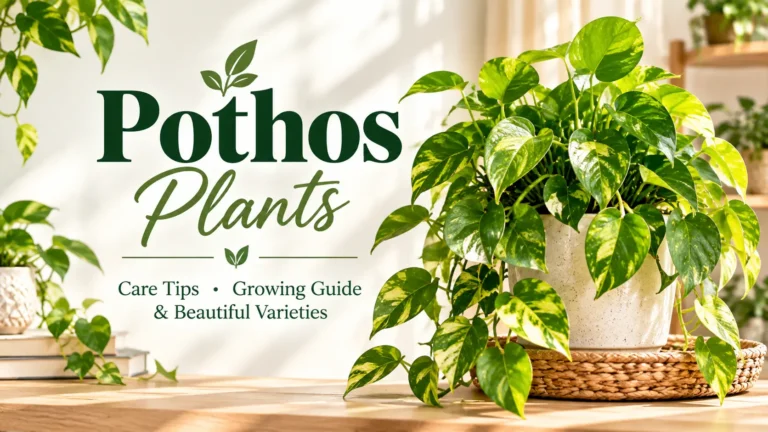
ZZ and pothos make the ultimate low light duo. Our complete guide on Pothos Plants covers the other great survivor plant for dark spots.
Air purifying properties
You may have heard that houseplants clean the air, based on a well known NASA clean air study. The study used sealed chambers, so the effect in a real room is much smaller than headlines suggest. Think of a ZZ as a lovely bonus for freshness and atmosphere, not a replacement for ventilation.
Feng shui and culture
In some cultures, the ZZ plant is seen as a lucky plant. Its upright stems and sturdy leaves are linked with prosperity and steady growth, which is why you often see it near shop entrances and office desks around Lunar New Year.
Why it is perfect for offices
It handles artificial light, air conditioning and the occasional weekend without anyone watering. That is exactly why it became the office plant of choice.
Styling tips
- Place a Raven ZZ in a pale ceramic pot for striking contrast.
- Group a classic and a Zenzi at different heights for a layered look.
- Use a woven basket as a cover pot, but remove the plant to water.
- Wipe the leaves with a damp cloth every month or two to keep them glossy.
Frequently Ask Questions
Water only when the soil is completely dry. In most homes that means every 2 to 3 weeks in summer and every 4 to 6 weeks in winter. When in doubt, wait a few more days.
Yes. It contains calcium oxalate crystals that can cause drooling, vomiting and mouth irritation in pets and people. Keep it out of reach, and contact your vet if your pet chews on it.
It grows well in low light, though slowly. In a room with no natural light at all, it can survive for a time under artificial light, but it will do better with some daylight or a small grow light.
Overwatering is the most common cause. Check the soil, let it dry out, look for soft rhizomes and consider whether direct sun might be scorching the leaves.
Slowly. Expect a few new stems per year, with faster growth in bright indirect light during spring and summer.
It is called the Raven ZZ plant, sold under the name Zamioculcas zamiifolia ‘Raven’. Its new leaves emerge green, then darken to a near-black shade.
Conclusion
The ZZ plant really is the perfect plant for everyone. Complete beginners love it because it forgives mistakes, and experienced collectors love it for the sculptural look and the thrill of chasing rare varieties like Raven and the variegated types.
If you have failed with other plants before, please give the ZZ plant a try. Water it sparingly, keep it out of harsh sun and out of reach of pets, and it will not let you down. You might even find that it gives you the confidence to try something new.
Ready to keep growing? Explore more care guides and plant inspiration at plantstylehome.com.