Almost everyone who has ever seen a venus fly trap has wanted one. There is something irresistible about a plant that catches and eats insects, and this one is the most famous carnivorous plant in the world, recognisable at a glance and deeply intriguing to children and adults alike.
The challenge is that most people accidentally kill theirs within a few months by caring for it the wrong way. The reputation for being difficult is real, but the plant is not fragile. It simply needs almost the opposite of what we instinctively give other plants.
This guide explains exactly why most of them die and how to keep one thriving for years. Once you understand what it actually wants, everything gets easier.
What Is a Venus Fly Trap?
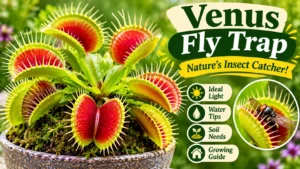
The venus fly trap (Dionaea muscipula) belongs to the Droseraceae family, the same family as sundews. It is the only species in its genus, which makes it one of the most specialised plants on Earth. Nothing else quite like it exists.
Its origin is surprisingly narrow. In the wild it grows only in a small area of coastal North and South Carolina, within about 100km of Wilmington, North Carolina. The Green Swamp and the surrounding longleaf pine savanna bogs are its home, where the soil is acidic, waterlogged and almost completely lacking in nutrients, and the sun is strong and the air is humid.
That habitat explains nearly every care rule you are about to read.
Venus Fly Trap Facts Worth Knowing
The wild plant is listed as vulnerable. Habitat loss and illegal poaching have cut wild populations significantly, so always buy from a reputable nursery selling tissue-cultured or legally propagated plants. Never buy a wild-collected specimen.
The way the trap works is a small marvel:
- Each trap is a modified leaf with tiny trigger hairs on the inside.
- An insect must touch those hairs twice within about 20 seconds. This two-touch system stops the plant wasting energy on raindrops and debris.
- The trap can snap shut in as little as 100 milliseconds, one of the fastest movements in the plant kingdom.
- Digestive enzymes then dissolve the soft tissue of the prey, which takes 5 to 12 days.
- The trap reopens afterwards. Each one can catch and digest roughly 3 to 5 insects before it turns black and dies, and new traps grow to replace it.
On a healthy plant, traps are usually 1 to 3cm long and the whole rosette spreads 5 to 15cm across. In spring it sends up a tall stalk of white flowers, which you will almost always want to cut off. More on that shortly.
If you are drawn to dramatic, slightly sinister plants, this one is hard to beat. Our Gothic Flowers guide explores more dark and extraordinary blooms, and the venus fly trap is arguably the most gothic plant in existence.
Venus Fly Trap Care: The 4 Rules That Change Everything
Get these four rules right and you prevent roughly 95% of deaths. Nearly every failed plant I have heard about broke at least one of them, and always with the best intentions.
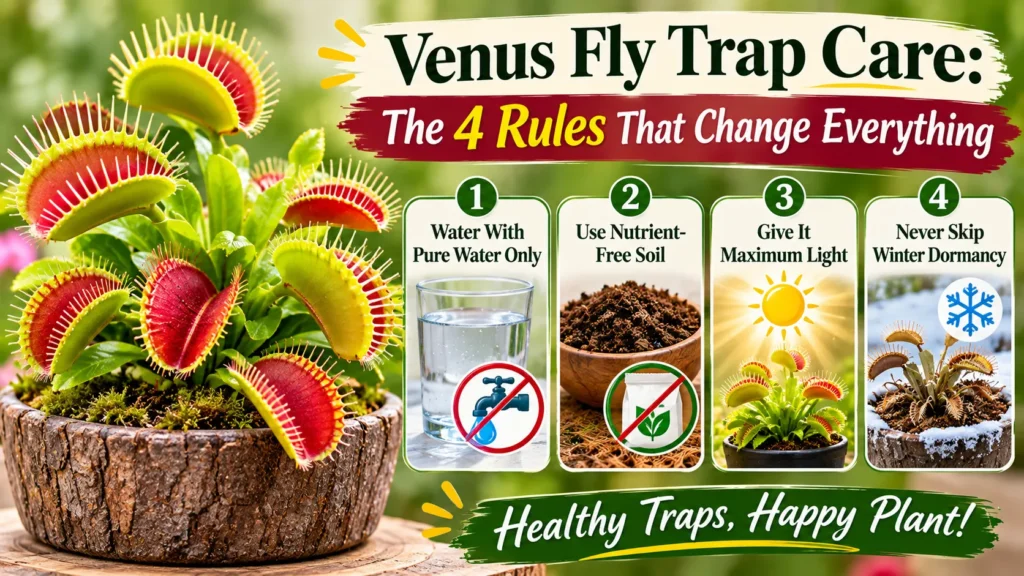
Rule 1: Water With Pure Water Only
Never use tap water. This is the number one killer of a venus fly trap kept indoors. Tap water carries minerals and salts that build up in the soil and poison the roots within months.
Use only:
- Distilled water
- Rainwater
- Reverse osmosis water
Here is how to water venus fly trap plants the way their bog habitat does it, using the tray method:
- Stand the pot in a shallow tray.
- Keep 1 to 3cm of water in the tray at all times.
- Let the plant draw water up through the drainage holes so the roots stay evenly moist.
- Change the tray water weekly so it never turns stagnant.
In winter, keep the tray much drier. The soil should be barely moist rather than sitting in water.
Like the venus fly trap, cacti thrive when you give them less than you think, and our Cactus Plants guide covers another group of plants with brilliantly specific and rewarding care needs.
Rule 2: Use Nutrient-Free Soil
Never use normal compost. Regular potting mix, garden soil and anything fertilised contains nutrients that damage the roots. It feels backwards, but the plant evolved in starved ground and the roots simply cannot handle richness.
The right venus fly trap soil is one of these:
- Pure sphagnum moss, live or dried
- A mix of 50% unenriched peat and 50% perlite or pure silica sand
- A specialist carnivorous plant compost
Never add fertiliser, ever. The traps provide the nutrients, and the roots are there only for water and anchorage.
This need for poor conditions connects the plant unexpectedly to desert species. Our Desert Plants guide explores more plants that thrive where most others cannot survive.
Rule 3: Give It Maximum Light
This plant wants far more light than most houseplants, and a weak windowsill is a slow death sentence. Aim for a minimum of 4 hours of direct sun and ideally 6 or more.
For a venus fly trap indoors, the best spot is the sunniest south or west-facing windowsill in the house. In summer it loves being outside in full sun, from late spring to early autumn.
Watch for the signs of too little light:
- Small, pale traps
- Long, spindly leaves stretching toward the window
- Traps losing the red colour inside
- A plant that weakens gradually over months
If your home is dark in winter, a full-spectrum LED grow light works well. Hang it 15 to 20cm above the plant and run it 12 to 14 hours a day.
Rule 4: Never Skip Winter Dormancy
This is the most commonly ignored rule, and skipping it weakens or kills the plant within two to three years. The venus fly trap is a temperate plant that needs a cold winter rest of 3 to 4 months.
Here is what venus fly trap dormancy looks like:
- October to November: the traps stop catching and growth slows.
- November to February: some or all of the traps die back. The plant can look nearly dead, and this is completely normal.
- February to March: fresh growth appears from the crown.
To provide the rest, you have a few options:
- An unheated greenhouse, cold frame or cool garage that stays frost-free, ideally 2 to 10°C (35 to 50°F)
- A cool windowsill in an unheated room
- The refrigerator method: wrap damp sphagnum around the roots, seal the plant in a zip-lock bag and keep it at about 4°C (39°F) for 3 to 4 months
Whichever you choose, water much less than usual. Keep the soil barely moist, not wet.
A plant that never rests stays “awake” all year, exhausts itself within a couple of years and becomes far more prone to disease.
Venus Fly Trap Feeding: What, How Often and What Not to Do
This is one of the most asked questions, and also the one surrounded by the most myths.
Does It Need Feeding?
Outdoors in summer, no. It catches its own insects. Kept inside all year, occasional feeding helps, though it is not strictly essential. The plant will survive without it and simply grow more slowly.
What to Feed
Good choices are:
- Small live flies, gnats, fruit flies, ants and spiders
- Small crickets from a pet store
- Freeze-dried bloodworms, which are excellent and widely available
- Mealworms, live or rehydrated
The size rule matters more than anything else. Prey must be no larger than one third of the trap. Anything bigger stops the trap sealing properly, and it rots and dies.
What Never to Feed
- Human food such as meat, cheese or hot dog pieces. This is a common mistake, and it causes rot and bacterial infection that kills the trap.
- Dead insects that are already dried out and hard.
- Fertiliser of any kind, through the soil or onto the leaves.
How to Feed
- Place the prey inside an open trap.
- Gently squeeze the trap closed with your fingers to mimic the two-touch trigger. Alternatively, use tweezers to drop a live insect in and let it trigger the trap itself.
- Feed only one or two traps at a time, never every trap on the plant.
- Repeat every 2 to 4 weeks during the growing season.
- Do not feed at all during winter dormancy.
What Happens Next
The sealed trap starts producing digestive enzymes straight away and takes 5 to 12 days to finish the job. When it reopens you will see the dried remains, which you can brush or blow away. After 3 to 5 meals, the trap turns black. That is the natural end of its life and nothing to worry about.
Why Is My Venus Fly Trap Dying? Troubleshooting Common Problems
A blackening plant is alarming, but the cause is usually easy to find. Work through these common situations.
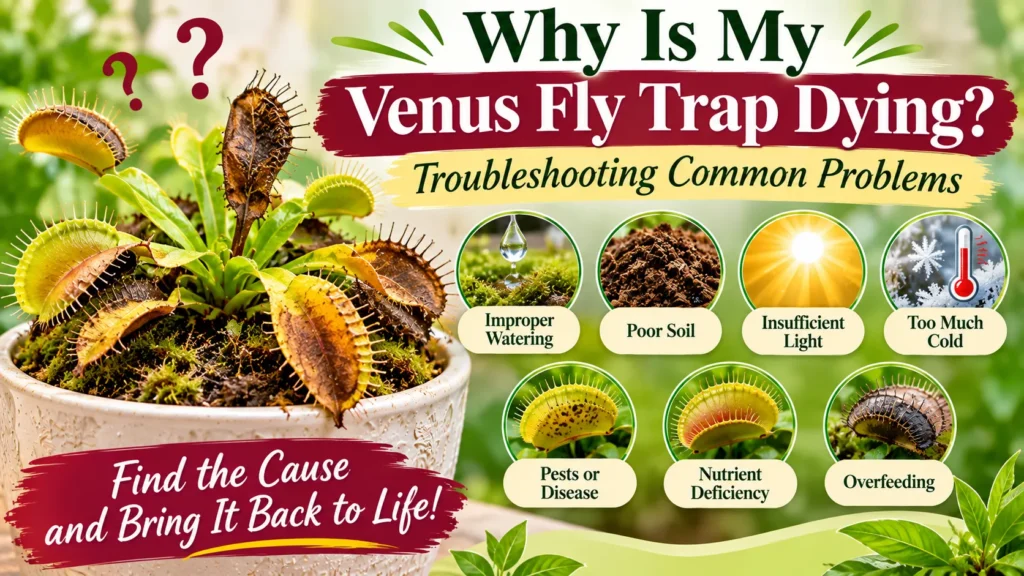
Traps Turning Black
- After digestion: normal. Each trap dies after 3 to 5 meals.
- After being triggered with no prey: every empty closing wastes energy and shortens the trap’s life. Resist the urge to poke it for fun.
- Prey that was too large: the trap could not seal, so it rotted.
The fix is simple. Cut black traps off at the base, because new ones grow continuously.
The Whole Plant Going Black or Brown
- Dormancy: in winter this is normal, so wait for spring regrowth.
- Tap water poisoning: the plant blackens and browns gradually over months. Switch to distilled or rainwater immediately and repot into fresh carnivorous plant compost.
- Root rot: this follows waterlogging in a pot with poor drainage.
Traps Not Closing
- Too cold: traps move slowly in low temperatures.
- Old age: traps near the end of their life react more slowly.
- Too little light: weak traps become unresponsive.
Improve the light and warmth and check your watering, and responsiveness usually returns.
No New Traps Growing
- It may simply be winter dormancy.
- It may be exhausted from flowering.
- Too little light is the most common cause of slow growth all year round.
- The wrong soil or water may be to blame.
Should You Let It Flower?
Generally, no. Cut the flower stalk off as soon as it appears. Flowering takes enormous energy and weakens the plant, often at the cost of that whole year’s growth. The exception is if you want to collect seed for propagation, which is an advanced technique best left until you have a strong, established plant.
If all of this sounds like more work than you want, there is no shame in it. Our ZZ Plant guide covers one of the most resilient and architectural houseplants you can grow, and it is far more forgiving.
Venus Fly Trap Varieties Worth Knowing
Beyond the standard form there are many cultivars, and collecting them becomes addictive quickly.
- ‘Typical’: the classic form, with green traps and a red interior.
- ‘Red Dragon’ (Akai Ryu): deep burgundy-red all over, and one of the most striking forms.
- ‘Big Mouth’: extra-wide, gaping traps that can handle larger prey.
- ‘Dentate’: short, pointed teeth with a distinctive look.
- ‘Fused Tooth’: teeth partly fused together for an unusual appearance.
- ‘B52’: one of the largest traps available, popular with collectors.
- ‘Dente’: small rounded teeth on a compact plant.
For beginners, start with ‘Typical’ or ‘Red Dragon’. Both are robust and widely available.
If you enjoy keeping unusual and characterful houseplants, our Goldfish Plant guide covers another fascinating species, with uniquely shaped orange blooms that genuinely look like swimming fish.
Give It Another Try
The venus fly trap has a reputation as a difficult plant, but it is really a fascinating plant with very specific needs. Once those are understood, it is entirely manageable.
The four rules are the whole secret: pure water, nutrient-free soil, maximum light and a proper winter rest. Follow them and a single plant can live for many years, slowly producing new traps and sometimes dividing into several plants.
If you have killed one before, please try again. Most venus fly trap deaths are entirely preventable once you know what the plant actually needs, and watching a trap snap shut on a gnat for the first time makes every bit of effort worthwhile.
When you are ready for your next green obsession, explore more plant and flower guides at PlantStyleHome.