
Coleus is proof that you do not need flowers to have a spectacular garden. The leaves do every bit of the work, in colors that most flowering plants can only dream of. A single coleus plant can carry burgundy, lime, hot pink and copper on one leaf, and it keeps performing from early summer until frost.
What makes it even better is how much the plant has changed. The old grandfather’s garden varieties were shade-only specialists, but today’s hybrids thrive in full sun and often color up even harder there.
This guide covers varieties, colors, sun vs shade, everyday care, propagation and overwintering, so you can grow coleus well and keep your favorites going year after year. You can also explore more plant and flower guides at PlantStyleHome.
What Is a Coleus Plant?
The botanical name is Coleus scutellarioides. You may also see it labeled Plectranthus scutellarioides or Solenostemon scutellarioides, because taxonomists have moved it around several times. Garden centers simply call it coleus, and that is the name that stuck.
Here are the basics worth knowing:
- Family: Lamiaceae, the mint family
- Origin: tropical Southeast Asia, including Malaysia, Indonesia and the Philippines
- Habit: upright, bushy and fast growing, usually 30 to 90 cm tall depending on variety
- Stems: square, a classic mint family trait you can feel by rolling a stem between your fingers
- Lifespan: grown as an annual in most climates, and a tender perennial in zones 10 to 11
Coleus is grown entirely for its foliage. It does send up small blue and white flower spikes, but most gardeners pinch these off so the plant keeps its energy in the leaves.
One safety note. Coleus is mildly toxic to cats and dogs, and eating it can cause skin irritation and digestive upset. If pets roam your garden, plant it where they are less likely to nibble.
Coleus Plant Colors and Varieties: The Most Exciting Foliage Plant Available

The range of coleus plant colors is almost unmatched in the plant world. You can go from deep burgundy that looks black to electric lime green, with every combination in between. Once you start growing coleus, it is almost impossible to stop at just one. The variety of colors, patterns and sizes is genuinely addictive.
Foliage colors to look for
- Deep burgundy and near black: ‘Black Dragon’, ‘Molten Lava’
- Bright lime and chartreuse: ‘Limelight’, ‘Pineapple’
- Vivid red and scarlet: ‘Wizard Scarlet’, ‘Red Head’
- Pink and rose: ‘Pink Chaos’, ‘Flamingo’
- Purple and violet: ‘Purple Emperor’, ‘Amora’
- Multicolor mixes: ‘Wizard Patchwork’, ‘Rainbow Mix’
- Chocolate and copper: ‘Chocolate Covered Cherry’, ‘Copper’
- Yellow and gold: ‘Goldfinger’, ‘Solar Gold’
If you love the deep purple tones that many coleus varieties bring, our Purple Flowers guide celebrates the most beautiful purple blooms and foliage plants for gardens and containers.
The vivid reds and fiery tones of many coleus varieties are as bold as any flower. Our guide to Flowers That Look Like Fire celebrates more spectacular hot-colored plant displays.
Three series every coleus fan should know
When you start exploring coleus plant varieties, these three series are the best place to begin.
1. Wizard Series
- Classic, reliable and widely available
- Compact, around 30 to 45 cm
- Excellent shade tolerance
- Best for traditional shade gardens and mixed borders
2. Solar Series
- Bred specifically for full sun performance
- Colors intensify in bright sun instead of fading
- Vigorous, around 45 to 75 cm
- Great for sunny beds and containers
3. Kong Series
- Giant leaves, dramatically larger than standard varieties
- Huge visual impact
- Prefers partial shade, since the big leaves can scorch in full direct sun
- Perfect for bold container statements
Choosing by use
- Shade gardens: Wizard, Stained Glassworks, Fairway series
- Full sun: Solar, Sunlover, Inferno series
- Containers: Kong, ‘Chocolate Covered Cherry’, ColorBlaze series
- Hanging baskets: trailing types such as ‘Trailing Rose’ and ‘Trailing Plum’
Coleus in Sun or Shade: The Question Everyone Asks
For generations, this was the biggest coleus question, and the answer has changed dramatically. Understanding coleus in sun or shade comes down to knowing which type you bought.
Traditional coleus
Older varieties are shade lovers. Full sun causes leaf scorch, fading and wilting. They do best in dappled shade or bright indirect light, and they are still excellent for shade gardens.
Modern sun coleus
The newer hybrids were bred for full sun. Solar series plants and similar sun-tolerant types develop more vivid color in strong light, with shades that deepen rather than fade. In extreme midday heat they may wilt, but they usually perk back up by evening.
The simple rule
Check the plant label when you buy.
- “Sun” or “Full Sun” on the label: suitable for 6 or more hours of direct sun
- No sun mention: treat it as a shade or part shade plant
- Not sure? Morning sun with afternoon shade suits virtually every coleus
What wrong conditions look like
Too much sun for a shade variety shows up as bleached, scorched leaves with brown crispy edges. The plant may wilt even when the soil is moist.
Too little light causes the opposite problem. Colors turn dull and muted, growth gets leggy and stretched, and the bold patterns that make coleus special start to disappear.
Coleus Plant Care: Complete Growing Guide
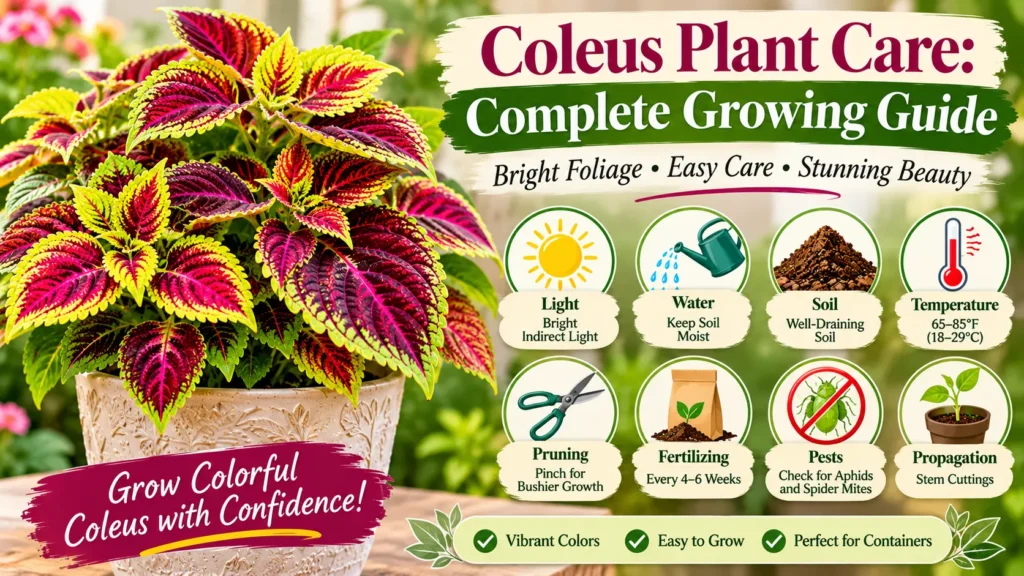
Good coleus plant care is simple once you know what these plants want. They like warmth, steady moisture and regular feeding.
When to plant
Coleus is a tender annual, so plant outdoors only after the last frost. Soil should be at least 15°C (60°F). As a rough guide for US zones:
- Zones 9 to 11: March to April
- Zones 7 to 8: April to May
- Zones 5 to 6: late May to June
Transplants are the easiest route. If you prefer seed, sow indoors 8 to 10 weeks before your last frost date.
Soil
Coleus is a hungry, thirsty plant, so give it rich, moist, well-draining soil full of organic matter. Aim for a pH of 6.0 to 7.0. In containers, use a high-quality potting mix and skip garden soil.
Watering
Keep the soil consistently moist. Coleus wilts dramatically when it dries out, though it usually recovers quickly once watered.
- Water at the base and avoid wetting the foliage, which invites disease
- Check containers daily in hot weather
- Mulch garden plants to hold moisture in
Feeding
A regular feeding schedule rewards you with lush, vibrant leaves. Use a balanced liquid fertilizer every 2 weeks through the growing season. Because you are growing for foliage, a nitrogen-rich feed is perfectly appropriate. Slow-release granules at planting work well in containers. Ease off in late summer to slow growth before frost.
Coleus pinching
Coleus pinching is the single most important maintenance task, and it is the secret behind those full, bushy plants you see at nurseries.
- Pinch out the growing tips regularly to encourage compact, branching growth
- Remove the top pair of leaves and stem just above a leaf node, using your fingers or sharp scissors
- Repeat every 2 to 3 weeks through the growing season
Always pinch off flower spikes the moment they appear. Flowering tells the plant to put its energy into seed instead of leaves. Left alone, the spikes lead to smaller, duller foliage and reduced vigor.
Growing a coleus plant indoor
A coleus plant indoor can look fantastic on a bright windowsill. Give it the brightest spot you have, ideally with some direct morning sun, and keep the potting mix evenly moist. Turn the pot every week so growth stays even, and keep pinching to prevent legginess. Indoor air can be dry, so watch for spider mites and whitefly.
How to Propagate Coleus
Coleus propagation is almost foolproof, which makes it one of the most satisfying plants to multiply. Spring and summer are the best times to do it.
Stem cuttings (the easy way)
- Take 10 to 12 cm stem tip cuttings from healthy, non-flowering stems with at least 3 to 4 pairs of leaves.
- Strip off all but the top 2 to 3 leaf pairs.
- Place the cuttings in a glass of water on a bright windowsill, out of direct sun.
- Roots appear in 7 to 14 days, often visible through the glass.
- Pot up into moist potting mix once the roots are 2 to 3 cm long.
- Water well and keep in bright indirect light for 1 to 2 weeks while the plant settles in.
Growing from seed
- Surface sow, because the seeds need light to germinate
- Keep them at 21 to 24°C (70 to 75°F)
- Expect germination in 10 to 14 days
- Prick out the seedlings when the first true leaves appear
One catch. Seeds from named varieties will not come true, so use cuttings when you want an exact copy of a plant you love.
For another brilliantly easy foliage plant to propagate and grow in containers, our Pothos Plants guide covers one of the most versatile and color-varied trailing plants available.
Coleus Overwintering: How to Keep Plants Year to Year
Coleus is frost-tender but very easy to keep going as a houseplant. Carrying a favorite through winter also preserves a variety you love and gives you a head start on next season. It also preserves a variety you love and gives you a head start on next season.
Method 1: Take cuttings (most reliable)
- In late summer or early autumn, take several stem cuttings
- Root them in water as described above
- Pot them up and grow them on a bright windowsill through winter
- Water only when the soil is barely dry, and skip feeding until spring
Method 2: Bring the whole plant indoors
- Before the first frost, cut the plant back by half
- Inspect carefully for pests, especially whitefly and aphids, before it comes inside
- Put it in the brightest window you have
- Reduce watering significantly, because overwatering in low winter light is the most common killer
- Expect some leaf drop as the plant adjusts, which is normal
For both methods
Keep plants away from cold drafts and never let them drop below 10°C (50°F). Resume feeding in spring once new growth is vigorous. When the danger of frost has passed, harden plants off over 1 to 2 weeks before moving them back outdoors.
Common Coleus Plant Problems and How to Fix Them
Leggy, stretched growth. This comes from too little light or too little pinching. Move the plant somewhere brighter and pinch it back hard to encourage bushy regrowth.
Faded, washed-out colors. The cause is either too much direct sun on a shade variety or too much shade on a sun variety. Adjust the position, and colors often recover within 2 weeks.
Wilting despite watering. Suspect root rot from overwatering or compacted, airless soil. Check the roots, and if they are brown and mushy, repot in fresh mix and water less.
Rust or leaf spots. These usually follow overhead watering or poor airflow. Water at the base, improve circulation and remove affected leaves.
Pests
- Aphids: soft-bodied insects on new growth. Blast them off with water and treat with insecticidal soap.
- Whitefly: tiny white flies under the leaves. Use yellow sticky traps and neem oil spray.
- Mealybugs: white cottony clusters. Dab with a cotton swab dipped in rubbing alcohol, or use neem oil.
Final Thoughts on Growing a Coleus Plant
Few plants give you this much color for so little effort. A coleus plant is one of the most exciting and versatile foliage plants available to gardeners today, whether it fills a shady border, glows in a sunny pot or brightens a winter windowsill.
My best advice is to experiment. Mix colors you would never think to pair, grow sun and shade varieties side by side to see the difference, and take cuttings each autumn to carry your favorites through winter.
Coleus is one of summer’s most reliable container performers. Our Summer Flowers guide covers all the best blooms and foliage plants to fill your garden with color all season long.
If you love growing plants for their dramatic foliage, our Rubber Plant guide covers another striking indoor plant with bold, glossy leaves that make a real statement.
A garden with coleus in it always has something worth looking at, even on the most flowerless day of the year.