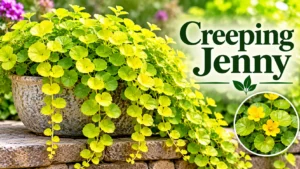
Few plants work as hard as creeping jenny. It carpets bare soil under shrubs, spills over the rim of a pot, softens the edge of a pond, tumbles out of a hanging basket and tucks itself into rockery crevices, all with barely any fuss from you.
That cascading curtain of bright golden-green softens every hard edge and trails so beautifully you would think it was designed specifically for containers. It is also one of the hardest-working low-maintenance plants you can grow.
This guide covers what it is, how to care for it, how to use it as ground cover, how to make it shine in pots and by water, how to keep it in check, and how to make more of it for free. You can explore more plant and garden guides at PlantStyleHome.
What Is Creeping Jenny?
Creeping jenny is a low, mat-forming perennial that trails along the ground and roots as it goes. Here are the key facts at a glance:
- Scientific name: Lysimachia nummularia
- Family: Primulaceae (the primrose family)
- Common names: creeping jenny, moneywort, herb twopence and wandering jenny
- Origin: native to Europe, where it grows in damp meadows, along riverbanks, at woodland edges and around pond margins
- Height: 5 to 10cm
- Spread: unlimited if not contained, and it can cover 60cm or more in a single season
- Hardiness: USDA zones 3 to 9, RHS H7
The name moneywort comes from the round, coin-shaped leaves. The species name nummularia comes from the Latin nummulus, meaning small coin, and once you spot the paired round leaves marching along a stem you will see why.
In mild climates the foliage stays evergreen or semi-evergreen. In harder winters it may die back, but it regrows reliably from the roots each spring.
Small, bright yellow, cup-shaped flowers appear in June and July. They are cheerful without being showy, so the foliage remains the main attraction. If you love yellow blooms, our Yellow Flowers guide is packed with the most beautiful ones for every garden style.
The Two Main Varieties
Green creeping jenny (Lysimachia nummularia) is the original species. Its leaves are mid to dark green, it tolerates more shade than the golden form, and it is slightly less vigorous.
Golden creeping jenny (Lysimachia nummularia ‘Aurea’) is by far the most popular garden form. The chartreuse-gold leaves seem to glow, and the color is most vivid in good light. In deep shade it turns greener. It is also one of the best container spiller plants available.
Creeping Jenny Care: Light, Water & Soil
Once you understand what creeping jenny needs, which is not much, it repays you with one of the most effortlessly beautiful trailing effects in the garden. The good news is that this plant is wonderfully adaptable.
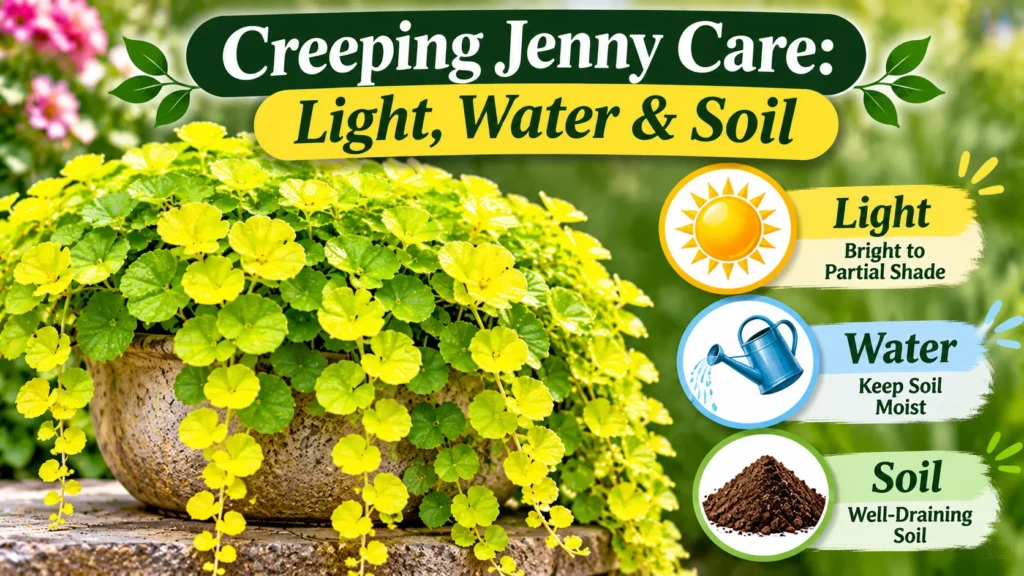
Creeping Jenny Sun or Shade?
This is one of the most common questions, and the answer depends on which form you grow.
- Golden form in full sun: the color is at its most vivid and bright.
- Golden form in partial shade: it still performs well, with slightly less intense color.
- Golden form in deep shade: the leaves turn more green than gold and lose that distinctive glow.
- Green form: it tolerates fairly deep shade where the golden form struggles.
The simple rule is that more sun gives you more gold on ‘Aurea’, while more shade gives you a greener look. Neither is a problem, as long as you choose the color effect you want.
One note for hot climates. In scorching afternoon sun, golden leaves can scorch if the soil dries out, so give them a little shade in the hottest part of the day.
Water
Moisture is the real key to success. This is one of the few ground cover plants that genuinely thrives in wet conditions.
- Ideal: consistently moist soil
- Tolerates: boggy ground, pond edges and temporarily waterlogged soil
- Dislikes: prolonged drought, which turns the leaves crispy and brown
In containers, water regularly, and daily in hot, dry weather. In garden beds the plant is far more forgiving once established, because the roots find moisture easily.
Soil
Moist, fertile soil suits it best, but it copes with a wide range of types, including clay, loam and sandy soil as long as moisture is adequate. It is happy with a pH between 6.0 and 7.5.
Unlike most garden plants, it does not need sharp drainage. It actually tolerates poor drainage, which makes it a godsend for those soggy spots where other plants sulk.
Temperature
It is fully hardy across most of the UK, Europe and much of the US. No special winter protection is needed in the ground, and any dieback is followed by reliable regrowth from the roots.
Creeping Jenny as a Ground Cover: Uses, Benefits & Control
As a creeping jenny ground cover, this plant is hard to beat for the effort involved. It spreads quickly to fill gaps and covers bare soil effectively.
Why It Works
- The dense mat leaves little room for weeds once established.
- Evergreen or semi-evergreen foliage gives year-round interest.
- The low height means it never overwhelms neighbouring plants.
- It grows under trees and shrubs where grass will not.
Best Places to Use It
- Under deciduous shrubs and trees
- On damp, shady banks and slopes where grass is difficult to maintain
- Along pond and stream edges, where it will grow right to the water
- Between stepping stones, since it tolerates light foot traffic
- In rock gardens and wall crevices where some moisture is available
Planting is simple. Set plants about 30cm apart, water them in well and keep the soil moist for the first few weeks. They knit together faster than you would expect. For another incredibly easy and fast-spreading plant, our Spider Plant guide covers a classic that earns its place in any collection.
Is Creeping Jenny Invasive?
This is one of the most searched questions about the plant, so here is the honest answer.
In its native Europe it is not considered invasive. It is a naturally occurring plant that belongs in damp meadows and riverbanks.
In North America the picture is different. It is listed as invasive or potentially invasive in some states and provinces, particularly in natural wetland areas, where it can outcompete native plants. If you garden there, check your local regulations before planting near natural water bodies or wetlands.
In an ordinary garden setting it is vigorous but controllable, and regular trimming keeps it in check. In containers there is no invasive risk at all, because it is contained and completely manageable.
Controlling the Spread
- Trim back regularly with shears or scissors. It takes minutes.
- Pull up unwanted runners. The roots are shallow, so they come up without a fight.
- Edge your beds to stop it creeping into lawns or neighbouring borders.
- For strict control, grow it in containers or use root barrier edging in beds.
Treat it like a friendly neighbour with a tendency to wander. A little regular attention keeps the relationship happy.
Creeping Jenny in Containers & Hanging Baskets
This is where the plant truly shines. Creeping jenny in containers is one of the most popular and effective spiller plants you can buy.
Creeping jenny is one of those plants that makes a container look finished. Long stems cascade over the pot edge with no training needed. The golden ‘Aurea’ form lights up mixed plantings alongside darker flowers and foliage, and it grows fast enough to fill gaps quickly. It also combines with almost everything.
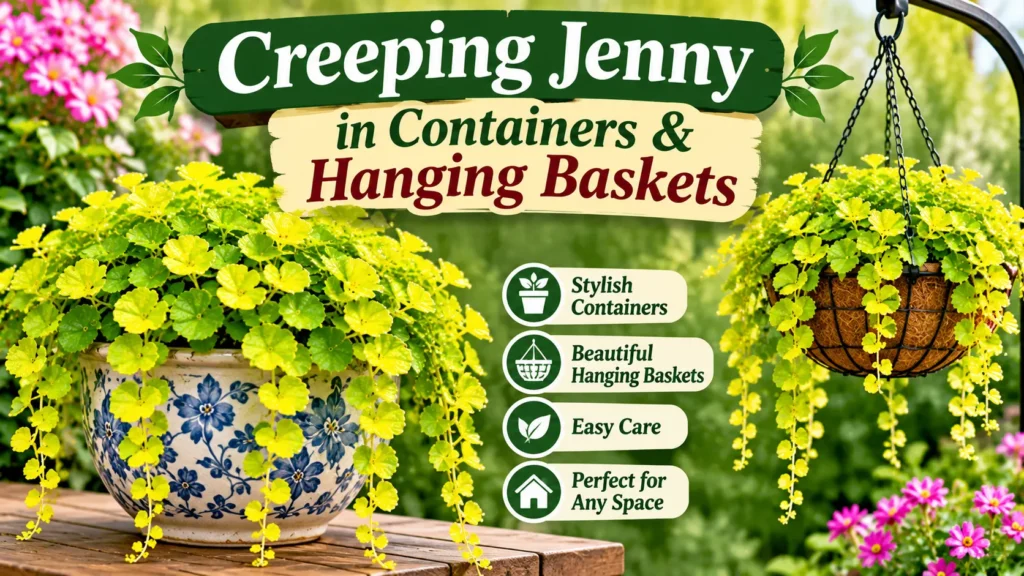
Container Combinations
Classic thriller, filler and spiller:
- Thriller: upright cordyline, canna or a tall ornamental grass
- Filler: petunia, calibrachoa, lobelia or begonia
- Spiller: golden creeping jenny trailing over the edge
Shade container:
- Thriller: hosta or fuchsia
- Filler: impatiens or begonia
- Spiller: green or golden creeping jenny
Simple two-plant combination: dark purple petunias or deep blue lobelia with golden creeping jenny make a striking color contrast with almost no effort.
Creeping jenny pairs beautifully with coleus in mixed containers too. Our Coleus Plant guide covers the most colorful foliage plant you can grow for bold summer displays.
Container Care
- Water regularly. Containers dry out much faster than the ground, so water daily in hot weather.
- Feed every 2 weeks with a balanced liquid fertilizer during the growing season.
- Trim as needed to keep the look you want. There is no invasive risk in a pot.
- Overwinter with care. The plant is hardy, but roots in containers are more vulnerable to hard freezes. Move pots to a sheltered spot and reduce watering significantly.
Hanging Baskets
A hanging basket is an excellent home for this trailing plant. The golden form is particularly effective, because its color catches the light beautifully as the stems swing and sway. If you love that trailing, cascading effect, our Pothos Plants guide covers another brilliantly versatile trailing plant for indoors and out.
Keep the basket consistently moist, since baskets dry out extremely fast. In peak summer you may need to water daily, and sometimes twice on very hot days. A moisture-retaining compost or a liner helps enormously.
Creeping Jenny as a Pond & Water Garden Plant
For a creeping jenny pond plant, you could hardly ask for a better candidate. It is one of the most useful and attractive plants for pond edges and water gardens.
- It can grow with its roots in shallow water, up to about 5cm deep.
- It softens hard pond edges and trails naturally into the water.
- It grows happily in boggy margins where many plants would rot.
- It provides cover for pond wildlife, because frogs, insects and other small creatures shelter under the dense mat.
- Its yellow summer flowers attract pollinators.
How to Plant It at the Pond Edge
You have two easy options:
- Use a marginal basket. Plant in aquatic compost in a shallow basket and place it at the pond edge or in very shallow water.
- Plant directly in moist soil. Set it right at the edge and let it trail naturally over the side.
In a garden pond context the roots are shallow and non-invasive, so it will not damage a pond liner. Just remember the earlier advice. If your pond is connected to natural waterways or wetlands, especially in North America, think carefully before planting it.
The golden-green of creeping jenny is one of gardening’s most cheerful colors. Our Green Flowers guide celebrates more stunning green and chartreuse plants for the garden.
Propagating & Dividing Creeping Jenny
This is one of the easiest plants to propagate. It practically does the work for you.
Division
This is the simplest method.
- Lift a clump in spring or autumn.
- Divide it into smaller sections, making sure each piece has some roots.
- Replant immediately and water in well.
New divisions establish within days.
Stem Cuttings
- Take 10 to 15cm stem sections with a few pairs of leaves.
- Push them into moist compost, or stand them in a glass of water.
- Wait one to two weeks for roots to form. It is one of the fastest-rooting plants you can propagate.
- Pot them up once the roots are 2 to 3cm long.
Natural Layering
Wherever stems touch moist soil, they root. Simply peg down runners, or let them spread onto bare compost. Once they have rooted, sever them from the parent plant. It is entirely free and needs no special effort.
Spare cuttings make lovely gifts, and a few rooted pieces can fill a whole row of pots in a single season.
Final Thoughts on Growing Creeping Jenny
Whether it is trailing from a container, carpeting a shady bank, spilling over a pond edge or lighting up a hanging basket, creeping jenny consistently earns its place. It asks for moisture, a little trimming and not much else, and gives back months of glowing color and effortless movement.
If you have not tried golden ‘Aurea’ in a mixed container yet, make this the season you do. Pop one over the edge of a pot, keep it watered and watch what happens. Creeping jenny has a way of turning an ordinary planting into something special.