
Few flowers move in the garden quite like scabiosa. Domed, pincushion-shaped blooms in purple, lavender, pink, white and deep crimson float above the foliage on long, slender stems, nodding and swaying at the slightest breeze.
Butterflies and bees adore them, and they last well in a vase, so one planting serves both the border and the kitchen table.
Here is the best part. It looks delicate and romantic, but it is a tough, drought-tolerant plant that thrives on very little attention. It asks for sun, sharp drainage and a pair of secateurs, and gives months of flowers in return.
This guide covers the main species, light, soil and watering, growing from seed, deadheading, cutting for the vase and fixing common problems. You can also explore more flower and garden guides at PlantStyleHome.
What Is Scabiosa?
Scabiosa is a genus in the Caprifoliaceae family, the honeysuckle family. It used to sit in its own family, Dipsacaceae, but botanists have since merged the two, so older books and plant labels may still show the previous name.
The common name, pincushion flower, makes sense the moment you look closely. The domed centre is studded with protruding stamens that look like pins pushed into a cushion.
The Pincushion Structure Explained
Each bloom is really a cluster of tiny florets:
- Ray florets: the larger, slightly irregular outer petals that form the frilly decorative ring.
- Disc florets: the small, tightly packed florets in the domed centre.
- Stamens and pistils: these stand proud of the dome and create the “pins” effect.
That open, accessible structure is exactly why pollinators love it. Every bloom is a landing pad stocked with nectar.
Key Species
Scabiosa atropurpurea (sweet scabious) is the classic cottage garden annual or biennial, native to southern Europe and the Mediterranean.
- Grows 60 to 90cm tall
- Blooms in deep purple, crimson, pink, white and lavender
- Noticeably fragrant, which is unusual in this group
- An excellent cut flower
Scabiosa columbaria (small scabious, or dove scabious) is the longest-lived and most reliable choice for a scabiosa perennial display. It comes from Europe and Asia.
- Compact, at 30 to 60cm
- Lavender-blue to pale pink flowers
- Cultivars ‘Butterfly Blue’ and ‘Pink Mist’ flower from June right up to frost
Scabiosa caucasica (Caucasian scabious) is the old-fashioned perennial from the Caucasus mountains and the Middle East.
- Large, flat-faced blooms in lavender-blue or white
- Grows 45 to 70cm tall
- Prefers alkaline soil, which matters for where you plant it
Colour Range
Lavender and lilac-blue are the best known shades, and ‘Butterfly Blue’ has become the most popular scabiosa flower for good reason. If you love that cool colour, our Blue Flowers guide celebrates more of the most stunning blue and lavender blooms you can grow.
Then there are the moody ones. Crimson, burgundy and near-black forms such as ‘Black Knight’ look dramatic against silver foliage. Our Purple Flowers guide explores more of the most beautiful purple flowering plants if this deeper palette speaks to you.
Pink comes in every shade, white is crisp and clean, and yellow or orange forms are rare.
Where It Comes From
In the wild, these plants grow in meadows, chalky grasslands and rocky hillsides, all open, sunny and free-draining. That origin explains nearly everything about their care. They love full sun, put up with poor soil, shrug off drought and alkaline conditions, and struggle in heavy, waterlogged ground.
Scabiosa Care: Light, Soil & Watering
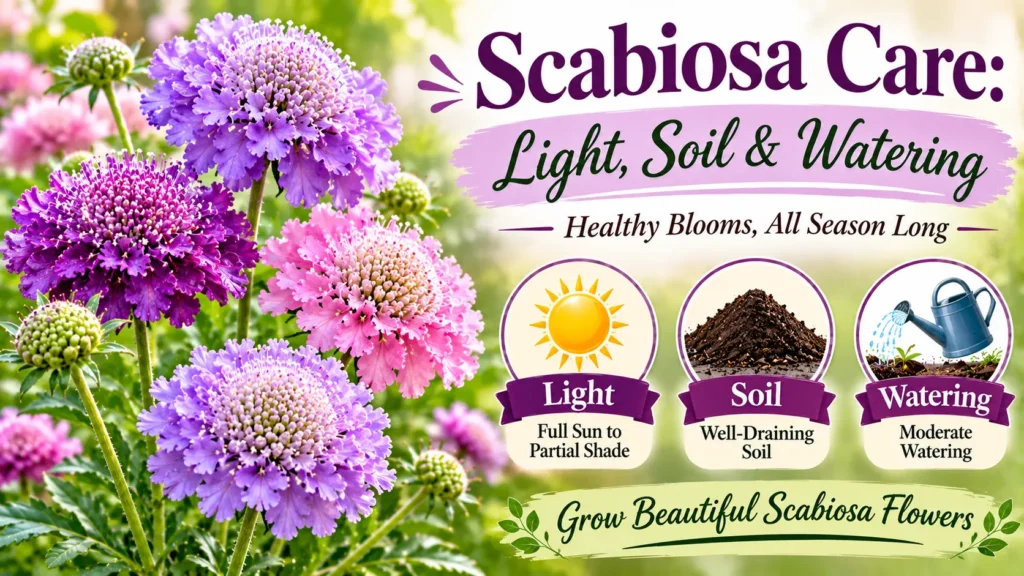
Good scabiosa care comes down to copying that hillside. Give it sun and drainage, then step back.
I think of pincushion flower care as a lesson in restraint. The plants that get the least fuss tend to look the best, with sturdier stems and far more blooms than the pampered ones.
Light
- Full sun: at least 6 hours of direct sun a day for the best flowering.
- Partial shade: dappled afternoon shade is tolerated, but you will get fewer flowers.
- Deep shade: no flowers at all, so avoid it.
More sun means more blooms, sturdier growth and better drought tolerance.
Soil
Well-drained soil is non-negotiable. Waterlogged roots are the main reason this plant fails.
- Poor soil is fine. Stony, sandy or lean ground often suits it better than rich borders.
- Ideal pH: slightly alkaline to neutral, around 6.5 to 7.5.
- Acidic soil: add garden lime if you want Scabiosa caucasica to thrive.
- Heavy clay: mix in grit or coarse sand, or grow in a raised bed.
Rich, fertile soil produces lush leaves and fewer flowers. This is a plant that blooms best when it has to work a little for its supper.
Watering
Once established, a scabiosa plant is wonderfully drought-tolerant. Young plants need regular watering through their first season while the roots settle in.
After that:
- Let the soil dry out between waterings.
- Water deeply and infrequently rather than little and often.
- Established perennials can usually manage on rainfall alone in most UK climates.
- Water pots more often, because containers dry out far faster than beds.
- Never let the plant sit in standing water.
If you only remember one thing, remember this. Overwatering does more damage than underwatering.
How to Grow Scabiosa from Seed
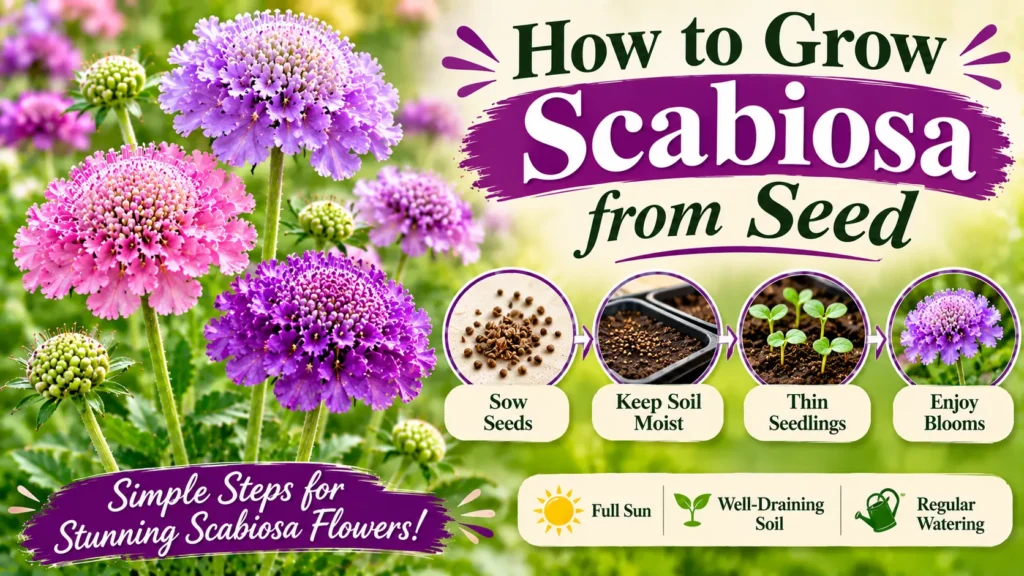
If you are wondering how to grow scabiosa without spending much, seed is the cheapest route. The method differs slightly for annuals and perennials.
Annuals (Scabiosa atropurpurea)
Sowing indoors gives the earliest flowers and is my recommended approach.
- Sow indoors from February to March.
- Scatter seed on the surface of moist seed compost and cover very lightly with vermiculite.
- Keep at 15 to 18°C. Germination takes 10 to 21 days.
- Prick out seedlings once they are big enough to handle.
- Harden off in late April or May.
- Plant out after the last frost, from May to early June, spaced 30cm apart.
Sowing direct outdoors is easier if you have limited space indoors.
- Sow from April to May, once the soil has warmed.
- Thin seedlings to 30cm apart when established.
Autumn sowing works well in the UK and other mild climates. Sow in September, overwinter the young plants in a cold frame, and enjoy earlier and heavier flowering the following year than any spring sowing will give.
Perennials
Sow Scabiosa columbaria and Scabiosa caucasica in spring using the same method. They usually will not flower until their second year, though a very early indoor start can sometimes bring flowers in the first.
Division is quicker for named cultivars, and a scabiosa perennial planted in spring will often be ready to split by its second autumn. ‘Butterfly Blue’ and ‘Pink Mist’ are best bought as plants, since seed does not give consistent results.
Buying Plants
Plants bought in spring will flower the same season. Choose compact, bushy specimens and avoid anything leggy or pot-bound.
Deadheading, Feeding & Extending the Scabiosa Flowering Season
If you are chasing months of colour, deadheading is the job that matters most. It turns a few weeks of flowers into a season that can run from June to October, or until the first frost. Scabiosa is one of the longest-blooming summer flowers you can grow, and our Summer Flowers guide covers the best blooms for keeping your garden colourful all season long.
Deadheading
Do not simply snap off the flower head. Follow the stem down and cut it back to the next side shoot or leaf. That triggers fresh stems and more buds.
- Deadhead every week or two through summer.
- ‘Butterfly Blue’ and ‘Pink Mist’ tidy themselves somewhat, but deadheading still extends their flowering noticeably.
- Leave the spent blooms and the plant sets seed, then stops flowering.
Feeding
Resist the urge to fuss. Too much feed means leaves instead of flowers.
- Annuals: one dose of balanced granular fertiliser at planting is enough. A liquid tomato feed every 3 to 4 weeks during flowering is optional and helps stretch the season.
- Perennials: top-dress with well-rotted compost in spring and avoid high-nitrogen feeds.
The rule is simple. Lean soil with minimal feeding gives more flowers, while rich soil with heavy feeding gives lush foliage and fewer blooms.
Cutting Back
Simple pincushion flower care at the end of the year sets up next summer’s display, so it is worth ten minutes.
- Annuals: pull them up after the first frosts and compost them.
- Perennials: cut back to the basal rosette of leaves in autumn. Leave a few seedheads for the birds and winter structure if you like, and mulch the crown lightly in colder areas.
Scabiosa as a Cut Flower
Few blooms are finer for informal arrangements. Properly conditioned stems last 7 to 14 days, and the long, wiry stems with domed blooms bring movement and lightness to a vase.
Like scabiosa, carnations are a cottage garden classic that works as beautifully in a vase as it does in the border. Our Carnation Flower guide covers everything about growing and enjoying this timeless flower.
Cutting for Vases
- Cut in the morning, before the heat of the day.
- Choose blooms that are just opening rather than fully open.
- Use clean, sharp scissors or snips and cut at an angle.
- Put the stems in water straight away.
Conditioning
- Strip all leaves that would sit below the waterline.
- Stand the stems in deep, cool water for several hours before arranging.
- Change the vase water every 2 to 3 days.
Best Companions in a Vase
Scabiosa fills in beautifully around larger blooms. Those airy stems and pincushion heads add movement and lightness to any arrangement.
Try it with:
- English roses in pink and apricot
- Lavender
- Achillea (yarrow)
- Nigella (love-in-a-mist)
- Cosmos
- Sweet peas
If you love the airy, romantic quality of this flower in arrangements, our Freesia Flowers guide covers another beautifully delicate cut flower with incredible fragrance.
Companions in the Border
Planted outdoors, these partners share its love of sun and sharp drainage:
- Lavender
- Nepeta (catmint)
- Salvia
- Echinacea
- Verbena bonariensis
- Achillea
Scabiosa Common Problems & Solutions
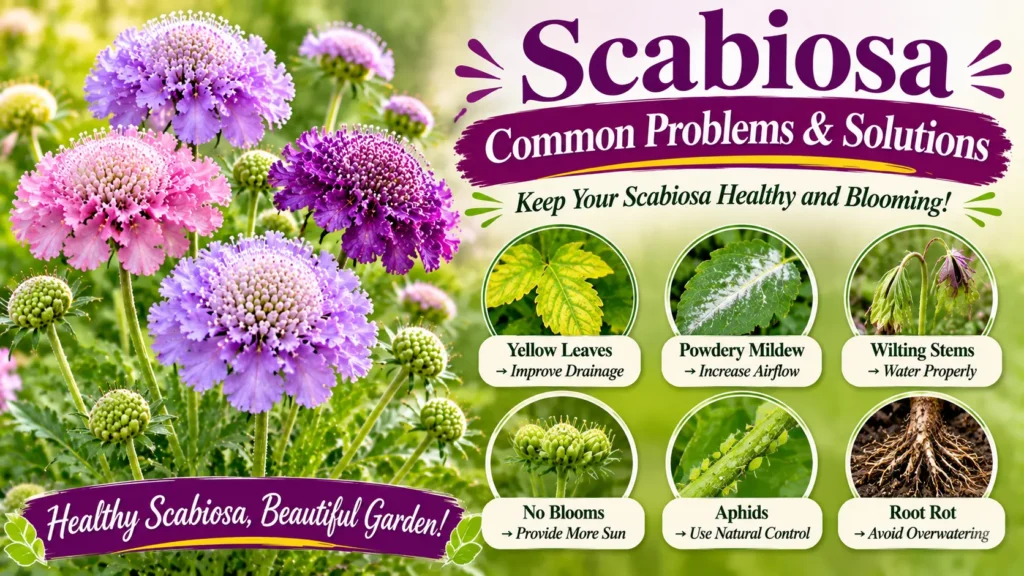
Most issues trace back to wet feet, too much shade or too much love. A healthy scabiosa plant rarely needs more than a small adjustment, so here is how to put each problem right.
Not flowering
- Cause: too little sun, soil that is too rich, or a perennial still in its first year.
- Fix: move it somewhere sunnier, cut back on feeding, and be patient with first-year perennials.
Root rot and plant collapse
- Cause: waterlogged soil, the most common killer.
- Signs: the plant wilts even though the soil is moist, and the crown turns mushy.
- Fix: if caught early, improve drainage straight away. If the damage is severe the plant is usually lost, so fix the drainage before replanting.
- Prevention: start with well-drained soil from day one.
Short flowering season
- Cause: not deadheading.
- Fix: deadhead every 1 to 2 weeks and cut whole stems down, not just the flower heads.
Powdery mildew
- A white powdery coating on the leaves, more common in hot, dry summers and on stressed plants.
- Fix: improve air circulation, water at the base, and treat with diluted neem oil or a bicarbonate of soda solution.
- It is usually cosmetic and rarely kills the plant.
Slugs and snails
- They go for young plants and fresh spring growth.
- Fix: protect seedlings with copper tape, wool pellets or organic slug pellets. Established plants are much less vulnerable.
Leggy growth in annuals
- Cause: too little light, or seed sown indoors too early without enough light.
- Fix: pinch out the growing tips of young plants for a bushier habit, and give them full sun.
Short-lived perennials
- ‘Butterfly Blue’ and ‘Pink Mist’ can fade after 2 to 3 years in some gardens.
- Fix: divide clumps every 2 to 3 years in spring to rejuvenate them, and keep your stock going by division.
Final Thoughts
A garden with scabiosa in it always feels a little more alive. The blooms dance, the butterflies arrive, and a handful of stems in a jug brings that wildflower charm indoors.
Try at least one variety this year. Choose annual atropurpurea for fragrance and cutting, or ‘Butterfly Blue’ for the longest perennial flowering season. Give either one sun, good drainage and a light hand, and scabiosa will reward you from early summer until the frosts.