Few flowers carry quite so much weight for something so small and quietly modest. The edelweiss flower is barely larger than a fingertip, yet it has inspired legends, national emblems, military badges and one of the most beloved songs ever written.
Most people recognise it instantly, even if they have never set foot in the Alps. Thanks to The Sound of Music, a tiny white woolly bloom has become shorthand for home, courage and love of country. The contrast is part of its charm: so much cultural, romantic and national significance across Central Europe, carried by a plant that grows hardly taller than a teacup.
This guide gathers everything worth knowing: what edelweiss actually is, what it means, the stories told about it, where it grows and how you can grow it yourself. For more flower guides and plant inspiration, visit PlantStyleHome.
What Is the Edelweiss Flower?
Edelweiss is the common name for Leontopodium alpinum, a perennial that is also listed in botanical references as Leontopodium nivale subsp. alpinum. It belongs to the Asteraceae, the daisy family, which makes it a surprising cousin of sunflowers, chamomile and chrysanthemums.
The name is German and wonderfully direct. Edel means noble and weiß means white, so the plant is simply the “noble white.” One look at its soft, downy, silvery bloom and the name feels exactly right.
What it actually looks like
That famous star shape is not made of petals. The fuzzy white points are bracts, which are modified leaves arranged around the true flowers. Those true flowers are the tiny yellow-white clusters sitting in the centre.
The whole plant is covered in dense white hairs called trichomes. They reflect harsh ultraviolet light, hold on to moisture and help the plant cope with thin mountain air.
- Height: typically 10 to 20 cm
- Bloom time: July to September in its natural habitat
- Foliage: narrow, grey-green and felted with white hairs
- Habit: low, tufted clumps that spread slowly
Where does edelweiss grow?
If you have ever wondered where does edelweiss grow, the answer is high and rocky. It favours limestone slopes, stony meadows and crags, usually between 1,500 and 3,000 metres above sea level.
As an edelweiss alpine flower, it is found across the Alps, Carpathians, Pyrenees, Apennines, Balkans and Caucasus, with relatives reaching into the mountain ranges of central Asia. You can meet it in Austria, Switzerland, Bavaria in Germany, France, Italy, Slovenia, Romania and Poland.
Conservation status
There is a sadder chapter here. Edelweiss was once picked so enthusiastically, as a trophy and a souvenir, that it nearly vanished from some Alpine regions.
Today it is legally protected in several countries, and picking it in the wild is illegal in places including Austria and Switzerland. Careful protection has allowed many populations to recover, which is a rare and cheering piece of conservation news. If you hike in the Alps, admire it, photograph it and leave it where it grows.
Edelweiss Flower Meaning and Symbolism
The edelweiss flower meaning is layered, and that is part of why the plant has endured in the imagination. Few Alpine blooms carry as much symbolic weight. Here are the main threads of edelweiss flower symbolism.
Love and devotion. This is the oldest and most enduring meaning. A young man who climbed dangerous heights to bring back edelweiss for the woman he loved was proving that his feelings were sincere. The flower came to stand for romantic devotion so deep it was worth risking everything. It is still given in Alpine-influenced cultures as a token of true affection.
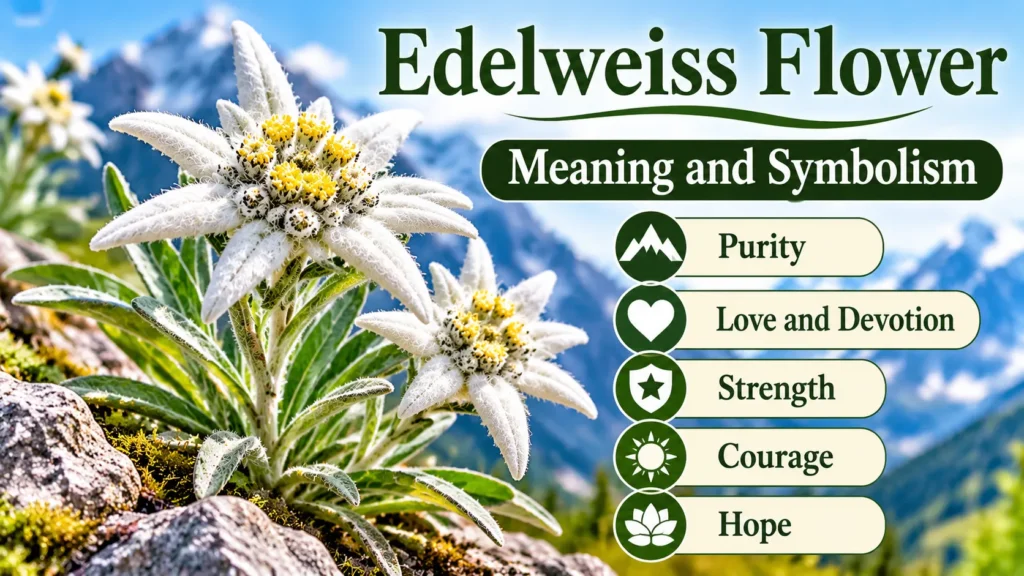
Courage and bravery. Reaching edelweiss meant climbing, and climbing meant skill and nerve. That association made it a natural badge for mountain soldiers.
- Austrian and German mountain troops (Gebirgsjäger) wear edelweiss insignia as a mark of elite status
- Italian Alpini carry the flower on their hats, one of the best-known military emblems in Europe
National pride and Alpine identity. Edelweiss turns up wherever mountain communities want to say who they are.
- Austria: it appears on the 2-cent euro coin
- Switzerland: it is closely tied to Swiss Alpine heritage and tourism
- Bavaria: it is a proud emblem of regional culture
- Slovenia: it is cherished as part of the country’s Alpine imagery
Purity and resilience. White suggests purity, innocence and untouched nature. But the real lesson is in where the plant lives. There is something deeply appealing about a flower that chooses to bloom where almost nothing else can, high on rocky Alpine slopes where the air is thin and the winters are brutal. It stands for quiet strength and the ability to thrive against the odds.
Good luck. In Alpine folk tradition, finding edelweiss on a mountain was a sign of good fortune. A rare discovery in a hard place felt like a gift.
Edelweiss is one of the most iconic white flowers in the world, and our White Flowers guide celebrates the most beautiful and meaningful white blooms from gardens and cultures across the globe.
The Edelweiss Flower Legend: Stories and Cultural History
The edelweiss flower legend is a love story with a high price. Across the Alpine regions, tales describe young men who scaled treacherous slopes to pick the flower as proof of their courage and their love. Returning with a bloom was the ultimate declaration. Some never returned at all.
Whether or not any single story is literally true, the legend did its work. It fixed edelweiss in the Alpine mind as the grandest romantic gesture, a flower that cost everything to give.
The Sound of Music
Global fame arrived with the 1959 Rodgers and Hammerstein musical and the 1965 film. In The Sound of Music, Captain von Trapp sings “Edelweiss” as a farewell to his homeland. The flower becomes a symbol of Austrian identity, love of home and quiet resistance.
The song is so tender and so closely linked with Austria that many people assume it is the national anthem. It is not. Yet its emotional pull makes it feel like one, and it introduced edelweiss to audiences who had never seen a mountain.
Military history
Austro-Hungarian mountain troops adopted edelweiss as an emblem in the late 19th century. During the Second World War it was also the symbol of the German 1st Mountain Division, a chapter of history that sits uneasily beside the flower’s gentler image.
After the war, edelweiss was gradually reclaimed by Alpine clubs and mountain rescue organisations. For them it stands for peaceful endeavour and outdoor courage. Alpine troops in several European armies still wear it today.
Folk medicine and modern skincare
Alpine communities traditionally used edelweiss preparations for stomach complaints and respiratory troubles, and as a general tonic. Modern research has identified compounds in the plant, including leontopodic acids, with antioxidant properties.
That is why edelweiss extract now appears in premium skincare, valued for its protective qualities. There is a pleasing irony in it: the plant developed these compounds to survive intense ultraviolet light at altitude, and people now borrow them for their faces.
Like edelweiss in Alpine culture, flowers carry extraordinary meaning in Japanese tradition. Our Japanese Flowers guide explores the symbolism and beauty of Japan’s most iconic blooms.
Growing Edelweiss in Your Garden
Here is the happy surprise. Despite its legendary reputation, growing edelweiss is more achievable than most people expect. If you can offer sun, grit and drainage, you can have edelweiss in garden beds, rockeries and troughs far from any mountain.
Key requirements
- Full sun: essential, because the plant evolved in intense Alpine light
- Excellent drainage: the single biggest factor. Waterlogged soil is the number one killer of garden edelweiss
- Poor, gritty, alkaline soil: rich soil gives lush leaves but weaker plants and fewer flowers
- Cool temperatures: it performs best where summers are not scorching
- Cold hardiness: fully hardy in USDA zones 4 to 7, so frost is rarely the problem. Wet is.
Soil mix for pots and borders
- Combine 50% horticultural grit with 50% peat-free compost
- Add limestone chips or crushed oyster shell if your soil is acidic
- Choose raised beds and rockeries where you can, since they drain naturally
Planting
Plant in spring or early autumn, spacing plants 15 to 20 cm apart. A rockery, alpine trough, raised bed or sunny, well-drained border all work well. Keep edelweiss away from larger neighbours that might shade it as they grow.
Growing from seed
Seed is a rewarding route, though it asks for a little patience.
- Sow in late winter or early spring
- Surface sow and do not bury the seed, because it needs light to germinate
- For better results, chill seeds in a damp paper towel in the refrigerator for 3 to 4 weeks first
- Expect germination in 2 to 4 weeks at around 15 to 18°C (60 to 65°F)
- First flowers usually arrive in the second year
Ongoing care
- Water sparingly, far less than most garden plants
- Avoid watering from above in humid or rainy weather
- Remove spent flower heads to encourage further blooms
- Top-dress with grit each year to keep drainage sharp
- Divide clumps every 2 to 3 years to maintain vigour
- Skip nitrogen-rich feed, which makes plants floppy and untrue to form
Containers and alpine troughs
Edelweiss is a natural for terracotta pots and alpine troughs. Choose a container with several drainage holes, fill it with alpine or cactus compost mixed with grit, and set it in full sun. In very wet winters, move it under the cover of a cold frame or unheated greenhouse. The main enemy is wet, not cold.
Edelweiss thrives where most flowers cannot survive, and our Winter Flowers guide covers more remarkable blooms that brave the cold with extraordinary results.
Edelweiss Flower Facts: Fascinating Things You Might Not Know
A few edelweiss flower facts tend to surprise people, even those who feel they know the plant well.
- The petals are not petals. The white star is made of woolly bracts, and the real flowers are the small yellow-white centres.
- The wool has three jobs. It shields against UV light, holds moisture in thin mountain air and insulates against frost.
- It is a daisy relative. Sunflowers, chrysanthemums and chamomile all share its family.
- It travels on coins. Edelweiss has featured on currency and national imagery in more than one country.
- It nearly disappeared. Over-picking pushed it close to local extinction in parts of the Alps before legal protection arrived in time.
- The name means “lion’s paw.” Leontopodium comes from Greek, and the woolly bracts do look like a soft paw around the central flowers.
Edelweiss is one of the most fascinating flowers beginning with this letter, and our Flowers That Start With E guide covers many more beautiful and unusual blooms worth discovering.
If you are fascinated by flowers with deep cultural meaning, our Carnation Flower guide explores another bloom with centuries of symbolism, from love and devotion to national identity.
A Small White Flower With a Very Large Story
The edelweiss flower is modest in size and extraordinary in meaning. It holds a love story, a soldier’s badge, a farewell song and a lesson in resilience, all folded into a few woolly white bracts.
You do not need a mountain to enjoy it. Bringing a piece of Alpine legend into your own garden is more achievable than the flower’s reputation suggests, and more rewarding than you might expect. Give it sun, grit and a little restraint with the watering, and a rockery or alpine trough may soon hold something quietly legendary.