Few flowers make people smile quite like a sunflower. Bold, cheerful and impossibly tall, they turn up in cottage gardens, school playgrounds and allotment borders every summer, and kids and adults love them equally.
The best part is how simple they are. Learning how to grow sunflowers from seeds is one of the easiest and most satisfying things you can do in a garden, and even complete beginners get spectacular results.
There is something almost magical about dropping a sunflower seed into the soil and watching it become a towering, golden bloom in just a few months. This guide walks you through choosing seeds, planting, care, common problems and the best varieties, so you can enjoy that same thrill.
How to Grow Sunflowers from Seeds: Choosing the Right Seeds
Before you sow anything, it helps to know there are two main types of sunflower.
- Annual sunflowers (Helianthus annuus): These grow, bloom, set seed and die within a single season. They are the most common choice and the ones most people picture.
- Perennial sunflowers (Helianthus x multiflorus and relatives): These come back each year from the same roots and form bigger clumps over time.
For most gardeners growing sunflowers from seed, annuals are the place to start. Here are the best sunflower varieties to grow, all worth a spot in your garden:
- ‘Mammoth Russian’: The classic giant, reaching 3 to 4m with huge seed heads.
- ‘Teddy Bear’: Compact, with fluffy double flowers that look wonderful in pots.
- ‘Velvet Queen’: Deep burgundy and red blooms, stunning in a cutting garden.
- ‘Sunrich Orange’: An excellent pollen-free cut flower, so no yellow dust on your table.
- ‘ProCut Gold’: Tall and single stemmed, superb for flower arrangements.
- ‘Little Becka’ and ‘Music Box’: Dwarf varieties that suit containers and small gardens.
Many sunflower varieties lean more orange than yellow. If you love that warm, fiery palette, our Orange Flowers guide is full of brilliant inspiration.
You will find seed at garden centres and online seed suppliers, and you can also use seed saved from last year’s plants. Buy or save fresh seed each year, because old seed loses viability fast and germination drops.
Sunflowers are the ultimate symbol of summer’s golden palette. For more stunning yellow bloom inspiration, our Yellow Flowers guide covers the most beautiful varieties for gardens and cutting.
When to Plant Sunflower Seeds
Timing matters a lot, because sunflowers are frost sensitive. Knowing when to plant sunflower seeds is half the battle.
Direct sowing outdoors
Sow outside after the last frost date in your area. The soil should be at least 10°C (50°F), and the ideal range is 18-21°C (65-70°F).
- UK: late April to late May
- USA: April to May in most zones, and March to April in warm southern states
- Australia: September to November
Do not rush. Cold soil means slow germination and weak seedlings, and an over-eager sowing is the most common beginner mistake.
Starting seeds indoors
For a head start, sow 2-3 weeks before your last frost date. Sunflowers dislike root disturbance, so use biodegradable peat pots or toilet roll tubes that can go straight into the ground. Harden plants off for 7-10 days before planting out.
Here is a reassuring secret. Sunflowers sown directly outdoors often catch up with indoor-started ones very quickly, precisely because they hate having their roots disturbed.
Succession sowing
Sow a fresh batch every 2 weeks from late April to mid-June. That gives you continuous blooms all summer and into autumn.
Sunflowers are the signature flower of the summer garden, and our Summer Flowers guide covers all the best companions to grow alongside them.
How to Grow Sunflowers from Seeds Step by Step
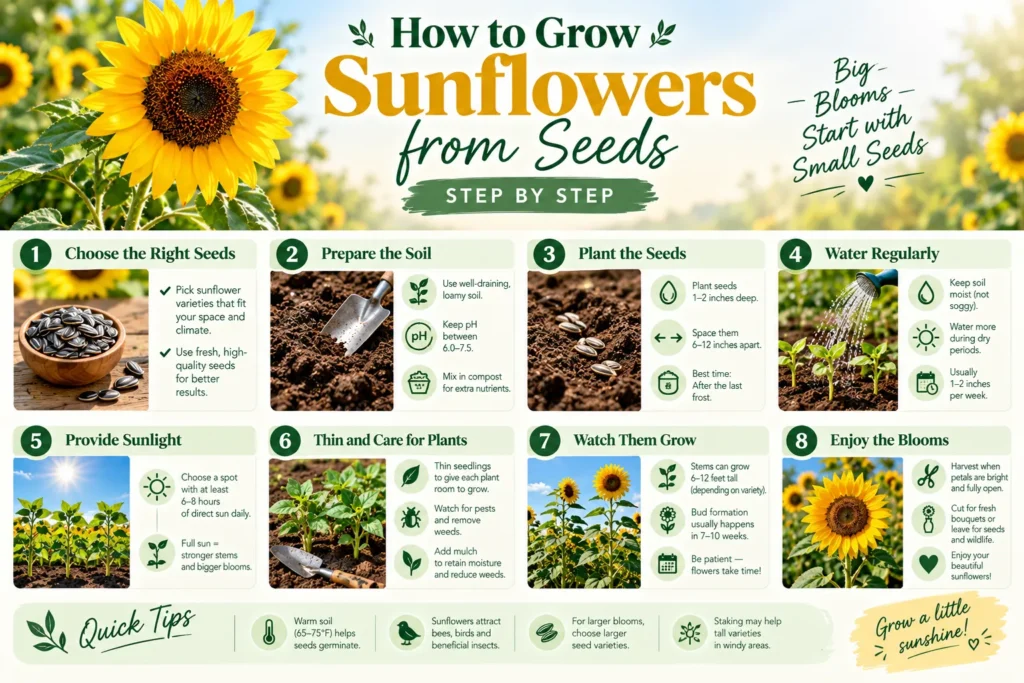
Choosing the site
- Full sun is non-negotiable. Aim for at least 6 hours of direct light, and 8 or more is ideal.
- Shelter from strong wind matters, because tall varieties can snap in storms.
- Well-draining soil is a must, as sunflowers hate waterlogged roots.
- Keep them away from vegetables. Sunflowers release allelopathic chemicals that can inhibit some crops, so leave 1m or more between them and potatoes or beans.
Preparing the soil
Dig over to a spade’s depth. Add compost or well-rotted manure to improve drainage and nutrients, then remove stones and large clumps. Sunflowers are not fussy about pH, and anything from 6.0 to 7.5 works fine.
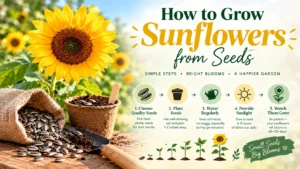
Planting steps
Sunflower seed planting depth is refreshingly simple: about 2.5cm (1 inch).
- Make a hole 2.5cm (1 inch) deep.
- Place 1-2 seeds in each hole.
- Cover gently and firm down.
- Water in gently, without flooding.
- Label with variety and date.
- Thin to the strongest seedling once it is 10-15cm tall.
Spacing
- Giant varieties (over 1.5m): 60-90cm apart
- Medium varieties (60-120cm): 30-45cm apart
- Dwarf and pot varieties: 20-30cm apart
- Rows: 75cm apart
Growing sunflowers in pots
You can absolutely enjoy growing sunflowers in pots, but stick to dwarf varieties.
- Use a pot at least 30cm wide and 30cm deep for each plant.
- Choose a heavy, loam-based compost so the pot does not topple.
- Water daily in hot weather, since pots dry out very fast.
- Feed every 2 weeks with a balanced liquid fertiliser.
How Long Do Sunflowers Take to Grow?
Patience is part of the fun, but the wait is shorter than most people expect. If you are working out how to grow sunflowers from seeds on a timeline, here is what to expect.
- Germination: 7-14 days, faster in warm soil and slower in cold.
- First true leaves: 2-3 weeks after sowing.
- First bud visible: 6-8 weeks from sowing.
- Full bloom: 70-110 days from sowing, depending on variety.
By variety type, dwarf sunflowers bloom in 70-80 days, standard ones in 80-90 days and giants in 90-110 days.
A seed sown outdoors in mid-May will bloom from August into September. Seed started indoors in early April can flower from late July.
Did you know sunflowers are one of the August Birth Flowers? Our guide explores all the flowers associated with this golden month.
Several things slow growth down:
- Cold soil or cold nights
- Too little sunlight
- Waterlogged soil
- Nitrogen-heavy feed, which makes leaves at the expense of flowers
- Overcrowding and root competition
Sunflower Care After Planting
Once seedlings are up, sunflowers are wonderfully low maintenance. These sunflower growing tips cover the few jobs that make the biggest difference, and good sunflower care after planting really comes down to water, light feeding and support.
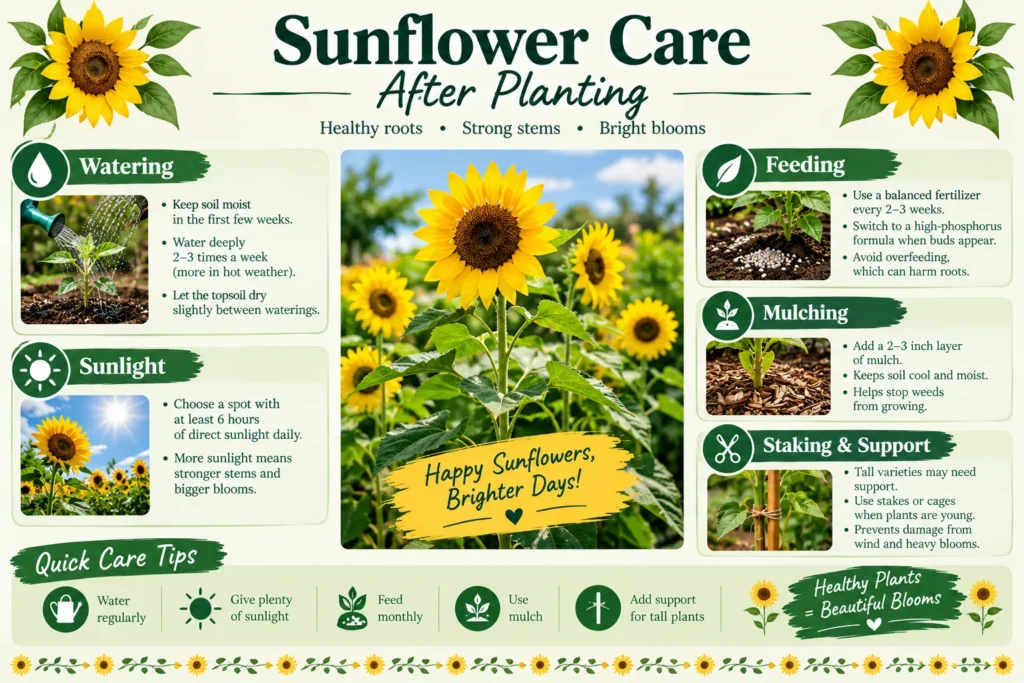
Watering
- Seedlings: Keep the soil evenly moist but never waterlogged.
- Established plants: Water deeply and less often, which encourages deep roots.
- Water at the base rather than over the leaves.
- Once settled in, sunflowers are surprisingly drought tolerant.
- Increase watering while buds form and flowers open.
Feeding
Go light. Too much nitrogen gives you all leaves and no flowers, so avoid high-nitrogen feeds once plants are established. When buds begin to form, a balanced fertiliser (equal NPK) or tomato feed works well. If you enriched the soil at planting, you may not need to feed at all.
Staking
Tall varieties must be staked, especially in exposed gardens. Add a bamboo cane when plants reach 50-60cm and attach them with a soft tie. Keep it loose so the stem can move a little and grow stronger.
Deadheading
Branching varieties keep flowering for longer if you deadhead spent blooms regularly. Single stem varieties, and any plants you want seed from, are best left to set seed. In autumn, leave the seed heads standing, because birds love them and they keep the garden interesting.
How to Grow Sunflowers from Seeds Without the Common Headaches
Even experienced growers hit a few snags. Most are easy to fix, and none should put you off.
Seeds that never sprout
Cold soil is the usual culprit, so wait for warmer weather. Other causes are seed sown deeper than 2.5cm, soil so wet the seed rotted, or old seed. Resow with fresh seed, and remember that on sunflower seed planting depth, shallow is safer than deep.
Slugs and snails
These are the number one threat to young seedlings, nibbling stems at soil level. Try copper tape around pots, wildlife-friendly slug pellets, crushed eggshells and a nightly torchlight patrol. Starting seeds indoors helps plants grow past the vulnerable stage.
Birds
Birds will pull up newly sown seeds. Cover the area with fleece or netting until seedlings are established.
Powdery mildew
A white coating on leaves in late summer is usually cosmetic and will not kill the plant. Improve airflow between plants and avoid wetting the leaves when you water.
Aphids
Black aphids can cluster on young stems and buds. Blast them off with a strong jet of water, and let ladybirds (ladybugs) do the rest. Avoid insecticides, because sunflowers are important pollinator plants.
Drooping heads
Very heavy flower heads droop naturally, so there is no need to panic. On young plants, check your watering, as thirsty plants wilt quickly. Stake tall varieties before they droop to protect the stem.
How to Grow Sunflowers from Seeds and Save Your Own for Next Year
One of the great joys of growing sunflowers is free seed for next season.
- Wait until the flower head is fully dry and brown, usually 4-6 weeks after flowering finishes.
- Cover the head with a paper bag tied at the neck to catch seeds as they ripen.
- Cut the head off with 15cm of stem and hang it upside down somewhere dry and well ventilated.
- Rub the seeds free once the head is completely dry.
- Store them in a paper envelope in a cool, dark, dry place, labelled with variety and year.
Seed is best used within 1-2 years, though it can last 3-4 years in good storage.
Sunflowers are just one of dozens of stunning S-named blooms, and our Flowers That Start With S list is a great place to discover your next garden favourite.
Frequently Asked Questions
Most sunflowers bloom 70 to 110 days after sowing, depending on variety. Dwarf types are quickest and giants take the longest.
Give them full sun, sow 2.5cm deep after the last frost and go easy on nitrogen feed. Stake tall varieties early and the plants do the rest.
In the UK and most of the USA, April to May is ideal once frost has passed. In Australia, sow from September to November.
Sow directly outdoors in a sunny, sheltered spot once the soil is warm. Plant 2.5cm deep, water gently and thin to the strongest seedling.
Annual sunflowers die after one season, so replant each year or save your own seed. Perennial types such as Helianthus x multiflorus return from the same roots.
Sometimes, and self-sown sunflowers often pop up year after year. Results are far better when seeds go 2.5cm deep into prepared soil.
Start Your Sunflower Patch This Season
Growing sunflowers connects us to the simple joy of gardening. There is the patience of waiting, and then the reward of watching something magnificent emerge from a tiny seed.
If you are a first-timer, just start. Sunflowers forgive mistakes and reward effort generously.
So grab a packet, find a sunny spot and give it a go. Once you know how to grow sunflowers from seeds, you will want a row every summer. For more plant and flower guides, visit PlantStyleHome, your home for everything from garden flowers to indoor plant care.