
The carnation flower has been cultivated for over 2,000 years, making it one of the oldest garden flowers in history. Ancient Greeks and Romans wove it into garlands for gods and heroes, long before most of today’s favorite blooms existed.
Somewhere along the way, carnations were unfairly written off as a filler flower. Spend a little time with them and you’ll realise they are one of the most expressive, long-lasting and historically fascinating flowers you can grow or gift. They are hardy, clove-scented and rich in meaning.
This guide covers the carnation flower meaning behind each color, the main types, a little history, and how to grow and care for them. If you’ve dismissed carnations as ordinary, I’d love to change your mind.
Carnation Flower Meaning and Symbolism
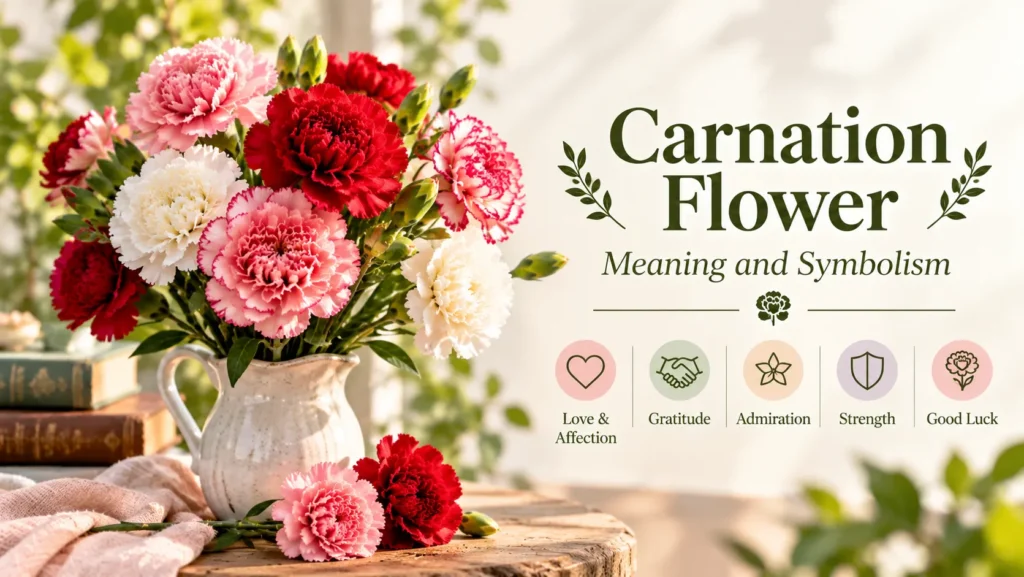
So, what does a carnation mean? In the simplest terms: love, fascination and distinction.
The name itself hints at why. The genus name Dianthus comes from the Greek dios (god) and anthos (flower), so a carnation is quite literally a flower of the gods.
The first time you learn that a carnation’s color carries a specific meaning, you start looking at every bouquet completely differently. Carnation symbolism is richer than that of almost any other cut flower, and it has been building for centuries.
Symbolism through history
- Ancient Greece and Rome: Carnations were braided into ceremonial garlands for gods, heroes and victors.
- Christianity: Legend says carnations sprang up where the Virgin Mary’s tears fell as she wept for her son, which is why they became linked with motherly love.
- Korea: On Parents’ Day, people pin red carnations on living parents to say thank you, while white carnations honor parents who have passed.
Modern carnation symbolism
Today the carnation carries three big meanings. The first is gratitude and a mother’s love, which is why it is the signature flower of Mother’s Day.
The second is solidarity. The red carnation became a symbol of labor and socialist movements, from May Day marches to Portugal’s peaceful 1974 Carnation Revolution.
The third is remembrance. White carnations stand for purity, luck and respect for those we have lost, and some countries wear them on Remembrance Day.
The remaining colors each have a message of their own, and I’ll walk through them in the next section.
The carnation birth flower for January
The carnation is one of the official January Birth Flowers, alongside the snowdrop, making it one of the most meaningful gifts you can give someone born in this month.
It stands for new beginnings, good luck and love for the year ahead. That makes the carnation birth flower a thoughtful choice, and a far more durable one than most winter blooms.
Carnation Flower Colors: What Each Shade Means
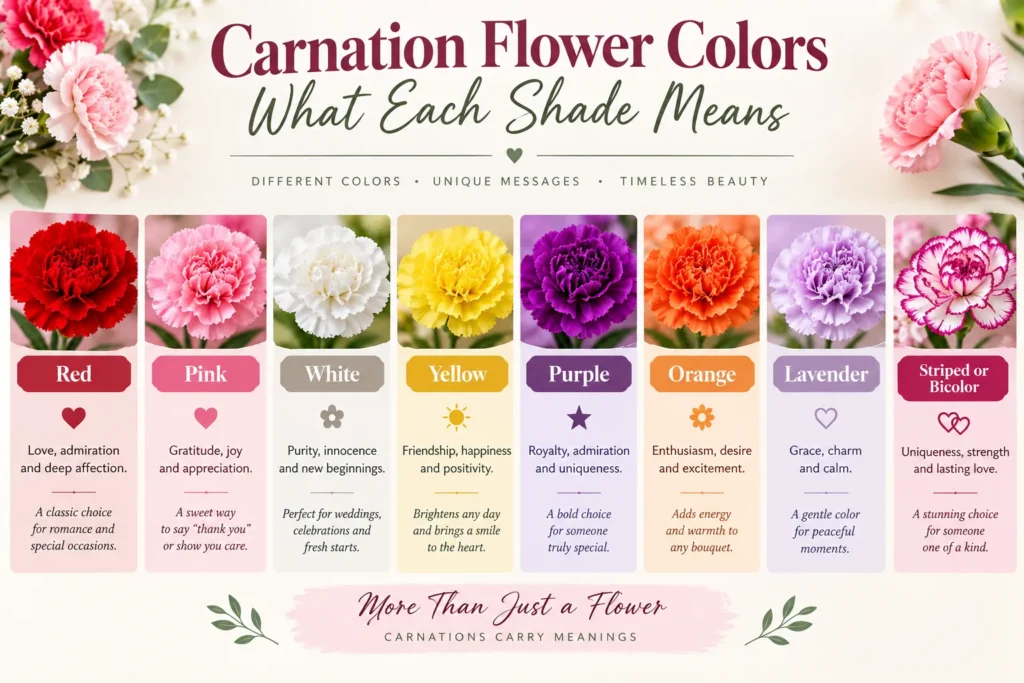
Few flowers are as color-coded as the carnation. The carnation flower colors you choose can turn a simple gift into a message, or accidentally send the wrong one, so it pays to know the language.
Colors for love and gratitude
- Red: deep love and admiration. It is romance without the Valentine’s Day cliché of roses, and it also stands for respect and pride. The red carnation rivals even the rose for its depth of meaning, and our Red Flowers guide explores the most passionate and striking red blooms in the flower world.
- Pink: motherly love, gratitude and warmth. Light pink says “I admire you,” while deep pink says “thank you from the bottom of my heart.” The pink carnation is the ultimate Mother’s Day flower, and for more gorgeous pink bloom inspiration, our Pink Flowers guide is full of beautiful ideas.
- Orange: enthusiasm, excitement and warmth. Choose it for cheerful, celebratory bouquets and gifts.
Color for purity and calm
- White: pure love, good luck and innocence. It is a favorite for weddings and remembrance ceremonies. In Japan, white carnations are associated with death, so skip them in Japanese cultural settings. White carnations are among the most elegant flowers for weddings and remembrance, and our White Flowers guide covers the most beautiful white blooms for every occasion.
- Lavender: enchantment and capriciousness. Think of it as a softer, more romantic reading than deep purple.
- Purple: unpredictability and whimsy. It looks striking in arrangements, and because the meaning is less widely known, it is a safe choice for décor.
Colors to handle with care
- Yellow: disappointment and rejection. It is a lovely flower with a tricky message. Avoid giving it as a gift unless that is exactly what you mean to say.
- Striped or bicolor: refusal. Traditionally it means “I cannot be with you.” These days it is mostly loved for its looks and is hugely popular in arrangements.
Mixing colors in bouquets
Carnation in bouquets is where color meaning turns into a story. Pink and white together say gratitude and purity, while orange with red adds warmth and passion. When you want one clear message, stick to a single color.
So what does a carnation mean? It depends entirely on the color you pick.
Types of Carnation Flowers
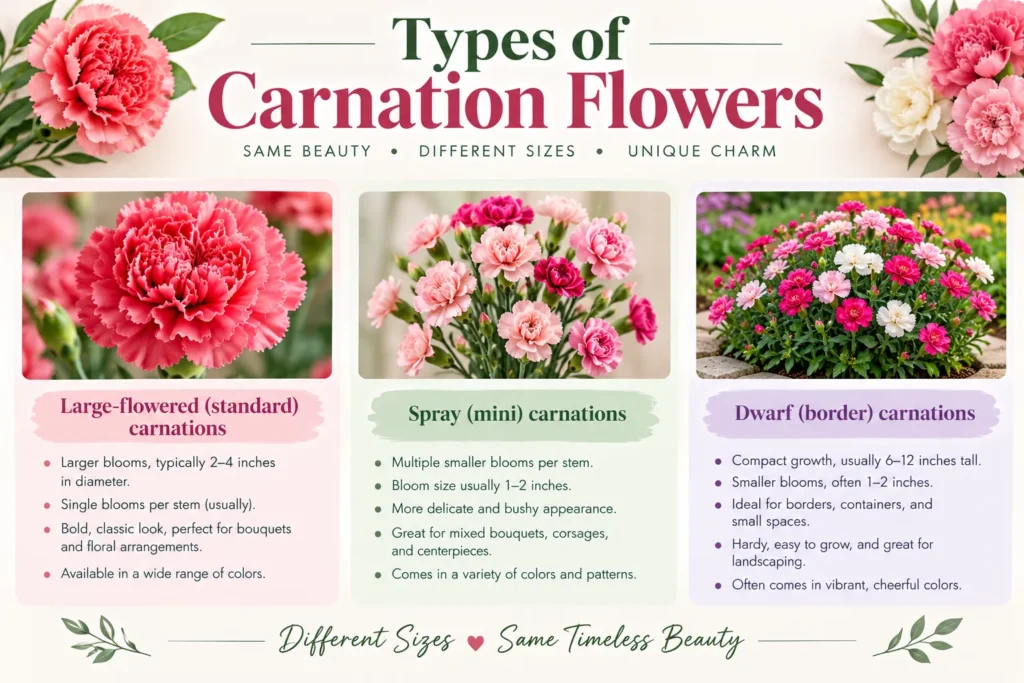
Carnations fall into three main groups, plus a few wild relatives worth knowing. The types of carnation flowers you choose depend on whether you want long cutting stems, compact borders or pots on a sunny step.
1. Large-flowered (standard) carnations
This is the classic florist’s carnation, and the one most people recognize. Each long stem carries a single big bloom.
- Height: typically 60 to 90 cm
- Vase life: 2 to 3 weeks
- Best for: formal bouquets, wedding flowers and cut flower gardens
- Varieties: ‘Chabaud Giants’, an old French variety that is highly fragrant; ‘Giant Chabaud’, sold in mixed colors; and ‘Grenadin’, excellent for cutting and deeply fragrant
2. Spray (mini) carnations
Spray carnations carry several smaller blooms on each branching stem. The look is more casual and contemporary.
They are wonderful value, because one stem gives you multiple flowers. The vase life stretches to as long as 3 weeks, which is why spray carnation in bouquets shows up so often in modern floral design and everyday arrangements.
If you love carnations in a bouquet, the Ranunculus Flower is another florist favorite worth discovering, layered, delicate and absolutely stunning in arrangements.
3. Dwarf (border) carnations
These compact plants are the hardy outdoor workhorses of the family. They are perfect for borders, pots and cottage gardens, and they are often fragrant.
- Height: 30 to 45 cm, with multiple flowers per stem
- Varieties: ‘Chabaud La France’, pale pink with a classic scent; ‘Scarlet Luminette’, a vivid red; and ‘Enfant de Nice’, a mixed-color heirloom
Wild species worth knowing
- Dianthus caryophyllus: the original wild carnation from the Mediterranean, and the ancestor of the florist’s carnation
- Dianthus plumarius (cottage pink): smaller, fringed flowers with an intense fragrance, excellent in cottage gardens
- Dianthus barbatus (Sweet William): a biennial with clusters of small flowers, superb in cottage-style borders
Carnation Flower Care: Growing and Keeping Them Beautiful
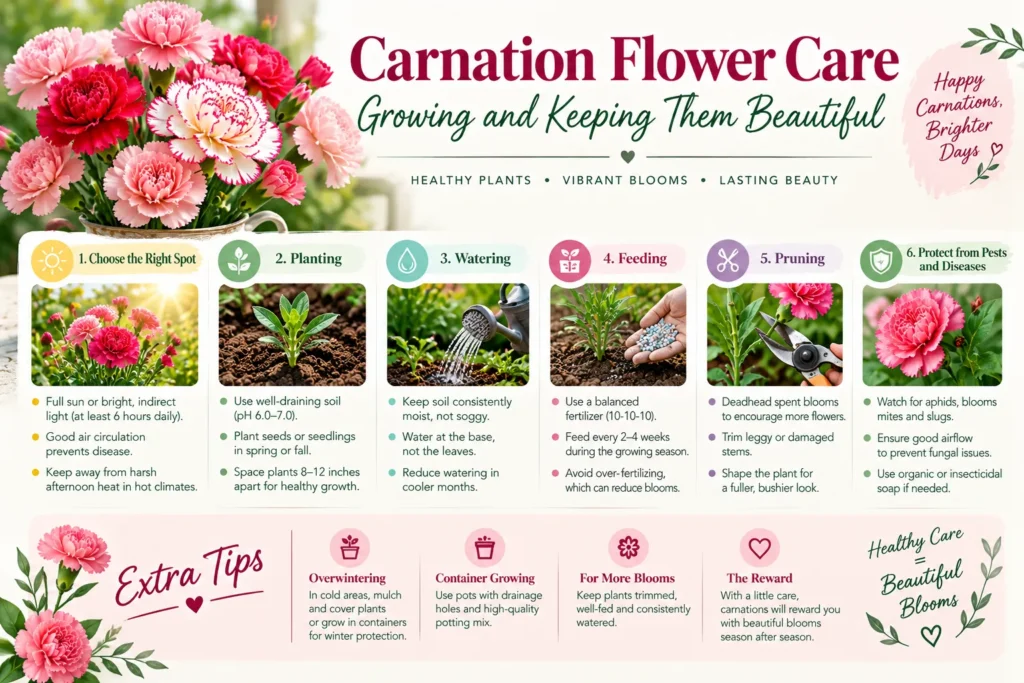
Good news: carnation flower care is refreshingly simple once you know what they dislike, which is mostly wet feet. Give them sun, drainage and a light hand with the fertilizer, and they reward you for months.
Growing carnations in the garden
- Sun: full sun, at least 4 to 6 hours daily
- Soil: well-draining and close to neutral, around pH 6.7 to 6.9
- Drainage: carnations hate waterlogged roots, so raised beds or well-dug borders are ideal
- Planting: in spring after the last frost, spaced 30 to 45 cm apart for good airflow
- Deadheading: remove spent blooms regularly to encourage continuous flowering
- Support: tall standard varieties need bamboo canes
Growing carnations in pots
Dwarf and border varieties are excellent in containers. Choose a pot at least 25 to 30 cm across, filled with good quality, free-draining compost with added grit or perlite.
Water when the top 2 cm of soil is dry, and never let the pot sit in a saucer of water. During the growing season, a balanced liquid fertilizer every two weeks is plenty.
Feeding and watering
Carnations are light feeders. Overfeed them and you get lots of leafy growth with fewer flowers.
- Switch to a low-nitrogen, high-phosphorus feed once buds form
- Water at the base, because wet foliage invites fungal problems
- Reduce watering in winter
Common problems
- Fusarium wilt and root rot: yellowing and wilting, made worse by soggy soil. Improve drainage and avoid overwatering.
- Aphids: they cluster on buds and stems. Blast them off with water or use insecticidal soap.
- Rust: orange powdery spots on the leaves. Improve airflow and remove affected leaves.
- Leaf curling: usually underwatering, or spider mites in hot, dry weather.
Keeping cut carnations fresh
Carnations are outstanding cut flowers, and one of the longest-lasting of all florist flowers. These habits get you the most from every stem:
- Cut stems at a 45° angle
- Change the water every 2 days
- Add cut flower food to the water
- Keep them away from fruit, because ethylene gas shortens vase life
- Choose a cool spot away from direct sun and heat
- Remove any leaves below the waterline
- Recut the stems every few days
Carnation Flower in History and Culture
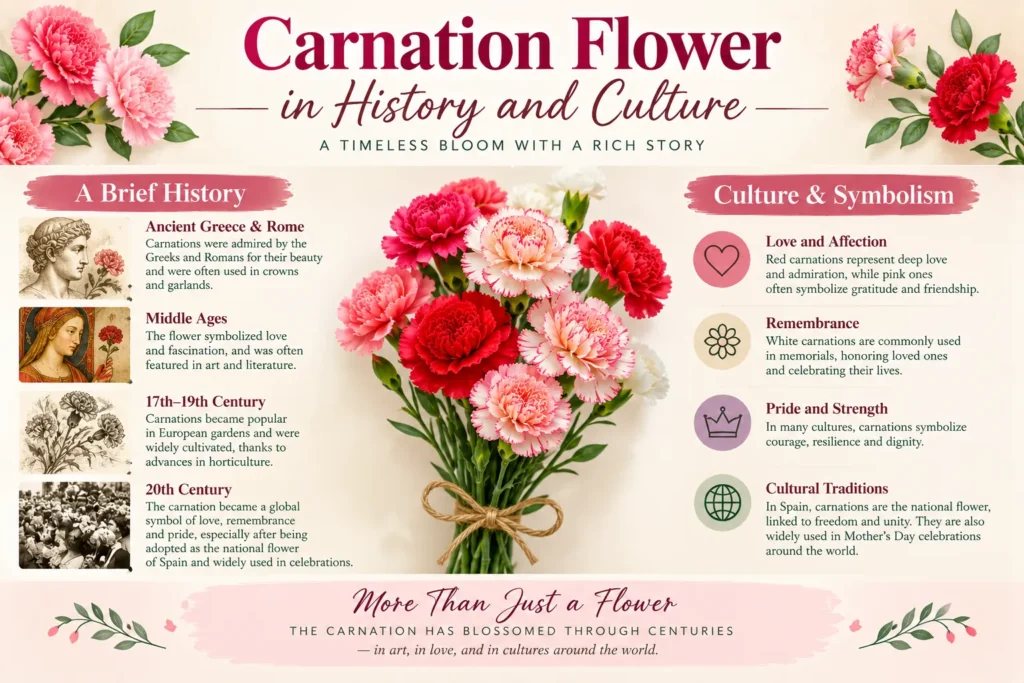
The carnation began in the Mediterranean region and has been grown for more than 2,000 years. Few garden flowers can claim a pedigree like that.
Renaissance art is full of them. Carnations in portraits traditionally signify engagement or betrothal, and many famous paintings show a sitter holding or being offered one. Leonardo da Vinci’s Madonna of the Carnation is a well-known example.
Spain gave the carnation (clavel) a role as a symbol of passion, woven into flamenco culture and deeply embedded in Spanish national identity.
Mother’s Day has a carnation at its heart. In 1907, Anna Jarvis held a memorial for her late mother and handed out white carnations, her mother’s favorite flower. The first official Mother’s Day services followed in 1908, and the custom grew into red or pink carnations for living mothers and white ones for those who have passed.
Carnations as national and state flowers
- Spain: the red carnation is widely treated as a national symbol
- Monaco: the carnation is the national flower
- Slovenia: carnations are a beloved folk symbol, famously spilling from balcony window boxes
- Ohio, USA: the scarlet carnation is the state flower
Frequently Ask Questions
Carnations symbolize love, fascination and distinction. The specific message depends on the color: red for deep love and admiration, pink for gratitude and a mother’s love, white for purity and remembrance, and yellow for disappointment. They have also stood for solidarity, especially the red carnation in labor movements.
The genus name Dianthus combines the Greek words dios (god) and anthos (flower), which translates to flower of the gods. The nickname also reflects how ancient Greeks and Romans used carnations in garlands for gods and heroes, and the Christian legend linking them to the Virgin Mary’s tears.
Yes, in the right color. Red carnations say deep love and admiration, and pink ones add warmth and affection. Renaissance portraits often used a carnation to signal engagement. Skip yellow and striped blooms if romance is the goal, since they traditionally mean disappointment and refusal.
Sometimes, but not only. White carnations are widely used for remembrance and funerals, and in Korea they honor parents who have passed. In Japan, white carnations are strongly tied to death. Carnations are just as common at weddings, birthdays and on Mother’s Day, so color and context decide the message.
Give the Carnation a Second Look
This was never a filler flower. The carnation is one of the most storied, meaningful, long-lasting and versatile blooms in the world. Gods wore it in ancient garlands, mothers receive it every spring, labor marchers carried it, and flamenco dancers still tuck it behind an ear.
So choose carnations on purpose. Bring pink ones for Mother’s Day, and give a January birthday the carnation birth flower with a note about luck and new beginnings. Tuck dwarf varieties into your borders and pots, and ask your florist for carnation in bouquets that say something real.
Once you know the carnation symbolism behind every color, you can’t unsee it. To keep exploring, visit PlantStyleHome for our full library of flower guides and plant care tips. I suspect that once you’ve fallen for the carnation flower, you’ll never call it ordinary again.