
Campanula is one of those flowers that always feels a little magical. Those perfect nodding bells in blue, violet, lavender and white have a timeless, storybook quality that makes them look at home in every kind of garden. They rise on stems that run from ground-hugging mats just a few centimetres high to tall, stately spires.
The range is extraordinary. There are tiny alpine gems for rockeries, tall perennials for borders, trailing plants that tumble from walls and cheerful pot plants for patios.
For all their elegant looks, bellflowers are tough, easy and rewarding. That makes them some of the most versatile flowering plants you can grow. This guide covers the best species, how to look after them, how to propagate them and how to fix the usual problems, so you can match the right plant to the right spot.
What Is Campanula?
Campanula is a huge genus of flowering plants in the bellflower family. The name comes from the Latin campana, meaning bell, and one look at the flowers tells you why.
- Genus: Campanula
- Family: Campanulaceae (the bellflower family)
- Common name: bellflower
- Size of the genus: over 500 species, making it one of the largest flowering plant genera
- Native range: northern temperate regions, including Europe, the Mediterranean, the Caucasus, western Asia and North America
Much of this family grew up on rocky slopes and in mountain meadows, which explains why so many species love sharp drainage and sunshine. Like campanula, edelweiss is a beautiful flower with its roots in the mountain meadows of Europe, and our Edelweiss Flower guide tells the full story of that iconic bloom.
Key Campanula Species and Their Uses
Choosing the right species is half the battle. Here are the ones I would point any gardener towards.
Campanula portenschlagiana (Dalmatian bellflower)
This is the classic wall plant. It forms a low, spreading mat only 5 to 15cm tall and covers itself in small violet-purple bells from June to August.
- Best for: wall crevices, rockeries, paving gaps and container edges
- Evergreen in mild winters
- Very tough and drought-tolerant once established
Many bellflowers bloom in rich violet and purple shades, and our Purple Flowers guide explores more of the most beautiful purple blooms for borders and containers.
Campanula poscharskyana (Serbian bellflower)
A vigorous, trailing grower with star-shaped lavender-blue flowers. The shape is slightly different from the classic bell, but the charm is just the same.
- Best for: walls, banks, hanging baskets and ground cover
- Extremely tough, tolerating poor soil and partial shade
Campanula persicifolia (peach-leaved bellflower)
Tall, elegant and quietly romantic, this perennial reaches 60 to 90cm. Its large, open bells in blue or white sit on slender stems.
- Best for: classic cottage garden borders
- Excellent cut flower
- Self-seeds freely, which is a gift in informal gardens
Campanula lactiflora (milky bellflower)
A tall, branching perennial of 90 to 150cm, carrying masses of small, pale lavender-blue bells. It makes a stately back-of-border plant, and bees adore it.
Campanula medium (Canterbury bells)
A biennial, so you sow it one year and enjoy the flowers the next. The big cup-and-saucer blooms come in blue, pink and white on stems of 60 to 90cm. It is a cottage garden classic.
Campanula carpatica (Carpathian bellflower)
Compact and low at 20 to 30cm, with large upward-facing cups in blue or white. It flowers for a very long season, from June to September. Use it at the front of borders, in rockeries and in containers.
Campanula isophylla (Italian bellflower, star of Bethlehem)
A tender trailing perennial with masses of pale blue or white star-shaped flowers. It is not frost hardy, so grow it as a houseplant or as a summer container and hanging basket plant.
Colour Range
Blue and violet are the most iconic shades. The beautiful blue and violet bells of campanula are among the most enchanting in the garden, and our Blue Flowers guide celebrates more of the finest blue and violet flowering plants you can grow.
You will also find:
- Lavender and pale lilac
- Pure white
- Pink, which is less common
- Rarely, a deep purple
Whatever the shade, the bells draw in bees, bumblebees and butterflies all summer. Wherever you garden, there is a bellflower to suit the style, whether cottage, formal, rock, wildlife, container or wall.
Campanula Care: Light, Soil and Watering
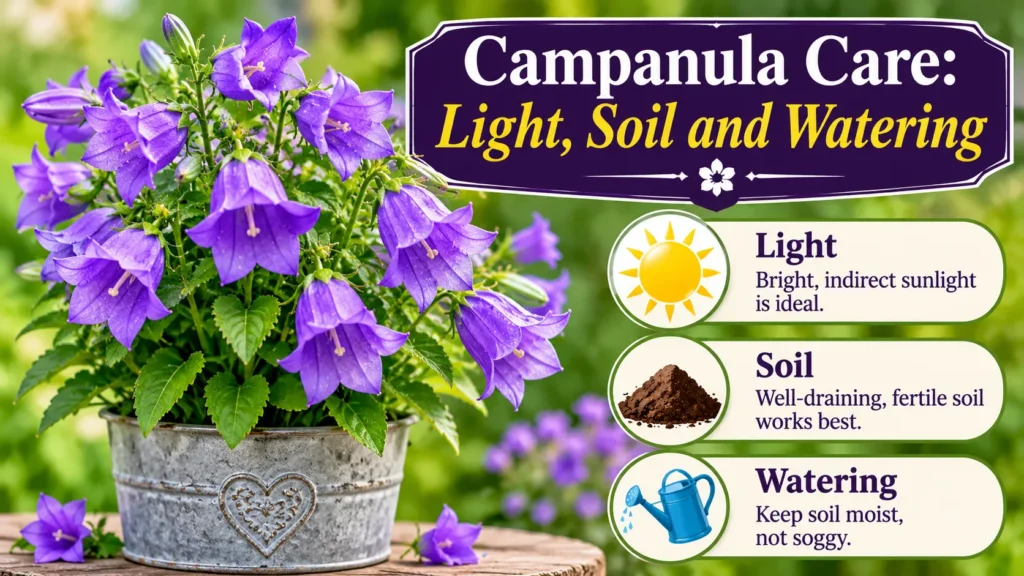
The good news is that campanula care is simple once you know what these plants want. Think mountain slope rather than rich, pampered border.
Light
- Full sun gives the best flowering and the most compact growth.
- Partial shade (3 to 4 hours of sun) suits most species. C. poscharskyana is the most shade-tolerant, and C. lactiflora copes with dappled shade.
- Deep shade is not suitable. Growth turns weak and leggy and flowers are few.
- Indoors, C. isophylla wants bright indirect light. Keep it out of harsh midday sun through glass.
Soil
- Well-drained soil is essential for most species.
- Poor, stony, sandy or chalky soil is often better than rich, heavily amended ground.
- Aim for slightly alkaline to neutral, around pH 6.5 to 7.5.
- On heavy clay, mix in grit or use a raised bed.
- Very fertile soil gives lush leaves at the expense of flowers.
Wall and alpine species such as C. portenschlagiana and C. poscharskyana are happiest in dry, free-draining spots like wall crevices, gravel and rocky ground.
Watering
Once established, most garden bellflowers are drought-tolerant. Good bellflower plant care is mostly about not overdoing it.
- Young plants: water regularly through their first season.
- Established perennials: let the soil dry between waterings. Deep, infrequent watering beats frequent sprinkles, and rainfall alone is usually enough in temperate climates.
- Containers: check daily in summer heat, and never leave pots standing in water.
- C. isophylla indoors: let the top 2 to 3cm of compost dry between waterings, and water less in winter when growth slows.
How to Grow Campanula: Planting, Propagation and Division
If you are wondering how to grow campanula, the easiest start is a nursery plant or plug. Seed and division are rewarding too, and both are cheap.
Planting Nursery Plants
Spring or autumn is the best time. Here is what to do:
- Add grit to the soil if it is heavy.
- Plant at the same depth as in the pot, and never bury the crown.
- Water in well and keep moist until established.
Spacing depends on the species:
- Low growers (C. portenschlagiana, C. carpatica): 20 to 30cm apart
- Medium (C. persicifolia): 30 to 40cm apart
- Tall (C. lactiflora): 45 to 60cm apart
Growing from Seed
Biennials such as Canterbury bells:
- Sow outdoors in June or July.
- Prick out into individual pots once big enough to handle.
- Overwinter in a cold frame or sheltered spot.
- Plant out in spring, and they will flower that summer.
Perennials such as C. persicifolia and C. carpatica:
- Sow indoors in February or March on the surface of moist compost. The seed needs light to germinate, so do not cover it.
- Keep at 15 to 18°C.
- Be patient. Germination takes 14 to 28 days and can be slow and uneven.
- Prick out when big enough to handle.
- Harden off and plant out in spring.
Perennials grown from seed will not flower until their second year, so give them time.
Division
Division is the easiest way to increase established perennials.
- Lift clumps in spring or autumn.
- Split with two forks back to back, or by hand. Each piece needs roots and shoots.
- Replant at the same depth.
- Water well and keep moist until re-established.
Divide every 3 to 4 years to rejuvenate clumps and keep them vigorous.
Stem Cuttings
Tender types like C. isophylla are best propagated from cuttings.
- Take 8 to 10cm tip cuttings in spring.
- Strip the lower leaves.
- Insert in moist compost.
- Keep warm in bright, indirect light.
Roots form in 3 to 4 weeks.
Deadheading and Caring for Campanula Through the Seasons
A little regular attention keeps a campanula plant flowering for weeks longer.
Deadheading
Tall species (C. persicifolia, C. lactiflora): snap or cut off individual spent blooms. When every bloom on a spike has finished, cut the whole spike to the base. This often triggers a second flush.
Low-growing species (C. portenschlagiana, C. carpatica): shear lightly with scissors or hedging shears after the main flush. A second wave of flowers follows, and the plant stays neat and compact.
Self-Seeding
Campanula persicifolia self-seeds freely. If you want it to wander through your borders, let some seed ripen. The seedlings transplant easily when small. If you do not want it spreading, remove spent flowers promptly.
Spring
- Remove winter-damaged leaves.
- Top-dress perennials with well-rotted compost.
- Divide overcrowded clumps.
- Start regular watering as growth gets going.
Summer
Campanula is one of the most reliable summer-flowering perennials you can grow, and our Summer Flowers guide covers the best blooms for a colourful garden all season long.
- Deadhead regularly.
- Water containers in dry spells.
- Stake tall species such as C. lactiflora and C. persicifolia in exposed gardens.
Bellflowers and scabiosa are two of the finest cottage garden perennials to grow together. Our Scabiosa guide covers the beautiful pincushion flower that pairs perfectly with them in beds and borders.
Autumn
- Cut perennials back to the basal rosette after flowering.
- Divide clumps if needed.
- Collect seed from C. persicifolia if you like.
Winter
Most garden campanulas are hardy and need no protection in the UK or similar temperate climates. Bring C. isophylla indoors before the first frost, and mulch the crown of less hardy species in colder areas.
Feeding
Garden bellflowers need very little. A spring top-dress of well-rotted compost is plenty. Avoid high-nitrogen feeds, which give leaves instead of flowers. For containers, use a balanced liquid feed every 2 to 3 weeks during the growing season.
Campanula Common Problems and Solutions
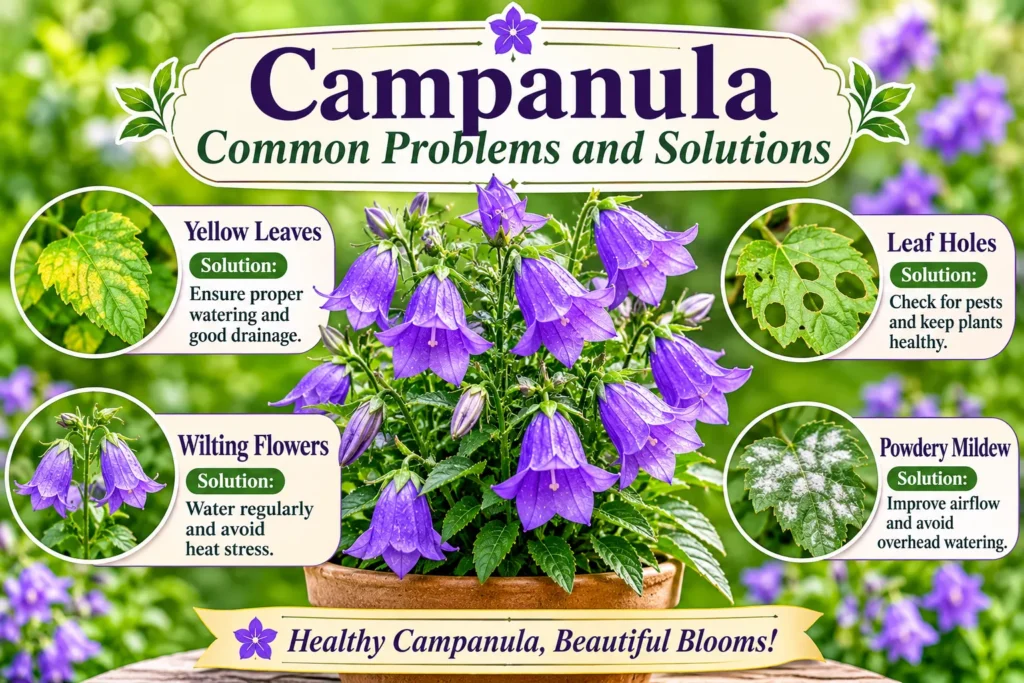
Bellflowers are robust, but a few issues turn up now and then.
- Not flowering or flowering poorly. The cause is usually too little sun, over-rich soil, a young plant (perennials from seed in their first year) or crowded clumps. Fix it with a sunnier position, less feeding and division of overcrowded clumps.
- Root or crown rot. Waterlogged soil or water pooling around the crown is the culprit, most often in heavy clay or poorly drained pots. The plant collapses and the crown turns brown and mushy. Improve drainage immediately and replace affected plants. Prevention is the only real cure.
- Rust (orange spots on leaves). This fungal disease is more common in wet conditions. Remove all affected leaves, improve air circulation and treat with a copper-based fungicide.
- Powdery mildew. A white powdery coating appears in dry summers and crowded plantings. Improve air circulation, water at the base and treat with neem oil or a bicarbonate solution. It is usually cosmetic rather than serious.
- Slugs and snails. Young growth and new spring shoots are their favourite. Protect new growth with copper tape, wool pellets or organic slug pellets. Established plants recover well.
- Vine weevil in containers. The larvae eat the roots, and a plant suddenly collapses. Check for white, C-shaped grubs. Apply nematodes in late summer or early autumn, and repeat yearly for valued pots.
- Leggy growth. Not enough light is to blame. Move the plant to a sunnier spot, or cut it back hard and let it regrow in better conditions.
Start Your Own Campanula Collection
Few flowers give as much for so little effort. There is a bellflower for every size of garden and every style, from a crack in a paving stone to a sweeping cottage border. Once you grow one, you will almost certainly want to grow more.
If you are not sure where to begin, start with one of the easiest. C. portenschlagiana is perfect for walls and rockeries, C. carpatica shines in containers and borders, and C. persicifolia gives you that classic tall cottage garden look.
Give them sun, good drainage and a light touch, and they will repay you every summer with their nodding bells. You can explore more flower and garden guides at PlantStyleHome, and I hope this one helps you fall for campanula as hard as I have.