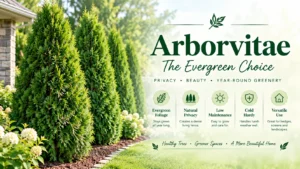
Walk through almost any North American neighborhood and you will spot arborvitae doing quiet, dependable work. It screens a patio, softens a fence line, shelters a vegetable bed from wind and stays green through the coldest months. Few plants work as hard as arborvitae while asking for so little in return.
Gardeners love it for good reasons. It is cold hardy, forgiving and fast enough to reward your patience without taking over your yard. Once a hedge fills in, you genuinely forget the neighbors exist. It is that effective.
This guide walks through everything you need to know: what these trees are, the best varieties, how to plant them, how far apart to place them, how to care for them and what to do when the foliage starts to brown.
What Is Arborvitae?
Arborvitae belongs to the genus Thuja in the cypress family, Cupressaceae. Two species matter most to gardeners. Thuja occidentalis is the Eastern or American type, native to eastern North America. Thuja plicata is the Western red cedar, native to the Pacific Northwest.
The common name means “tree of life.” The story goes that French explorers learned from Indigenous people to brew tea from the foliage, which is rich in vitamin C, and it helped sailors recover from scurvy. Whether every detail of that tale is exact, the name stuck.
Here are the basics at a glance:
- Lifespan: 50 to 150 years or more
- Wild height: up to 20m in native forests, though garden varieties stay far shorter
- Foliage: flat, scale-like sprays that smell sweet and resinous when crushed
- Habit: evergreen, so it keeps its foliage all year
That last point is the real selling point. While maples and oaks stand bare in January, your hedge is still doing its job.
Popular Arborvitae Varieties
Choosing the right one matters more than anything else you will do. The range of arborvitae varieties is wide, from tiny garden globes to towering windbreak trees. Here are the ones I would look at first.
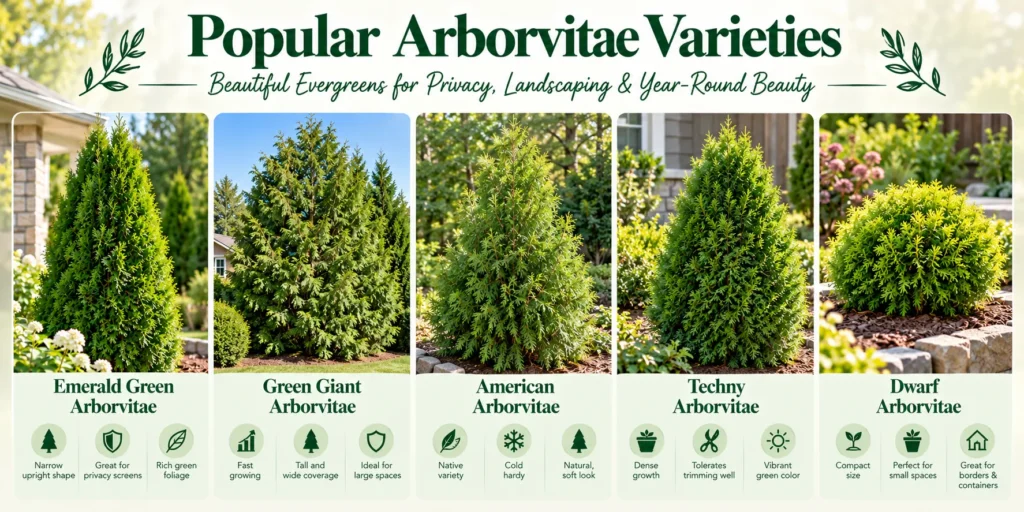
Emerald Green Arborvitae (Thuja occidentalis ‘Smaragd’) is the most popular garden choice, and it earns it. It grows in a narrow column, reaching 3 to 4m tall and only 1 to 1.2m wide. Unlike many relatives, it stays bright green all winter instead of bronzing. Growth is slow to moderate, around 30cm a year. It suits formal hedges and tight spaces beautifully.
Green Giant Arborvitae (Thuja standishii × plicata) is the one to pick when you want privacy quickly. It adds 60 to 90cm a year and can reach 15 to 20m if left unclipped. The form is dense and pyramidal, and it resists disease better than the Thuja occidentalis types. It shines on large properties as a windbreak or a tall screen.
American Arborvitae (Thuja occidentalis) is the classic species and the parent of many cultivars. It is more cold hardy than Green Giant and grows at a moderate pace. The foliage bronzes slightly in winter, which some gardeners find charming and others do not.
Techny Arborvitae (Thuja occidentalis ‘Techny’) has dark green foliage that holds its color through winter. It grows wider than Emerald Green and reaches 4 to 5m. It is very hardy, down to Zone 2 or 3, which makes it a strong pick for exposed, windy sites.
Dwarf Arborvitae options are perfect for foundation beds, containers and small gardens. Look at:
- ‘Danica’: a neat globe, about 60cm tall
- ‘Little Giant’: rounded, 1 to 1.5m
- ‘Hetz Midget’: very compact and tidy
These grow slowly and need almost no maintenance. If foliage color is what draws you in, our guide to Green Flowers explores plants that bring lush color to the garden all year.
How to Plant Arborvitae
A good start pays off for decades, so it is worth getting this part right.
When to plant: Spring or early autumn is ideal. Summer heat stresses young roots, and frozen winter ground makes planting impossible.
Where to plant: Choose full sun to part shade, with at least 4 to 6 hours of direct light. Full sun gives you the densest, healthiest growth. In deep shade, the foliage turns sparse and thin.
Soil: These trees want moist, well-draining ground that is slightly acidic to neutral (pH 6 to 8). They dislike wet feet, and roots rot easily in soggy soil. If you garden on heavy clay, mix in compost and some grit before planting.
Here is the planting process:
- Dig a hole 2 to 3 times wider than the root ball and no deeper than the root ball itself.
- Loosen the sides of the hole with your spade so roots can spread.
- Remove the container and disturb the roots as little as possible.
- Backfill with your original soil mixed with a little compost.
- Water deeply right away.
- Mulch 5 to 8cm deep around the base, keeping it clear of the trunk.
Stake only if your site is very exposed, and take the stakes off after the first growing season so the trunk can strengthen on its own.
If you love beautiful garden trees, our guide to the Autumn Blaze Maple covers one of the most spectacular deciduous trees you can grow, a stunning contrast to evergreen arborvitae in any landscape.
Arborvitae Spacing Guide
Spacing is one of the questions I hear most, and the answer depends on what you want the trees to do. The golden rule: always check the mature spread, not just the height.
For a privacy hedge with Emerald Green: Plant 60 to 90cm apart (2 to 3 feet). Tighter spacing gives you a faster screen, and it usually fills in within 3 to 5 years. Wider spacing is healthier over the long run because air moves more freely between trees.
For a privacy hedge with Green Giant: Plant 1.5 to 2.5m apart (5 to 8 feet). The fast growth means it closes the gaps quickly. Crowd it too much and the trees compete for water and nutrients.
For a windbreak: Space trees 1.5 to 3m apart depending on the variety. A double staggered row gives denser protection than a single line.
For a specimen or accent tree: Plant it alone and give it room to reach its natural width. Look up the mature spread of your chosen variety first.
Good arborvitae spacing is a bit of a balancing act. Planting too tight feels satisfying in year one and causes browning and disease in year ten.
Arborvitae Care: Watering, Feeding and Pruning
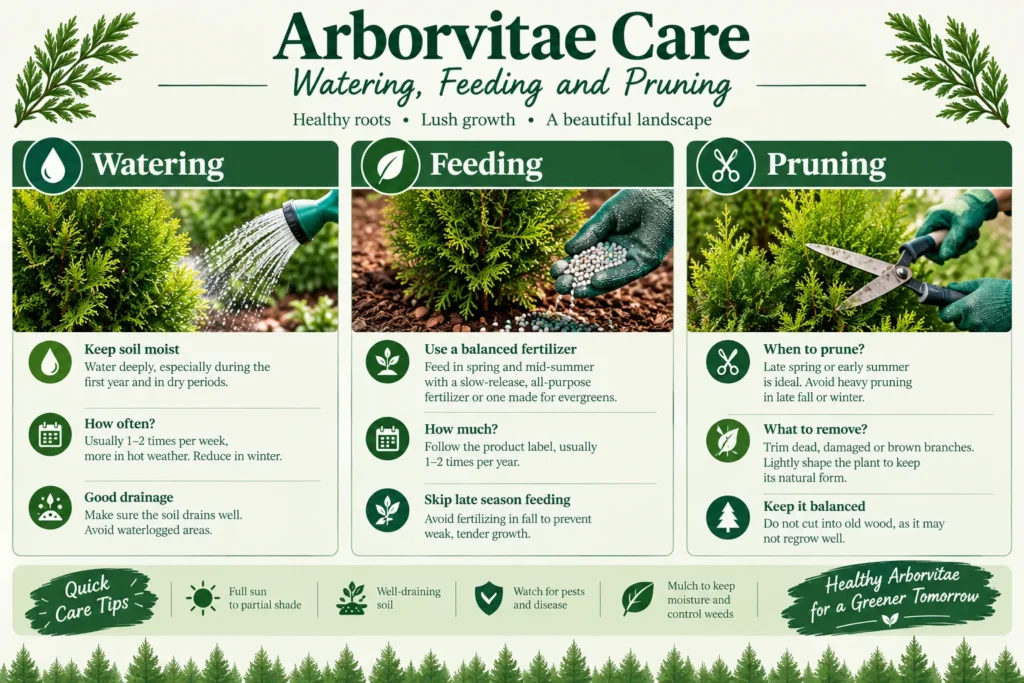
Reliable arborvitae care is simple, and most of it comes down to water in the first couple of years.
Watering
- Newly planted trees need a deep soak 2 to 3 times a week during the first season.
- Established trees do well with a weekly watering in dry spells, and less when the weather is cool.
- Deep, slow watering beats frequent shallow sprinkling every time.
- Never let the soil sit waterlogged.
- Browning foliage can signal drought stress, so check the soil before assuming something worse.
Feeding
Feed once in early spring with a balanced slow-release granular fertilizer (10-10-10), or use a fertilizer made for evergreens and conifers. Resist the urge to overfeed, because too much fertilizer pushes weak, soft growth. Trees that are 5 years or older need even less.
Pruning
This is where people make their biggest mistake. Arborvitae will not regrow from old brown wood the way many other shrubs do. If you cut back into the bare, leafless interior, that spot stays bare for good.
- Do light shaping in late spring after new growth hardens, or in late summer.
- Stick to tip pruning to keep the shape and encourage density.
- Avoid hard pruning, which causes permanent damage.
- Green Giant rarely needs trimming if you gave it enough space.
- Emerald Green stays naturally columnar and needs only minimal touch-ups.
For another low-maintenance evergreen option, our Olive Tree guide explores a drought-tolerant tree with timeless Mediterranean character.
Why Is My Arborvitae Turning Brown?
Of all the worries gardeners bring me, this is the biggest. The good news is that arborvitae turning brown is often fixable, and sometimes it is perfectly normal. Here are the usual causes.
1. Natural inner browning. In autumn, old interior foliage turns brown and drops. The outer growth stays green. This is normal, and you do not need to do anything.
2. Winter burn. In cold, dry, windy winters, foliage dries out faster than the roots can replace the moisture. The outer growth turns brown or orange. Prevent it by wrapping young trees in burlap before winter, applying an anti-desiccant spray and watering deeply in late autumn before the ground freezes.
3. Root rot or overwatering. Lower branches brown first, and the soil stays wet. Improve drainage and cut back on watering. Severe cases may not recover, which is why good drainage at planting matters so much.
4. Drought stress. Browning spreads evenly inward from the tips, and the soil is dry and cracked. Water deeply right away and add mulch to hold moisture.
5. Bagworms. Look for brown patches with small bag-like cocoons hanging from the branches. Pick the bags off by hand in winter and treat with Bt in early summer.
6. Spider mites. Fine webbing and bronze or gray stippled foliage are the clues, especially in hot, dry weather. Spray with horticultural oil or neem oil.
7. Salt damage. Browning on the side facing the road points to winter salt spray. A barrier planting or a burlap screen protects the trees.
Winter is also the season when your garden needs a little color. Arborvitae looks stunning paired with winter-blooming plants, and our guide to Winter Flowers covers the best blooms to add color alongside your evergreen hedge.
How Fast Does Arborvitae Grow?
The honest answer is that it depends on the variety. Typical yearly growth looks like this:
- Emerald Green: 20 to 30cm
- Green Giant: 60 to 90cm
- American Arborvitae: 30 to 45cm
- Dwarf varieties: 5 to 15cm
Conditions matter too. Full sun, good soil and steady moisture speed things up. Poor soil, heavy shade or dry spells slow growth to a crawl.
Here is a realistic timeline for a privacy screen. An Emerald Green planted at about 1.5m tall spends years 1 and 2 establishing roots, with little visible growth. Years 3 and 4 bring noticeable progress, and by years 5 to 7 you have a full arborvitae privacy screen. Green Giant at the same spacing can give you solid privacy in 3 to 4 years.
Patience pays off with an arborvitae hedge, and the wait is easier when you plant a little taller to begin with. These trees also grow beautifully alongside other statement trees. Our guide to Trees with Pink Flowers covers ornamental flowering trees that complement evergreen hedging perfectly.
Final Thoughts on Growing Arborvitae
Arborvitae remains one of the most dependable evergreens you can put in a home garden. It handles cold, fills gaps, screens views and stays green when everything else has given up for the season. Choose the right variety for your space, give it good soil, sensible spacing and a deep drink in its first year, and it will reward you for decades.
When you are ready to plan the rest of your garden, explore our complete library of plant and tree guides at PlantStyleHome, from evergreen trees to exotic houseplants.