If you’ve been hunting for flowers that start with X, get ready for a real botanical adventure. X is, without question, the hardest letter in the entire flower alphabet. Most letters give you dozens of options. X gives you a small, strange, and genuinely wonderful handful.
At Plant Style Home we have been exploring every flower from A to Z, and X is our most exciting discovery yet. Finding these plants felt less like writing a blog post and more like digging through a botanical treasure chest. Every name we uncovered had a story attached: ancient Chinese folklore, wildfire survival, medicinal roots used for centuries, flowers that literally close their petals to sleep at night.
Our A-Z flower series has taken us through nearly every letter by now, and honestly, this might be the most fascinating stop yet. If you haven’t seen it, catch up with our guide on Flowers That Start With W first.
So let’s dig in. Yes, flowers that start with X are real, they’re rare, and they’re absolutely worth knowing.
Do Any Flowers Really Start With X?
Here’s the fun surprise: yes, real flowers genuinely start with X, and they’re not obscure horticultural trivia either. Humans have cultivated, studied, and used several of them for centuries.
The reason X is so rare in botanical naming comes down to language. Most scientific plant names derive from Latin and Greek, and very few root words in either language begin with the letter X. When a genus name starts with X, it almost always borrows from Greek words like xanthos (yellow) or xeros (dry).
That’s actually why so many X flowers share a theme. Look closely at the list below and you’ll notice a pattern: yellow petals, dry conditions, tough survival strategies. It’s not a coincidence. It’s etymology quietly shaping an entire corner of the plant kingdom.
What makes X flowers botanically special isn’t just their rarity. It’s that so many of them evolved striking adaptations, from drought tolerance to fire resistance, that make them genuinely useful case studies in plant biology. These aren’t just curiosities. They’re survivors.
Complete List of Flowers That Start With X
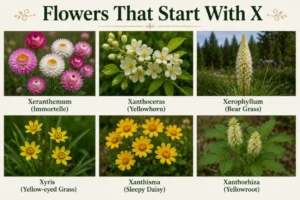
Before we go deep on each one, here’s a quick overview table so you can see the full X flowers list at a glance.
| Flower Name | Color | Origin | Rarity Level |
|---|---|---|---|
| Xeranthemum (Immortelle) | Purple, pink, white | Mediterranean, Southern Europe | Uncommon in gardens |
| Xanthoceras (Yellowhorn) | White with yellow/red center | Northern China | Rare outside China |
| Xerophyllum (Bear Grass) | Creamy white | Western North America | Rare, localized |
| Xyris (Yellow-eyed Grass) | Bright yellow | Wetlands, Americas | Rare, habitat-specific |
| Xanthisma (Sleepy Daisy) | Yellow | Southern & Central US | Uncommon, regional |
| Xanthorhiza (Yellowroot) | Small maroon-brown | Eastern North America | Rare in cultivation |
Flowers That Start With X: Detailed Descriptions
Now for the good part. Let’s meet each of these flowers properly, because each one deserves more than a passing mention.
Xeranthemum (Immortelle)
Xeranthemum is probably the most garden-friendly of all flowers beginning with X, and it’s an absolute joy once you understand it. The papery, daisy-like blooms come in soft purple, pink, and white, with a texture that feels almost artificial even when freshly picked.
That texture is exactly why it earned the nickname “immortelle,” French for “everlasting.” Unlike most cut flowers, Xeranthemum petals are naturally dry and stiff, so they hold their shape and color for years after cutting, no preservatives needed.
Gardeners have grown it since at least the 16th century, originally across the Mediterranean and Southern Europe, where it thrives in poor, dry soil that would kill most other annuals.
Care tips for Xeranthemum:
- Plant in full sun with well-drained, even sandy, soil
- Water sparingly once established; it prefers dry conditions
- Deadhead regularly to encourage continuous blooming
- Harvest for drying just before the flowers fully open
Fun facts: Victorian-era “everlasting flower” bouquets often relied on Xeranthemum specifically because it needed no special drying technique. It also self-seeds readily, so one good season often means volunteer blooms the following year.
Xanthoceras (Yellowhorn)
Xanthoceras sorbifolium, commonly called yellowhorn, is a small deciduous tree rather than a typical garden flower, but its spring blossoms are stunning enough to earn its place on any serious X flowers list. Each white, star-shaped flower has a center that shifts from yellow to deep red as it ages, creating a two-toned effect on the same branch.
The species is native to Northern China, where it has grown wild for thousands of years and holds genuine cultural weight. Chinese folklore ties yellowhorn to resilience and prosperity, and gardeners have long valued the tree for surviving harsh, cold winters that damage more delicate ornamentals.
What really surprises people is the seed. Yellowhorn produces walnut-sized capsules containing edible seeds that taste remarkably similar to macadamia nuts, and they’re pressed for a nutrient-dense oil used in Chinese cooking and traditional medicine.
Care tips for Xanthoceras:
- Choose a sheltered, sunny spot; it tolerates cold but dislikes wind
- Plant in well-drained soil, avoiding waterlogged ground
- Prune lightly after flowering to shape the tree
- Be patient; young trees may take a few years to flower reliably
Fun facts: Yellowhorn is sometimes called the “shubby yellow horn tree” for the curved yellow structures inside each blossom. Researchers have also studied its seed oil as a potential biofuel source.
Xerophyllum (Bear Grass)
Xerophyllum tenax, known as bear grass, produces one of the most dramatic flower spikes in North American wildflower country. Tall, wand-like stems rise up to five feet, topped with a dense cluster of small creamy-white flowers that bloom from the bottom up.
Despite the name, it isn’t a true grass at all. It belongs to the lily family, and its tough, wiry leaves were historically prized by Native American tribes across the Pacific Northwest, who wove them into baskets, hats, and clothing for their strength and flexibility.
Bear grass has an extraordinary relationship with wildfire. It typically blooms in mass the year after a fire clears competing vegetation, a strategy that lets it capture sunlight and pollinators when the landscape is otherwise bare. Some plants can go a decade or more between flowering events.
Care tips for Xerophyllum:
- Provide full sun and sharp drainage, mimicking mountain slope conditions
- Avoid rich, fertile soil; it prefers lean, rocky ground
- Be patient with blooming, since mature plants may flower irregularly
- Protect from heavy, constant moisture around the roots
Fun facts: Despite the common name, bears don’t actually eat bear grass; it’s more closely associated with elk and deer grazing on young shoots. Its old flower stalks can persist standing for years after blooming.
Xyris (Yellow-eyed Grass)
Xyris is a genus of small, cheerful wetland flowers with bright yellow, three-petaled blooms perched atop slender, grass-like stems. Each flower typically lasts only a single day, opening in the morning and closing by afternoon, but the plant produces a steady succession of new blooms throughout the season.
You’ll find Xyris species scattered across bogs, marshes, and wet savannas throughout the Americas, where they favor consistently damp, acidic soil that most garden plants can’t tolerate.
Because of that narrow habitat requirement, yellow-eyed grass rarely appears in cultivation and is considered rare outside its native wetlands, making any sighting genuinely special for wildflower enthusiasts.
Care tips for Xyris:
- Recreate boggy conditions with constantly moist, acidic soil
- Provide full sun; it does not tolerate shade
- Avoid fertilizer, since it’s adapted to nutrient-poor wetlands
- Best grown in a container bog garden rather than open beds
Fun facts: Some Xyris species are considered indicator plants, meaning their presence signals a healthy, undisturbed wetland ecosystem. The genus name comes from the Greek word for “razor,” a nod to the sharp-edged leaves.
Xanthisma (Sleepy Daisy)
Xanthisma, commonly called sleepy daisy, is a cheerful yellow wildflower native to the southern and central United States. The daisy-like blooms have narrow, slightly ragged-looking petals radiating from a golden center, giving the whole flower a slightly wild, sun-bleached charm.
The “sleepy” nickname comes from genuine behavior, not just a cute name. The flowers close their petals in the evening and on overcast days, then reopen when direct sunlight returns, a movement botanists call nyctinasty.
This daily rhythm is thought to protect the pollen from moisture and nighttime insects while conserving the flower’s energy for daytime pollinators like bees and butterflies.
Care tips for Xanthisma:
- Plant in full sun; it needs strong light to “wake up” fully
- Use well-drained, even poor, soil; it thrives on neglect
- Water minimally once established, as it’s drought-tolerant
- Deadhead spent blooms to extend the flowering season
Fun facts: Sleepy daisy is a favorite among native pollinator gardens precisely because it’s so low-maintenance. Some populations bloom nearly continuously from spring through the first frost.
Xanthorhiza (Yellowroot)
Xanthorhiza simplicissima, or yellowroot, is a low-growing shrub native to the eastern United States, prized more for its striking roots and foliage than its small, star-shaped maroon-brown flowers that appear in drooping spring clusters.
The name gives away its most famous feature: cut into the root or stem, and you’ll find wood and inner bark stained a vivid, unmistakable yellow. That pigment, berberine, has made yellowroot historically important to Native American and early Appalachian herbal medicine.
Traditionally, yellowroot was brewed as a bitter tonic for digestive complaints and used topically for skin irritations. Settlers also boiled the roots to produce a natural yellow dye for fabric and baskets, a practice that continues among some traditional crafters today.
Care tips for Xanthorhiza:
- Plant in part shade to full shade; it thrives as a woodland understory shrub
- Provide moist, well-drained soil rich in organic matter
- Allow it to spread; it forms a natural, low ground-cover colony
- Prune only to control spread, as it suckers readily
Fun facts: Yellowroot’s brilliant orange-red fall foliage is often more eye-catching than its actual flowers. It’s also one of the few native shrubs that reliably brightens shaded woodland gardens in autumn.
How to Grow Flowers That Start With X
Growing X flowers isn’t as intimidating as their rarity suggests. Most of them share a few underlying preferences, since so many evolved in dry, sunny, or nutrient-poor environments.
General care tips for X flowers:
- Favor well-drained soil over rich, heavily amended beds
- Give most species full sun, with a few shade-loving exceptions like Xanthorhiza
- Resist the urge to over-fertilize; many X flowers actually prefer lean conditions
- Match the plant to its native habitat type, whether that’s dry meadow or wetland bog
For sourcing seeds, specialty wildflower nurseries and native plant societies are your best bet, since big box garden centers rarely stock anything this unusual. Online seed exchanges focused on rare and heirloom varieties are also worth checking regularly.
If you’re just starting out, Xeranthemum is the easiest X flower for beginners by a wide margin. It tolerates poor soil, needs minimal fussing, and rewards you with long-lasting blooms even if you make a few mistakes along the way.
The most common mistakes to avoid are overwatering drought-adapted species like Xeranthemum and Xanthisma, and underestimating how specific wetland species like Xyris are about their moisture needs. Read the native habitat before you plant, and you’ll avoid most disappointments.
For Your Garden
Xeranthemum care essentials: full sun, sandy well-drained soil, sparing water, and regular deadheading for continuous blooms.
Xanthisma care essentials: full sun to trigger daily petal opening, poor to average soil, and minimal watering once roots are established.
Xanthorhiza care essentials: part to full shade, consistently moist organic soil, and room to spread as a natural ground cover.
Flowers That Start With X: Uses & Symbolism
Xeranthemum has a long history in dried arrangements, and it’s still one of the most reliable everlasting flowers you can grow today. Its papery petals hold color and shape for years, making it a favorite for wreaths, pressed botanical art, and rustic bouquets that never seem to wilt. Xeranthemum makes stunning dried arrangements, and if unusual, long-lasting blooms appeal to you, our guide on Gothic Flowers explores more dramatic and unconventional flower choices worth discovering.
Because true X flowers are so hard to find, they’ve become something of a quiet status symbol among serious plant collectors. Gifting someone a genuine X flower, whether as a live plant, dried arrangement, or pressed specimen, signals real botanical knowledge rather than a trip to the corner florist.
Symbolically, rare flowers like these have long represented discovery, perseverance, and hidden beauty, themes that fit X flowers perfectly given how much survival and adaptation runs through their history. If rare botanical wonders fascinate you, our guide on Night Blooming Jasmine is another extraordinary flower worth discovering.
Frequently Ask Questions
The main flowers that start with X include Xeranthemum, Xanthoceras, Xerophyllum, Xyris, Xanthisma, and Xanthorhiza. These represent nearly every widely recognized flowering plant genus beginning with the letter.
Yes, flowers that start with X are genuinely real, though they’re among the rarest in botanical naming. Their scarcity comes from Latin and Greek root words rarely starting with X, not from the plants themselves being fictional.
Xeranthemum is by far the easiest X flower for beginners. It tolerates poor, dry soil, requires minimal maintenance, and produces long-lasting blooms that work beautifully in both fresh and dried arrangements.
Specialty wildflower nurseries, native plant societies, and rare seed exchanges are the most reliable sources. Mainstream garden centers rarely carry X flower varieties due to their limited commercial demand.
Xeranthemum is prized primarily for dried floral arrangements, wreaths, and pressed botanical crafts, thanks to its naturally papery petals that retain color and shape for years without special treatment.
Wrapping Up Our Rarest Discovery Yet
We’ve now made it through almost the entire alphabet of flowers, and X has genuinely been the most rewarding stop on the journey. What started as a search for a handful of obscure names turned into six real, fascinating plants with roots in ancient folklore, wildfire ecology, traditional medicine, and everyday garden joy.
Flowers that start with X prove that rarity doesn’t mean insignificance. Every one of them earned its place through resilience, whether that’s surviving drought, wildfire, or centuries of quiet use by the people who first discovered them.
If this deep dive into flowers that start with X sparked your curiosity, explore the rest of our full A-Z flower series at Plant Style Home and see what other botanical treasures are waiting to be discovered.