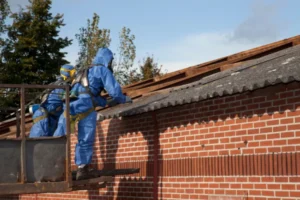
Removing asbestos from a building is an important step in managing exposure risks, but the work is not necessarily finished when the material has been taken away. The area must be cleaned, inspected, and evaluated according to the requirements that apply to the project.
For property owners and contractors, understanding asbestos clearance testing NYC requirements is essential before allowing occupants or renovation workers to return to an affected space. Clearance air testing helps assess airborne fiber levels after abatement and determines whether the work area meets the applicable release criteria.
1. What Is Asbestos Clearance Testing?
Asbestos clearance testing is air monitoring performed after asbestos abatement to evaluate whether the affected area meets the required clearance standard.
During removal, microscopic asbestos fibers may become airborne if asbestos-containing materials are disturbed. Even after the material has been removed, residual contamination may remain if cleanup is incomplete.
Clearance procedures generally involve a visual inspection followed by air sampling and laboratory analysis where required. The sampling method and acceptance criteria depend on the project type and applicable regulations.
In New York City, post-abatement air monitoring is governed by the city’s asbestos control rules. Testing must be conducted by appropriately qualified, independent professionals rather than treated as an informal check performed solely by the removal contractor.
Passing clearance testing does not mean that every part of a building is permanently free of asbestos. It indicates that the sampled work area met the applicable clearance criteria under the conditions and procedures used.
2. When Is Clearance Testing Required in NYC?
The requirement depends on the project’s classification, removal method, location, and circumstances. NYC regulations establish post-abatement monitoring requirements for different categories of asbestos projects.
For example, the city’s rules generally require clearance air monitoring for small and large projects according to the prescribed sampling schedules. Minor projects have more limited requirements, and clearance monitoring may not be required unless specific conditions apply.
Exceptions can include visible emissions outside the work area, air sample results exceeding the applicable action level, or work conducted in certain sensitive facilities, such as schools, daycare centers, and healthcare institutions.
This distinction matters because homeowners should not assume that every small repair requires the same testing protocol as a larger asbestos abatement project.
Before work begins, ask the asbestos professional to explain the project’s classification, required monitoring, and documentation. These details should be established before the removal process starts, not after the contractor has finished.
3. What Happens During Clearance Air Testing?
Clearance testing follows a defined sequence designed to prevent premature approval of an incompletely cleaned work area.
Step 1: Complete removal and cleanup. The abatement contractor removes the asbestos-containing material and carries out the required cleaning procedures. Waste must be removed and handled appropriately.
Step 2: Conduct a visual inspection. The applicable NYC procedure requires an inspection by a project monitor independent of the abatement contractor, together with the asbestos handler supervisor. Visible asbestos debris or residue must be absent before sampling begins.
Step 3: Prepare the area for sampling. NYC rules prescribe specific timing and sampling procedures. For applicable projects, sampling cannot begin until at least one hour after the area has dried from the third cleaning. Different timing applies to pre-demolition abatement.
Step 4: Collect air samples. Qualified personnel collect samples at prescribed locations using the required sampling method. The applicable rules specify sample numbers, volumes, and procedures based on the project.
Step 5: Analyze results and determine clearance. The samples are analyzed using the specified method, and the results are compared with the relevant criteria. If the work area does not pass, further cleaning and additional sampling are required.
4. What Do the Testing Results Mean?
The interpretation depends on the analytical method used and the type of project.
Phase contrast microscopy (PCM) counts airborne fibers meeting specified optical criteria but does not identify asbestos fibers individually. Transmission electron microscopy (TEM) provides greater specificity for identifying asbestos structures and may be required for certain projects.
NYC’s rules establish different sampling and clearance procedures according to project circumstances. For PCM clearance monitoring on alteration or renovation projects, the criteria generally require each sample to be at or below 0.01 fibers per cubic centimeter or the ambient concentration, whichever is greater. TEM results must meet the applicable interpretation criteria.
A passing result supports clearance under the prescribed protocol. A failing result means the affected work area must be addressed before clearance can be granted.
| Testing consideration | What it establishes | Why it matters |
| Visual inspection | Whether visible asbestos debris or residue remains | Sampling cannot begin until the required visual conditions are met |
| PCM analysis | Airborne fiber concentration under the method’s counting criteria | Used for applicable clearance protocols |
| TEM analysis | More specific identification of asbestos structures | Required for certain project categories |
| Repeat sampling | Whether the work area meets clearance criteria after further cleaning | Helps establish compliance when initial results fail |
| Project documentation | Records of monitoring and completion | Supports regulatory and project closeout requirements |
5. Who Should Perform Clearance Testing?
Clearance testing should be performed by appropriately qualified professionals who meet the applicable independence and licensing requirements.
NYC requires independent air monitoring for asbestos abatement projects. The city’s rules also specify who may perform sampling and analysis, including relevant New York State Department of Labor licensing requirements.
Property owners should verify that the air-monitoring provider is qualified for the project and independent of the abatement contractor as required. Ask for the sampling report, laboratory results, and confirmation of any required completion documentation.
The NYC Department of Buildings explains that owners must satisfy applicable asbestos requirements before certain building permits can be issued. Depending on the project, required closeout documents may include an ACP-21 completion form or an ACP-5 asbestos assessment report.
6. What Should You Do If Clearance Testing Fails?
A failed result should not be ignored or treated as a minor administrative issue. Under NYC rules, a work area that does not meet the applicable clearance criteria must be thoroughly recleaned using wet methods, with the required negative-pressure ventilation system operating. New samples must then be collected.
The process continues until the work area meets the required criteria.
Property owners should keep the affected area restricted until the responsible professionals confirm the appropriate next steps. Do not remove containment or allow renovation to resume simply because the visible asbestos has been taken away.
Planning for possible additional cleaning and testing can also help avoid unrealistic project deadlines.
Arrange Professional Asbestos Testing With BigApple Asbestos
Understanding asbestos clearance testing NYC requirements helps property owners plan abatement responsibly, verify that the required testing has been completed, and avoid reopening a work area prematurely.
BigApple Asbestos is the company to contact when discussing asbestos-related testing and project requirements in New York City. Visit BigApple Asbestos to review its services and ask about the assessment or testing support your property may need.
Before scheduling work, confirm the required monitoring procedures, professional qualifications, and documentation for your specific project. A clear plan helps property owners coordinate abatement, testing, and the next stage of construction with fewer uncertainties.