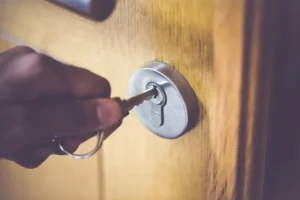
A key breaking inside a door lock can turn an ordinary day into a frustrating situation. You might be trying to leave for work, return home, or secure your business when the key suddenly snaps. The immediate concern is getting the broken piece out without damaging the lock or making the door harder to operate.
If you have a broken key stuck in lock, the first step is to remain calm and avoid forcing the remaining piece. A few careful decisions can help prevent additional damage and make it easier for a locksmith to resolve the problem.
1. Stop Turning the Key Immediately
When a key snaps inside a lock, stop turning it as soon as possible. Applying more pressure can push the broken fragment deeper into the cylinder or make it harder to extract.
Do not insert the remaining part of the key and attempt to turn it again. The two pieces may not align properly, and additional force can place stress on the lock mechanism.
Instead, keep the piece of the key that you still have. It may help a locksmith identify the key profile and determine whether a replacement can be made.
If the door is currently locked, avoid repeatedly operating the handle or forcing the door open. Assess whether you can safely access another entrance while arranging the appropriate repair.
2. Check How Much of the Key Is Visible
The position of the broken fragment determines whether a simple extraction attempt is reasonable.
If a small section of the key protrudes from the keyway, it may be possible to grip it with fine-nosed pliers and pull gently in a straight line. Do not twist the fragment or apply excessive pressure.
If the broken piece sits flush with the lock or has disappeared inside the cylinder, avoid pushing pins, paperclips, knives, or screwdrivers into the opening. These objects can move the fragment farther inside or damage delicate lock components.
A broken key stuck in lock situation becomes more complicated when the fragment is deep inside the cylinder or the lock is partially turned. In these cases, professional extraction is generally the safer option.
3. Avoid Common DIY Mistakes
Online tutorials sometimes suggest quick solutions, but improvised techniques can cause additional problems when used on an installed door lock.
| Common mistake | Why it can cause problems | Safer alternative |
| Forcing the remaining key | Can push the fragment deeper or damage internal components | Stop operating the lock |
| Using superglue | Adhesive may enter the cylinder and interfere with its mechanism | Leave extraction to a locksmith if the fragment is not accessible |
| Inserting sharp tools | Can damage internal components or wedge the fragment in place | Avoid probing inside the keyway |
| Twisting the broken fragment | May cause it to snap further or become more difficult to remove | Use only a gentle, straight pull if enough of the fragment protrudes |
| Forcing the door or handle | Can damage the lock, latch, or door hardware | Arrange professional assistance if the door will not operate |
The goal is to preserve the lock’s condition wherever possible. A careful assessment may allow the fragment to be removed without replacing the entire lock, although the final outcome depends on the damage and lock design.
4. Why Do Keys Break Inside Door Locks?
Keys rarely break without a contributing factor. Understanding what caused the problem can help prevent it from happening again.
Worn or weakened keys: Repeated use gradually wears a key. A bent key, visible crack, or heavily worn edge may be more likely to fail under pressure.
A stiff lock cylinder: If the key has become difficult to insert or turn, the cylinder may have worn components, contamination, or another mechanical problem.
Misaligned door hardware: A door that has shifted or a latch that does not align correctly can place additional pressure on the locking mechanism.
Incorrect keys: A poorly cut duplicate or an unsuitable key may not operate the lock smoothly.
If a broken key stuck in lock incident follows repeated sticking or resistance, do not assume that replacing the key alone will solve the issue. The lock and door alignment may also need inspection.
5. When Should You Call a Locksmith?
Professional assistance is advisable when the fragment cannot be gripped safely, the lock is jammed, or the door cannot be secured.
A locksmith can assess the cylinder, select suitable extraction tools, and determine whether the existing mechanism can be retained. Depending on the situation, the work may involve extracting the fragment, testing the lock, cutting a replacement key, or recommending cylinder replacement.
When arranging service, explain whether the door is locked, whether any part of the key is visible, and whether the key broke while turning. These details help the locksmith understand the problem before arriving.
If a broken key stuck in lock leaves your property unsecured, prioritize securing the entrance. If a child or vulnerable person is trapped, or another immediate danger exists, contact the appropriate emergency services.
6. How Can You Prevent Another Broken Key?
Regular attention to your keys and locks can reduce the likelihood of another incident.
- Replace keys that are bent, cracked, or visibly worn.
- Avoid applying excessive force when a key resists turning.
- Arrange a lock inspection if the cylinder repeatedly sticks or jams.
- Keep a spare key in a secure, accessible location.
- Ask a locksmith to assess door alignment if the lock becomes difficult to operate after changes in temperature or repeated use.
If a key breaks because the lock is worn or damaged, making a duplicate without addressing the underlying issue may only postpone another failure.
Get Reliable Broken-Key Assistance With SuSu Locksmith
A broken key stuck in lock problem does not always mean that the entire lock must be replaced. The right solution depends on the fragment’s position, the condition of the cylinder, and whether the mechanism has suffered additional damage.
SuSu Locksmith provides residential, commercial, automotive, and emergency locksmith services in Brooklyn and across New York City’s five boroughs. The company advertises 24-hour emergency locksmith assistance for lockouts and other urgent lock problems.
If you cannot safely remove the broken key, contact SuSu Locksmith to discuss the situation and arrange appropriate assistance. Call (347) 514-8142 or visit the company’s website to learn more about its locksmith services.
Avoiding force and choosing the right repair approach can help protect your lock, restore access, and reduce the chance of further damage.