Finding a musty smell, water stains, or dark patches on a wall can raise questions about possible mold growth. Property owners often wonder whether they need a mold inspection, laboratory testing, or both. Although these services are related, they serve different purposes.
Understanding mold testing vs mold inspection can help you decide which approach makes sense for your property. An inspection focuses on visible conditions, moisture problems, and potential sources of mold growth. Testing involves collecting samples and analyzing them to answer specific questions about mold in the environment.
For homeowners and property managers, knowing when each service is useful can help avoid unnecessary testing and direct attention toward the underlying moisture problem.
1. What Is a Mold Inspection?
A mold inspection is an assessment of a property for signs of mold growth, water damage, and conditions that may support mold development. The objective is to understand where a problem may exist and identify possible moisture sources.
Depending on the property, an inspection may include:
- Examining walls, ceilings, floors, and other areas for visible growth or water damage.
- Checking areas around plumbing fixtures, windows, basements, and other locations vulnerable to moisture.
- Using moisture meters or other instruments to investigate damp building materials.
- Assessing musty odors and areas where hidden mold may be suspected.
- Recommending further investigation or remediation when necessary.
The U.S. Environmental Protection Agency emphasizes that moisture control is central to managing indoor mold. A professional assessment should therefore look beyond visible discoloration and consider the conditions that allowed growth to develop.
An inspection does not automatically include laboratory analysis. It may provide enough information to recommend corrective action without collecting samples.
2. What Is Mold Testing?
Mold testing involves collecting samples from a property and analyzing them using an appropriate method. Depending on the purpose of the investigation, a professional may collect air samples, surface samples, or samples from specific materials.
Air sampling can help evaluate airborne spores under the conditions present when the sample is collected. Surface sampling can help identify mold on a particular material or investigate whether a suspected substance is mold.
Laboratory results may provide information about the types of mold detected in the samples. However, results must be interpreted in context because mold spores can be present indoors and outdoors, and concentrations can vary over time.
The Centers for Disease Control and Prevention does not recommend routine mold air sampling as a general indoor air quality assessment. There are no established health-based standards for airborne mold concentrations that allow a test result to determine whether a building is safe.
Testing is most useful when there is a clear question the results may help answer. It should not replace an assessment of moisture or necessary remediation.
3. Mold Testing vs. Mold Inspection: Key Differences
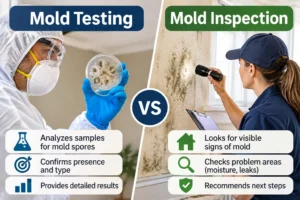
The following table explains how the two services differ in purpose and application.
| Comparison factor | Mold inspection | Mold testing |
| Primary purpose | Identify visible mold, moisture conditions, and potential problem areas | Analyze samples for evidence of mold or particular mold types |
| Typical methods | Visual assessment, moisture measurements, and examination of affected materials | Air, surface, or material sampling followed by analysis |
| Identifies moisture sources | Can investigate likely sources, although some may require further evaluation | Does not independently identify or repair the source of moisture |
| Laboratory analysis | Not necessarily included | Usually involves laboratory or other appropriate sample analysis |
| Best suited for | Visible growth, water damage, musty odors, and suspected moisture problems | Specific questions that sample analysis can meaningfully address |
| Main limitation | Hidden areas may require additional investigation | Results represent the samples and conditions assessed, not necessarily the entire building |
| Recommended next step | Correct moisture problems and determine whether remediation is needed | Interpret findings alongside the property’s condition and moisture history |
The key distinction is that inspection evaluates the building, while testing evaluates collected samples. Depending on the circumstances, a professional may recommend one service or combine both.
4. When Should You Schedule a Mold Inspection?
An inspection may be appropriate when you notice signs of moisture or suspect that mold is developing behind a surface.
Common warning signs include:
- Persistent musty odors without an obvious explanation.
- Water stains on ceilings, walls, or flooring.
- Previous flooding, plumbing leaks, or roof damage.
- Condensation around windows or on cold surfaces.
- Recurring dampness in basements, bathrooms, or other poorly ventilated areas.
Visible mold is also a reason to address the affected area and investigate the moisture source. The EPA explains that sampling is usually unnecessary when mold growth is already visible.
If you suspect hidden growth, avoid opening walls or disturbing potentially contaminated materials without an appropriate assessment. Further investigation may be needed to determine the extent of the problem.
5. When Is Mold Testing Worth Considering?
Testing may be useful when a specific question cannot be adequately answered through visual assessment and moisture investigation alone.
For example, testing may be considered when the source of suspected contamination is unclear, when a documented assessment is needed, or when there is a defined reason to compare samples before and after remediation.
The sampling plan should be designed around the question being investigated. Air samples, for instance, are affected by sampling location, timing, ventilation, and other environmental conditions. A negative result does not necessarily establish that mold is absent from every part of a property.
Similarly, identifying a particular mold species does not automatically establish the level of health risk. People can respond differently to mold exposure, and laboratory findings should not be treated as a medical diagnosis.
A qualified professional should explain what the proposed test can establish, what it cannot establish, and how the findings would influence the next steps.
6. Why Moisture Control and Remediation Matter
Regardless of whether testing is performed, controlling moisture is essential to preventing recurring mold growth. Mold can develop when building materials remain damp, including after leaks, flooding, or persistent condensation.
The EPA recommends correcting water problems and drying wet materials promptly. Mold growth can begin within approximately 24 to 48 hours under suitable moisture conditions, although the timing depends on the material and environmental conditions.
Depending on the situation, corrective work may involve repairing plumbing or roof leaks, improving moisture management, removing affected materials, and drying the area properly.
Testing alone does not remove mold or correct the conditions that support it. Where remediation is necessary, the work should address both the affected materials and the underlying moisture problem.
Get Professional Mold Assessment and Restoration Support From Mold Master Restoration
Choosing between mold testing vs mold inspection starts with understanding the signs present in your property and the questions that need to be answered. An inspection may be sufficient when visible growth and moisture damage already establish the problem. Testing can provide additional information when there is a specific reason to collect and analyze samples.
Mold Master Restoration provides mold inspection, mold testing, mold remediation, and water damage restoration services in New Jersey. Its published services include moisture detection using tools such as moisture meters and infrared thermal imaging, along with air and surface sampling where appropriate.
If you have noticed water damage, persistent musty odors, or suspected mold growth, contact Mold Master Restoration to discuss the situation and determine whether an inspection, testing, or remediation assessment is appropriate.
Call 551-222-0773 or visit Mold Master Restoration to learn more about its services.
A well-informed assessment begins with understanding the moisture problem, selecting the right investigative approach, and taking appropriate corrective action based on the findings.