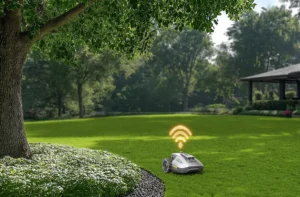
If you have spent every summer weekend pushing a mower in the heat, a robot lawn mower starts to sound less like a luxury and more like a very reasonable decision. It mows while you do other things, leaves a steady, even cut, and runs far quieter than a gas machine.
Choosing one is the tricky part. Prices run from $300 to $5,000+, features vary enormously, and your yard matters more than any marketing claim. Think of this robot lawn mower buying guide as the shortcut through the noise.
Know Your Yard Before You Shop for a Robot Lawn Mower
Four things narrow the field fast: size, slope, grass type and layout.
Yard size
- Under 1/4 acre (10,000 sq ft): Entry-level models work well here, and most cost under $800.
- 1/4 to 1/2 acre: Step up to a mid-range model, usually $800 to $1,500.
- 1/2 to 1 acre: You need higher capacity, typically $1,500 to $3,000.
- Over 1 acre: Look at commercial or premium models and budget $3,000+. A robot lawn mower for large yards needs real battery life and coverage muscle, so this is not the place to cut corners.
Yard slope
- Flat (under 15% grade): Any model handles it, which covers most suburban lawns.
- Moderate (15% to 35%): Read the manufacturer’s slope rating carefully, because not every mower can climb. If you want a robotic mower for sloped yard conditions, like hillside lots or sloped southern yards, look for a rating of 35% or higher.
- Steep (over 35%): Very few consumer models cope. Commercial-grade options are your best path.
Grass type
- Cool-season (Kentucky bluegrass, fescue, ryegrass): Common in the northern US, and most mowers handle these easily.
- Warm-season (Bermuda, St. Augustine, Zoysia): Denser and tougher. For a robot lawn mower for thick grass, look for a stronger cutting system and a higher-torque motor.
Layout and obstacles
A simple rectangle suits any model. Trees, flower beds, play equipment and pool areas call for GPS or vision-based navigation, which avoids obstacles far better.
The Most Important Features to Compare
This part of any robot lawn mower buying guide matters most, because features drive both price and daily experience.
Navigation system is the biggest factor in price. An autonomous lawn mower is only as smart as the way it finds its way around.
- Perimeter wire (older tech): You bury a boundary wire around the lawn edge. These models run about $300 to $1,200, suit simple yards, and take a few hours to install. Aeration or landscaping work can damage the wire.
- GPS + RTK (newer tech): A robot mower without perimeter wire maps your yard digitally and handles complex layouts much better. Expect $1,500 to $4,000+. Brands include Husqvarna EPOS, Mammotion LUBA, Segway Navimow and Worx Landroid Vision.
Cutting width and blades. Residential decks run 7 to 11 inches, and wider means faster coverage. A floating deck follows uneven ground, which helps on slopes. Look for cutting height adjustable from 1 to 4 inches so you can adapt to different grass types.
Battery and charging. The mower heads back to its base, charges, then resumes where it stopped. Expect 60 to 120 minutes of runtime and 30 to 90 minutes of charging. Bigger yards benefit from longer runtime or faster charging.
Rain sensor. Mowing wet grass hurts both the lawn and the machine. Most mid-range and higher models pause in heavy rain and resume when conditions improve.
App control and scheduling. Nearly every current model lets you schedule mowing days, set no-mow zones and check mowing history. Wire-free models add GPS tracking. Check App Store reviews, because a great mower with a terrible app is genuinely frustrating.
Theft protection. Look for PIN lockout, a lift alarm and, on premium models, GPS tracking. This matters if the mower runs overnight or your yard is unfenced.
Top Robot Lawn Mower Picks by Yard Type
Here is where the best robot lawn mower depends on your lot. Each pick below is a robot lawn mower US shoppers can find at major retailers, but confirm current specs and pricing before you buy. For more side-by-side guides, visit lawnrobothq.com.
Small flat yards (under 1/4 acre)
- Husqvarna Automower 115H: Reliable, well supported and wire-based, a great entry point.
- Worx Landroid M: Affordable, app-controlled and good for simple yards.
Medium yards (1/4 to 1/2 acre)
- Husqvarna Automower 430X: A proven robotic mower for sloped yard needs, with a strong reliability record.
- Segway Navimow i105N: A robot mower without perimeter wire, paired with an excellent app.
Large yards and no wire
- Mammotion LUBA 2 AWD: All-wheel drive, no wire, handles slopes up to 80% and covers up to 1.25 acres.
- Husqvarna Automower 450X: Premium and wire-based, covers up to 1.25 acres and performs very well on slopes.
Warm-season and southern grass
Prioritize higher blade torque and a cutting height that goes down to 1 inch. That combination keeps Bermuda and Zoysia looking sharp.
Match the Robot Lawn Mower to the Yard
The right robot lawn mower is the one built for your yard: its size, slope, grass type and how complicated the layout is. Whether you have a flat suburban lawn or a sprawling rural property, the market now has an option that fits.
Once the mower matches the yard, it delivers on its promise of a consistently cut lawn without giving up your weekends. Before you shop, measure your yard and check its slope grade. Those two numbers will narrow your choices more than any review. The best robot lawn mower for your neighbor may not be the best one for you.