Walk into a hotel, resort, or restaurant, and you’ll notice plenty of things at once. The architecture, the lighting, the furniture, the colours and, of course, the greenery.
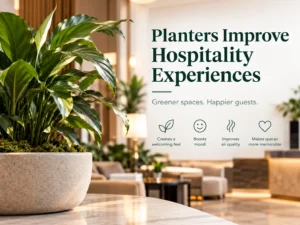
But have you noticed how much the greenery created in the beautiful planter itself contributes to the space?
Walk into a hotel, resort, or restaurant, and you’ll notice plenty of things at once. The architecture, the lighting, the furniture, the colours, and, of course, the greenery.
But have you noticed how much the planter itself contributes to the space?
It can frame an entrance, soften the look of a lobby, create a natural divide between two areas, or bring some life to an otherwise empty corner. In a hospitality space, where every detail contributes to the overall experience, even a planter can have a role beyond simply holding a plant.
That is why choosing the right planter is less about filling a space and more about making it feel complete.
Start With the Entrance
The entrance is where the experience begins.
A couple of well-placed planters can make a hotel entrance feel more welcoming and put together. Tall planters can add height around the doorway, while larger forms can give an open entrance a stronger sense of scale.
For spaces such as resorts, hotels and villas, larger planters can also work well with trees and fuller plants. Bonasila’s Massio collection, for instance, features large-format planters designed to work with bigger spaces and planting schemes.
The idea is simple: let the greenery make an impression, but give it a planter that can hold its own.
Bring Some Character Into the Lobby
Once you step inside, the planter becomes part of the interior.
A lobby usually has a lot going on already. Furniture, lighting, flooring, and architectural details all come together. The planter needs to fit into this picture without feeling like an afterthought.
Rounded forms can soften a space with sharper lines, while more structured designs can complement a contemporary interior.
Bonasila’s Marbelo collection, with its marble-inspired finishes, is one way to bring a more refined look into a lobby. The Existo collection, with its varied forms and sizes, can also work across entrances, lobbies, and other interior spaces.
Sometimes, the right planter is all it takes to make an empty corner feel considered.
Use Planters to Define Spaces
Hospitality spaces are rarely just one open area.
There may be a lounge next to a restaurant, a pool beside a seating area, or an outdoor dining space opening onto a walkway. Planters can help separate these areas without putting up walls.
Long planters can create a soft boundary. Larger planters can mark the edge of a seating area. Smaller groups can guide movement through a space.
The Rezelo collection is useful here, with the same design available in different sizes. This makes it easier to maintain a consistent look while adapting to different areas.
Why FRP Works Well Here
Hospitality spaces see a lot of activity. Planters are moved, cleaned, exposed to weather, and used across spaces with very different requirements.
This is where fiberglass planters can be a practical choice. FRP planter manufacturers offer a wide range of shapes, sizes, colours and finishes, giving designers more flexibility to find planters that work with the space.
FRP is also lightweight compared to many traditional planter materials and gives designers plenty of freedom with shapes, sizes, colours and finishes. This makes it easier to work with different design directions, whether the space calls for something subtle, sculptural, colourful or large-scale.
For a hospitality project, that flexibility can come in handy.
Think About Scale
A planter may look perfect on its own and still feel wrong in a space.
Why? Scale.
A small planter can easily get lost in a large hotel lobby. On the other hand, an oversized planter may make a smaller seating area feel crowded.
Think about the entire setting. The height of the ceiling, the width of the walkway, the size of the furniture and, of course, the plant itself.
Bonasila’s Newo collection, with its contemporary forms and varied sizes, gives designers room to make these choices for each space.
The right proportion helps the planter and the architecture work together.
Don’t Forget the Practical Side
Good-looking planters are great. Planters that continue looking good in a busy space are even better.
In hotels and resorts, planters can sit outdoors in the sun and rain or indoors around high-traffic areas. They also need to be easy to handle and maintain.
This is another reason FRP is often considered for hospitality applications. The hospitality designers often look at FRP planter manufacturers when choosing planters for commercial spaces.
Its versatile construction, design flexibility, and suitability for indoor and outdoor use make it easier to work with across different parts of a property.
The finish matters too. A planter that complements the space should continue to do so over time.
Create a Common Design Language
There is something satisfying about seeing the same design language continue throughout a property.
Maybe it is the same colour family. Maybe it is a particular finish. Or perhaps different planter shapes are used while keeping their proportions and visual character consistent.
The entrance, lobby, restaurant and pool area don’t have to look identical. They need to feel like they belong together.
Planters can quietly help create that connection.
A Little Greenery Goes a Long Way
Hospitality design is made up of many details. Some are immediately noticeable, while others simply make a space feel right.
Planters belong somewhere in between.
They hold the greenery, of course. But they also frame it, give it scale and help it become part of the architecture around it.
At Bonasila, we look at planters as more than containers. The shape, proportion, colour and finish all have a role to play in how a space comes together.
Because when the plant, planter and space work well together, you don’t just see greenery.
You feel the difference.
Frequently Ask Questions
They add greenery and define areas, helping entrances, lobbies, and outdoor spaces feel more complete.
They are lightweight and available in a wide variety of shapes, sizes, colours and finishes, making them flexible for different spaces.
Look at the plant as well as the surrounding space. The planter should feel proportionate to the architecture and furniture around it.
Yes. Fiberglass planters can be used across both indoor and outdoor spaces, depending on their construction and finish.
Yes. They can create soft boundaries between lounges, dining areas, walkways, pools, and other zones without making the space feel enclosed.
Conclusion: A Little Greenery Goes a Long Way
Hospitality spaces are made up of many details. Some catch your eye immediately, while others simply make a space feel right.
Planters are one of those details.
They bring greenery into the space, but also give it shape, scale, and character. When the plant, planter and surroundings work together, even a simple corner can feel more considered and complete.
At Bonasila, we believe a planter should do more than hold a plant. As FRP planter manufacturers, we look at its features, as they all have a role to play in how a space comes together.
Because, a well chosen planter makes greenery feel like part of the design, not an addition to it.