Have you ever stopped to notice how many truly spectacular flowers begin with the letter B? There’s something almost magical about it: from the delicate, nodding bells of Bluebells to the outrageous tropical flair of Bird of Paradise, the “B” family of blooms is wildly diverse and endlessly inspiring.
Whether you’re a seasoned gardener looking for your next showstopper, or a complete beginner trying to figure out what to plant in that sunny corner of your backyard, flowers that start with B offer something for everyone. Some are cottage-garden classics. Others are bold, architectural statement plants. A few are downright whimsical.
Just like our popular guide on Flowers That Start With A, this collection of B flowers will inspire your next garden project, whether that’s a fragrant window box, a wild-style border, or a thoughtful cut flower arrangement for someone you love.
Let’s dive in and meet some of the most beautiful, interesting, and garden-worthy flowers beginning with B.
Most Beautiful Flowers That Start With B (Full List)
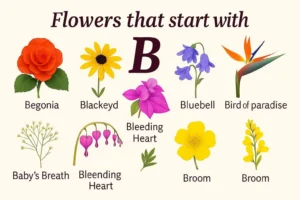
Before we get into the details, here’s a quick-reference table of the top B flowers list every flower lover should know:
| Flower Name | Color | Best Season | Difficulty Level |
|---|---|---|---|
| Begonia | Pink, Red, White, Yellow, Orange | Spring–Fall | Easy |
| Black-Eyed Susan | Golden Yellow with Dark Center | Summer–Fall | Easy |
| Bluebell | Violet-Blue, White, Pink | Spring | Easy |
| Bougainvillea | Magenta, Purple, Orange, White | Spring–Fall | Moderate |
| Bird of Paradise | Orange & Blue, Yellow & White | Year-round (indoors) | Moderate |
| Baby’s Breath | White, Light Pink | Summer | Easy |
| Bleeding Heart | Deep Pink, White | Spring | Easy–Moderate |
| Buttercup | Bright Yellow | Spring–Summer | Easy |
| Broom Flower | Yellow, White, Red | Spring–Summer | Easy |
| Bromeliad | Red, Pink, Orange, Purple | Year-round (indoors) | Easy–Moderate |
Flowers That Start With B Detailed Descriptions
Now let’s really get to know each one. These aren’t just names on a list each of these plants has its own personality, quirks, and reasons to love it.
Begonia
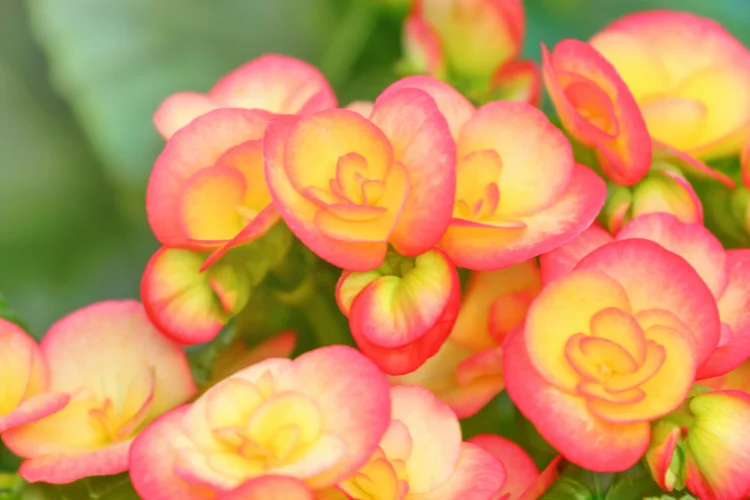
If there’s one flower on this B flowers list that truly earns the title of “crowd-pleaser,” it’s the Begonia. These plants come in an almost absurd variety waxy-leafed wax begonias, dramatic tuberous begonias with blooms the size of your fist, and delicate angel-wing begonias with spotted, wing-shaped leaves. The flowers range from soft blush pink to vivid scarlet, creamy white to buttery yellow and bright orange.
What makes Begonias so special is their versatility. They thrive in containers on a shady patio, brighten up window boxes, and add color to spots where most sun-loving plants would sulk. They’re also surprisingly long-blooming; once they start flowering, they rarely stop until frost.
Care Tips:
- Plant in well-draining, slightly acidic soil with plenty of organic matter
- Water when the top inch of soil dries out; they dislike soggy roots
- Provide bright indirect light; direct afternoon sun can scorch the leaves
- Deadhead spent blooms regularly to encourage continuous flowering
- Bring tuberous begonias indoors before the first frost and store bulbs over winter
Black-Eyed Susan
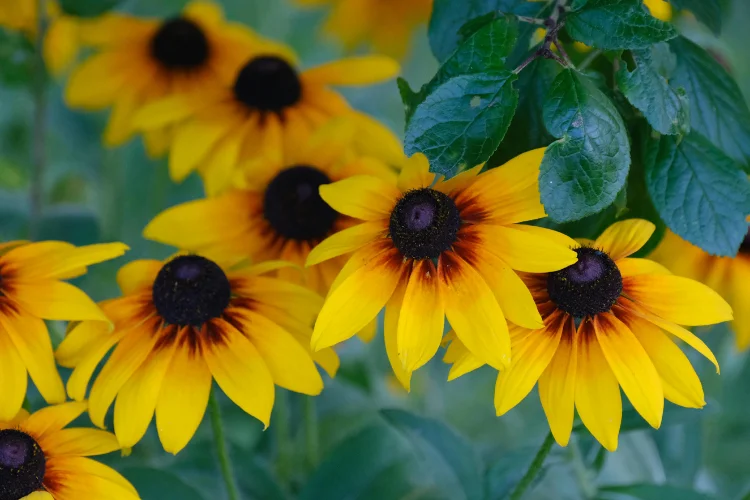
If sunshine had a flower, it would be the Black-Eyed Susan. Those cheerful golden-yellow petals radiating out from a rich, velvety dark center are practically impossible not to smile at. They’re one of the most recognizable flower names starting with B, and they’re a staple of wildflower meadows, cottage gardens, and prairie-style plantings across North America.
Black-Eyed Susans (Rudbeckia hirta) are tough plants: drought-tolerant, heat-loving, and attractive to bees, butterflies, and goldfinches who adore the seeds. They naturalize beautifully, spreading gently over time to fill a border with that warm, golden glow.
Care Tips:
- Plant in full sun for the best flowering (they’ll tolerate partial shade but bloom less)
- Very drought-tolerant once established, perfect for low-maintenance gardens
- Deadhead to prolong blooming, or leave seed heads standing for birds in winter
- Divide clumps every 2–3 years to keep plants vigorous
- Self-seeds freely, so be ready for happy surprises next spring
Bluebell
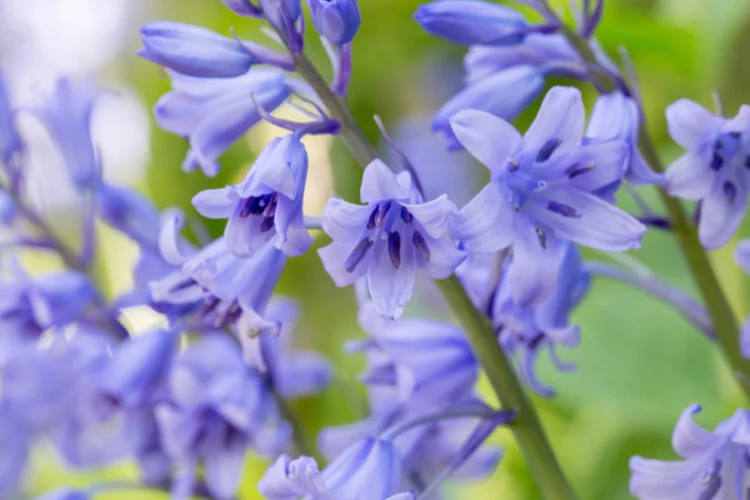
Few sights in the gardening world are as quietly breathtaking as a carpet of Bluebells in full bloom. The English Bluebell (Hyacinthoides non-scripta) creates those famous violet-blue woodland carpets you’ve probably seen in photographs, with drooping bell-shaped flowers clustered on arching stems, releasing a subtle, sweet fragrance into the spring air.
Spanish Bluebells are a bit more upright and come in white and pink as well as the classic blue. Whichever you choose, these bulbs are incredibly easy to grow, multiply reliably, and come back faithfully every spring with minimal fuss.
Care Tips:
- Plant bulbs in autumn, about 4 inches deep and 3–4 inches apart
- They thrive in dappled shade under deciduous trees, mimicking their natural woodland habitat
- Water lightly after planting; established bulbs need very little additional watering
- Allow foliage to die back naturally after flowering; don’t cut it until it yellows
- Avoid planting English and Spanish Bluebells together; the Spanish type can out-compete the native variety
Bougainvillea
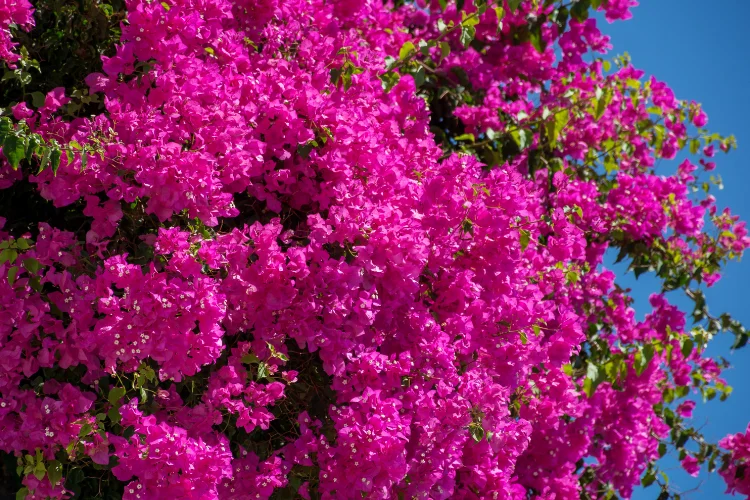
If you want drama in your garden, Bougainvillea delivers it in spectacular fashion. Those vivid magenta, purple, fiery orange, or white “blooms” you see cascading over walls and trellises? They’re actually modified leaves called bracts; the true flowers are the tiny white tubes nestled inside. But nobody cares about botanical technicalities when they’re staring at a wall absolutely smothered in color.
Bougainvillea is a sun-worshipper that thrives in hot, dry climates and rewards a little “tough love”; it blooms most prolifically when it’s slightly stressed. That makes it surprisingly low-maintenance once established, though it does need protection from frost in colder regions.
If bold warm colors excite you, our detailed guide on Orange Flowers has even more stunning bloom inspiration to fuel your creative planting ideas.
Care Tips:
- Plant in full sun; at least 6 hours per day is non-negotiable for good blooming
- Water deeply but infrequently; allow soil to dry between waterings
- Slightly underfeed and slightly underwater to trigger the best flowering
- Prune after each bloom cycle to encourage the next flush of bracts
- In colder climates, grow in large containers that can be brought indoors over winter
Bird of Paradise
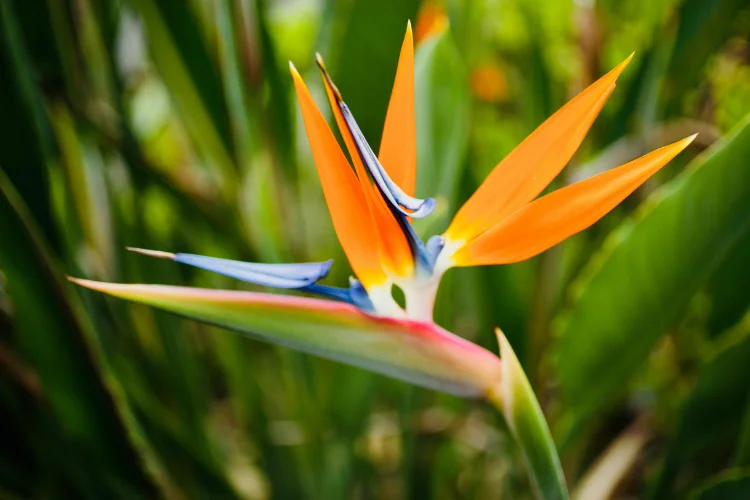
The Bird of Paradise (Strelitzia reginae) is one of those plants that makes people do a double-take. The flowers genuinely look like exotic tropical birds mid-flight: a bold orange “crest” and vivid blue “beak” emerging from a purple-green sheath. The giant white Bird of Paradise (Strelitzia nicolai) is equally dramatic, with white and deep blue flowers on towering stems.
As an outdoor plant, it thrives in warm, frost-free climates. As an indoor plant, it’s become one of the most popular statement houseplants in the world, and even when not in bloom, those large, glossy, paddle-shaped leaves make it a stunning foliage plant.
Care Tips:
- Place in the brightest spot you have direct sun is ideal outdoors, brightest window indoors
- Water thoroughly, then let the top few inches of soil dry before watering again
- Feed monthly during spring and summer with a balanced liquid fertilizer
- Re-pot every 2–3 years; blooming is actually encouraged by being slightly pot-bound
- Wipe dust off large leaves regularly to help the plant photosynthesize efficiently
Baby’s Breath
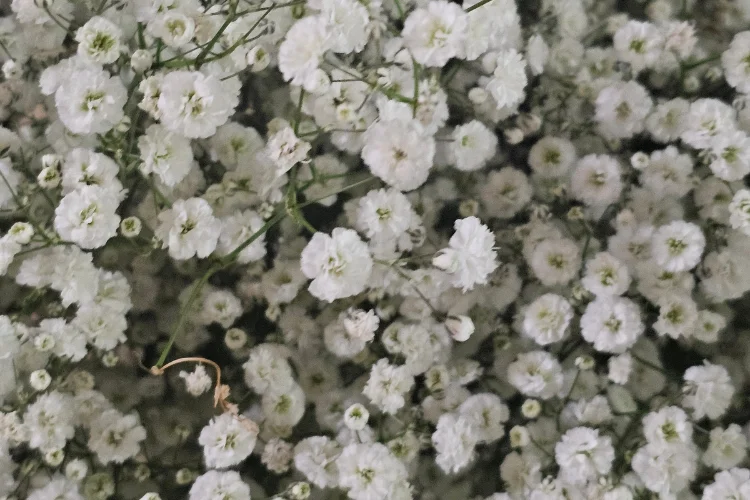
Baby’s Breath (Gypsophila) is one of those beautiful flowers starting with B that might seem understated at first glance, but try building a bouquet without it and you’ll quickly understand its magic. Those clouds of tiny white (or pale pink) star-shaped flowers create the most gorgeous, airy filler that makes every other flower look more beautiful around it.
In the garden, Baby’s Breath is equally valuable. The perennial variety forms mounding clouds of bloom that drift over borders and soften the edges between bolder plants. It’s also surprisingly tough, tolerating poor soils and dry conditions with ease.
Care Tips:
- Plant in full sun in well-drained, slightly alkaline soil (add lime if your soil is acidic)
- Very drought-tolerant once established do not overwater
- Cut back perennial varieties hard after the first flush of flowers to encourage a second bloom
- Avoid heavy clay soils, which can cause root rot
- Excellent for cutting and air-drying hang bunches upside down in a warm, airy space
Bleeding Heart
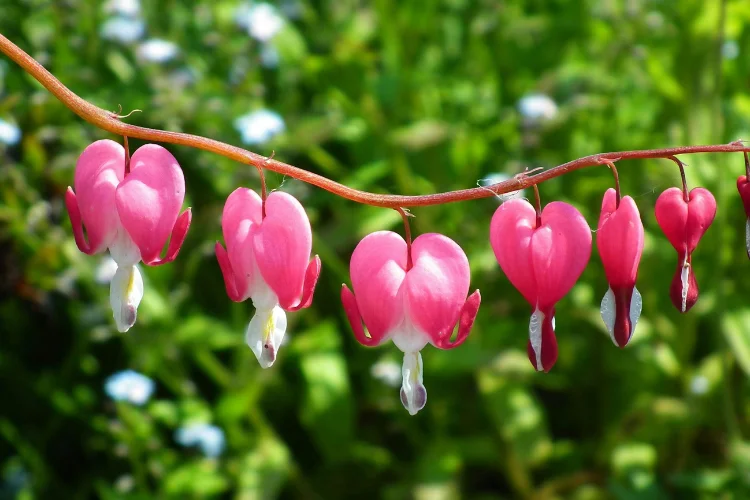
There’s something almost storybook-like about Bleeding Heart (Lamprocapnos spectabilis). The flowers are perfectly heart-shaped, in the most vivid shade of deep rose-pink, each one dangling from an arching stem like a row of tiny lockets. The white variety, ‘Alba,’ has a ghostly elegance that’s equally beautiful.
Bleeding Hearts are shade-loving perennials that shine brightest in spring which also means they go dormant and disappear by midsummer in most gardens. Smart gardeners plant hostas or ferns nearby to fill the gap they leave behind.
Care Tips:
- Plant in partial to full shade; too much sun will scorch the delicate foliage
- Keep soil consistently moist and rich in organic matter
- Allow foliage to die back naturally after flowering; don’t cut it prematurely
- Divide clumps every 3–4 years in early spring to maintain vigor
- Note: all parts of the plant are mildly toxic wear gloves when handling
Buttercup
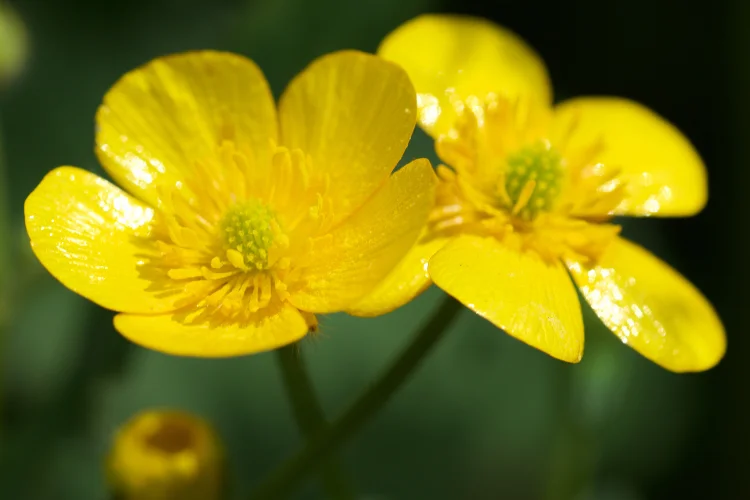
Buttercup (Ranunculus) is one of those flower names starting with B that instantly takes most people back to childhood holding a bright yellow bloom under a friend’s chin to see if they “like butter.” But garden-variety Ranunculus is something else entirely: layers and layers of tissue-paper-thin petals stacked into a bloom that looks almost too perfect to be real, in a rainbow of colors from white, cream, and yellow to peach, coral, red, and deep purple.
Persian Buttercups are spectacular cut flowers that last brilliantly in a vase, and they’re grown from small, claw-like corms in spring or autumn depending on your climate.
Care Tips:
- Plant corms with the “claws” facing downward, about 2 inches deep
- Choose a sunny spot with rich, very well-drained soil
- Water regularly during active growth, but reduce watering as foliage yellows and dies back
- In frost-prone areas, plant in spring after the last frost date
- Excellent as cut flowers harvest when the bud is just beginning to open
Broom Flower
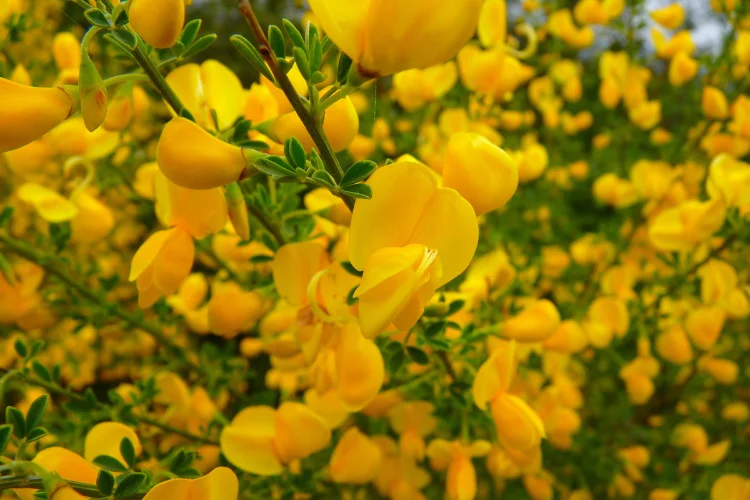
Broom (Cytisus and Genista species) is one of those underrated shrubs that absolutely earns its place in a garden. In late spring, established Broom plants transform into cascading fountains of small, intensely yellow pea-shaped flowers so many blooms that the branches bend under their weight. Some varieties come in creamy white, bicolored red and yellow, or soft pink.
Broom is a brilliant choice for dry, poor soils where many other plants struggle. It’s fast-growing, wildlife-friendly, and absolutely dazzling in full flower, even if it’s not always top of the shopping list at the garden center.
Care Tips:
- Plant in full sun; excellent for sandy, poor, or dry soils
- Avoid over-fertilizing too much nutrition reduces flowering
- Prune immediately after flowering, cutting back into the previous year’s growth (never into old wood)
- Highly drought-tolerant once established; very little supplemental watering needed
- Note: can be invasive in some regions (particularly the Pacific Northwest) check local guidelines before planting
Bromeliad
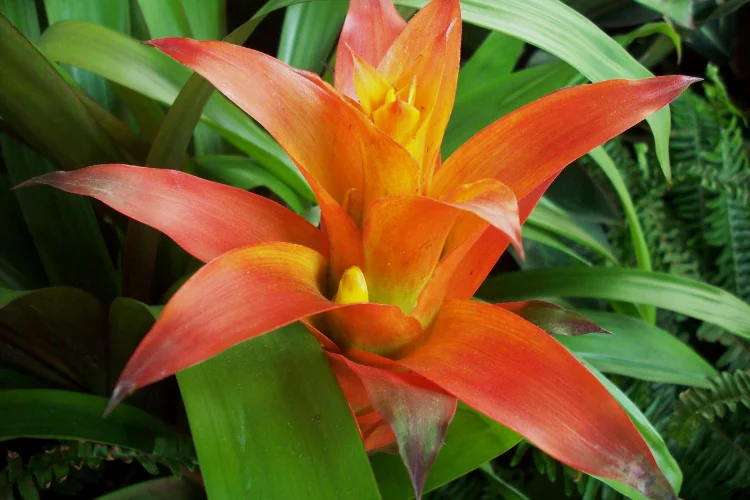
Bromeliads are the exotic overachievers of the B flowers for garden world, and particularly the indoor garden. These tropical plants produce spectacular central “tanks” of stiff, architectural foliage from which a bold, long-lasting flower spike emerges in vivid reds, oranges, pinks, and purples. The “flower” you see is often actually brightly colored bracts surrounding the small true flowers, and it can last for weeks or even months.
The most well-known edible bromeliad is, believe it or not, the pineapple. In the home, ornamental bromeliads are wonderfully easy to keep alive and incredibly rewarding.
Care Tips:
- Fill the central “tank” (cup formed by the leaves) with water and keep it topped up
- Water the soil only occasionally the central tank is the plant’s primary water source
- Bright indirect light is ideal; avoid harsh direct sun, which can bleach the leaves
- After flowering, the mother plant slowly dies but produces “pups” (offshoots) that can be separated and grown on
- Mist the leaves occasionally to maintain humidity, especially in centrally heated homes
Flowers That Start With B For Your Garden
Best B Flowers for Beginners
If you’re just starting out, these types of B flowers are almost impossible to fail with:
- Black-Eyed Susan: tough, drought-tolerant, and absolutely bullet-proof
- Begonia: forgiving, long-blooming, and available almost everywhere
- Baby’s Breath: thrives on neglect and rewards you abundantly
- Buttercup (Ranunculus): easy from corms, stunning results
Best B Flowers for Indoors
These beauties thrive as houseplants:
- Bird of Paradise: the ultimate statement plant for bright rooms
- Bromeliad: low-maintenance, exotic, and fascinatingly structural
- Begonia: particularly the trailing and cane varieties for bright windowsills
- Bougainvillea: challenging but spectacular in a very sunny conservatory
Best B Flowers for Gifting
Want to give someone something truly special?
- Bleeding Heart: romantic, unusual, and deeply meaningful
- Baby’s Breath: the classic addition to any bouquet
- Bird of Paradise: dramatic and unforgettable
- Begonia: cheerful, long-lasting, and widely available in beautiful colors
Flowers That Start With B Meanings & Symbolism
Flowers have carried meaning for centuries, and the B flowers list is rich with symbolism:
- Begonia: a symbol of caution and deep thoughts; in some traditions, a sign of uniqueness and individuality
- Black-Eyed Susan: encouragement, motivation, and justice; associated with the state of Maryland (USA)
- Bluebell: humility, gratitude, and everlasting love; deeply associated with fairy folklore in Celtic traditions
- Bougainvillea: passion, free spirit, and welcoming; commonly seen adorning homes as a symbol of hospitality
- Bird of Paradise: joyfulness, freedom, and magnificence; often used to celebrate achievements and milestones
- Baby’s Breath: purity, innocence, and everlasting love; the classic symbol of a pure heart
- Bleeding Heart: compassionate love, deep emotion, and sometimes, unrequited love
- Buttercup: childlike joy, cheerfulness, and youthfulness, one of the most carefree flowers in the symbolic language of flowers
- Broom Flower: neatness, humility, and new beginnings; also associated with cleansing and fresh starts
- Bromeliad: abundance, good fortune, and adaptability, fitting for such a resilient and versatile plant
How to Grow Flowers That Start With B
General Care Tips
Growing flowers that start with B successfully comes down to a few universal principles:
Soil: Most prefer well-draining soil enriched with compost. A few, like Broom and Baby’s Breath, actually prefer poorer, less fertile soil. Always check the individual requirements before planting.
Watering: The number one mistake with most flowering plants is overwatering. When in doubt, less is more; check the soil moisture before reaching for the watering can.
Sunlight: The majority of flowering plants on this list want full sun (6+ hours per day). Exceptions include Bleeding Heart and Bluebells, which prefer shade or dappled light.
Feeding: A balanced, slow-release fertilizer applied in spring suits most flowering perennials and shrubs. For heavy-flowering annuals like Begonias and Ranunculus, a liquid feed every two weeks during the growing season gives excellent results.
Deadheading: Removing spent flowers regularly is the single most effective thing you can do to extend the flowering season of most plants on this list.
Common Mistakes to Avoid
- Overwatering: responsible for more plant deaths than almost anything else; always check before watering
- Planting in the wrong light: a shade-lover in full sun, or a sun-lover in deep shade, will always struggle; read the label
- Cutting back Bleeding Heart too early: the dying foliage is feeding next year’s plant underground
- Pruning Broom into old wood: it won’t regenerate from the dead brown wood at the base
- Forgetting to top up Bromeliad tanks: the central cup must always have water in it
Frequently Ask Questions
Probably Bougainvillea for gardens in warm climates, and Baby’s Breath for florists and cut flower arrangements. In temperate gardens, Black-Eyed Susan and Begonia are perennial favorites.
Absolutely: Browallia (sapphire flower), Baptisia (false indigo), and Bergenia (elephant’s ears) are less commonly grown but genuinely beautiful. Bletilla (hardy orchid) is another stunning, underused choice.
Black-Eyed Susan, Borage (a brilliant blue herb-flower), and Buddleja (butterfly bush) are all exceptional for bees and butterflies. Bluebells are also important early-season food sources for bumblebees.
Yes! Begonias, Baby’s Breath, Bird of Paradise, and Bougainvillea all do beautifully in containers. Use a good quality potting mix and ensure excellent drainage.
Black-Eyed Susan, Begonia, and Bluebell bulbs are all excellent starting points. They’re forgiving, widely available, and reliably rewarding even with minimal experience.
Conclusion
The world of flowers that start with B is bigger, bolder, and more beautiful than you might have imagined. From the cheerful simplicity of a Buttercup to the tropical theatre of a Bird of Paradise, there’s a B flower for every garden, every skill level, and every sense of style.
The best thing you can do is start: pick one or two from this list that genuinely excite you, get them growing, and let your curiosity lead the way. Gardening has a way of snowballing beautifully: one successful Begonia leads to a whole patio of them; one clump of Bluebells becomes a woodland carpet over the years.
If you’ve found this guide helpful, explore our growing collection of flower guides for more inspiration, including our flowers that start with A guide and our gorgeous roundup of Orange Flowers.
This article covers the most popular and garden-worthy flowers beginning with B, with practical care advice suitable for gardeners of all experience levels.