I still remember the first time I truly noticed fenugreek. I was wandering through a spice market in a busy South Asian neighborhood, and this warm, slightly sweet, almost maple-like scent stopped me mid-step. The vendor smiled and handed me a pinch of golden-brown seeds. “Foenegriek,” he said simply, as if that explained everything.
It did, eventually.
Once I brought those seeds home and tucked them into a sunny corner of my herb garden, I was hooked. This plant is generous, resilient, and full of personality. Just like the graceful Night Blooming Jasmine, Foenegriek fills your garden with an unforgettable fragrance, earthy, rich, and somehow deeply comforting.
Whether you’re a seasoned herb gardener or just starting out, this guide will walk you through everything you need to know about growing and loving Foenegriek. And if you’d like to explore more plant guides, feel free to visit our home page.
What is Foenegriek?
Foenegriek is the Dutch and German name for fenugreek, a clover-like herb with one of the longest cultivation histories of any plant on earth. Its botanical name is Trigonella foenum-graecum, which translates loosely to “Greek hay,” a nod to its ancient use as livestock fodder across the Mediterranean.
Native to the Mediterranean region, southern Europe, and western Asia, fenugreek has been cultivated for over 6,000 years. Archaeologists have found fenugreek seeds in Egyptian tombs. Ancient Greek physicians prescribed it. Indian Ayurvedic healers have relied on it for millennia.
Today, it goes by many names around the world:
- Foenegriek (Dutch, German)
- Fenugreek (English)
- Methi (Hindi, Urdu, Bengali)
- Helba (Arabic)
- Shanbalileh (Persian)
- Uluva (Malayalam)
It belongs to the Fabaceae (legume) family, which makes it a distant cousin of beans and lentils. And like its leguminous relatives, it actually improves the soil it grows in by fixing nitrogen, a lovely bonus for any kitchen gardener.
Foenegriek Plant Characteristics
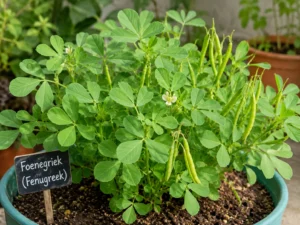
Foenegriek is a compact, upright annual herb that typically grows between 30 to 60 cm (12 to 24 inches) tall. It won’t dominate your garden, but it carries itself with quiet confidence.
Leaves: The leaves are trifoliate, meaning each stem carries three small, oval leaflets, much like clover. They’re a soft, bright green and have a mild, slightly bitter flavor when eaten fresh. In Indian cooking, these fresh leaves (called methi) are as prized as the seeds.
Flowers: Small and creamy-white to pale yellow, the flowers are delicate and appear from late spring into summer. Bees love them.
Pods & Seeds: After flowering, long, slender seed pods develop, usually 10 to 15 cm in length, each holding 10 to 20 small, golden-brown, angular seeds. These seeds carry that distinctive bittersweet, slightly maple-like aroma that makes Foenegriek so recognizable.
Smell & Taste: The seeds have a bold, complex flavor, bitter upfront with a warm, slightly sweet finish. When roasted lightly, they mellow beautifully. Fresh leaves are more subtle, with a gentle bitterness that softens when cooked.
Growing Season: Foenegriek is a cool-season annual. It prefers to be sown in early spring or early autumn, and it completes its full lifecycle from germination to seed harvest in about 3 to 5 months.
How to Grow Foenegriek
Here’s the good news: Foenegriek is genuinely easy to grow. It’s not fussy, it doesn’t demand expensive inputs, and it rewards even beginner gardeners with a satisfying harvest.
Soil Requirements
Foenegriek likes well-draining, loamy soil with a neutral to slightly alkaline pH, ideally between 6.0 and 7.0. It dislikes waterlogged conditions, so if your garden has heavy clay soil, mix in some sand or perlite to improve drainage.
The plant is a nitrogen-fixer, meaning it improves soil fertility naturally as it grows. This makes it an excellent companion plant and a great choice for crop rotation.
Sunlight Needs
Give your Foenegriek full sun, at least 6 hours of direct sunlight per day. It grows in partial shade, but you’ll get leggier plants and fewer seeds. A south-facing spot in your garden or on a sunny balcony works perfectly.
Watering Schedule
Foenegriek prefers consistent, moderate moisture. Water when the top inch of soil feels dry, but avoid overwatering, as root rot is one of the few things that will truly trouble this plant.
During germination (the first 1-2 weeks), keep the soil evenly moist. Once established, Foenegriek becomes fairly drought-tolerant. A good rule of thumb: water deeply twice a week in warm weather, once a week in cooler seasons.
Temperature & Climate
Foenegriek thrives in cool to moderate temperatures, ideally between 10°C and 25°C (50°F to 77°F). It dislikes intense summer heat, and plants tend to bolt (go to seed prematurely) when temperatures consistently exceed 30°C.
For those in hotter climates, try growing it in early spring or autumn when temperatures are milder. In very cold regions, it can be grown indoors under a grow light.
Container vs Garden Growing
One of the joys of Foenegriek is that it adapts beautifully to both container and garden growing.
For containers, choose a pot that’s at least 20-25 cm (8-10 inches) deep, as the roots need space. A terracotta pot with drainage holes works wonderfully.
For garden beds, direct-sow seeds 1-2 cm deep and thin seedlings to about 10 cm apart once they’re established. Foenegriek doesn’t transplant well (it dislikes root disturbance), so direct sowing is always preferred.
If you love growing unique plants outdoors, our detailed guide on Asiatic Lily is worth a read too, another rewarding garden addition with a rich sensory personality.
Foenegriek Care Tips
Fertilizing Guide
Foenegriek is a light feeder. Thanks to its nitrogen-fixing roots, it’s relatively self-sufficient. Avoid high-nitrogen fertilizers, which will encourage lush leaf growth at the expense of seed production.
If your soil is poor, a light application of balanced, slow-release fertilizer (like a 5-10-5) at planting time is sufficient. After that, let the plant do its thing.
Pruning & Harvesting Seeds
For leaf harvests, begin pinching off the top 5-7 cm of stems once plants are 20-25 cm tall. This encourages bushier, more productive growth. You can harvest leaves continuously throughout the growing season.
For seed harvests, allow the plants to flower and set pods. Harvest the pods when they turn yellowish-brown and dry, usually in late summer or early autumn. Cut the plants at the base, hang them upside down in a dry, ventilated spot for 1-2 weeks, then shell the seeds by hand.
Common Pests & Diseases
Foenegriek is relatively pest-resistant, but watch out for:
- Aphids: Small clusters on new growth. Blast off with water or use neem oil spray.
- Powdery mildew: White powdery coating on leaves, usually from poor air circulation. Space plants properly and avoid wetting foliage.
- Root rot: Caused by overwatering. Always ensure good drainage.
- Damping off: A fungal issue in seedlings. Use sterile seed-starting mix and don’t overwater young plants.
Common Growing Mistakes
- Sowing in heat: Planting in midsummer leads to bolting and poor yields. Stick to spring or autumn.
- Transplanting: Foenegriek hates having its roots disturbed. Always direct sow.
- Overwatering: This is the number one killer. When in doubt, underwater rather than over.
- Too little sun: Shaded plants get leggy and produce fewer seeds. Prioritize a sunny spot.
Foenegriek Uses & Benefits
This is where Foenegriek really shines. It’s one of the most versatile herbs you’ll ever grow.
Culinary Uses
| Use | Seeds | Fresh Leaves |
|---|---|---|
| Spice blends | ✅ Toasted & ground | ❌ |
| Curries & dals | ✅ Whole or ground | ✅ Sautéed |
| Bread & flatbreads | ✅ Added to dough | ✅ Mixed in |
| Pickles & chutneys | ✅ Whole seeds | ❌ |
| Salads | ❌ | ✅ Fresh garnish |
| Tea & infusions | ✅ Seed tea | ✅ Leaf tea |
| Herbal butter / pastes | ✅ Powdered | ✅ Blended |
Seeds are the workhorse of the kitchen. Toasted, they add depth to curries, spice blends like panch phoron, and Ethiopian berbere. Ground, they bring that signature warmth to Indian sambar and Pakistani achar gosht.
Fresh leaves (methi) are equally beloved. Sautéed with garlic and butter, stirred into lentils, or used to stuff methi parathas, they bring a pleasant, gentle bitterness that balances rich dishes beautifully.
Nutritional & Health Benefits
Foenegriek is nutritionally impressive:
- Rich in fiber, which supports digestive health
- Contains saponins and alkaloids, studied for blood sugar regulation
- High in iron, particularly beneficial for those prone to anemia
- Good source of protein, especially relevant for plant-based diets
- Contains diosgenin, a compound studied for its hormonal and anti-inflammatory properties
Research suggests fenugreek may help regulate blood sugar levels, support milk production in breastfeeding mothers, and contribute to healthy cholesterol levels. As always, consult your healthcare provider before using it medicinally.
Traditional Medicinal Uses
For thousands of years, traditional healers across the Middle East, South Asia, and North Africa have used Foenegriek to:
- Aid digestion and relieve bloating
- Soothe sore throats (seed tea with honey)
- Support postpartum recovery
- Treat skin inflammation (seed paste applied topically)
Beauty & Hair Care Uses
Fenugreek seeds soaked overnight and blended into a paste have long been used as a hair mask in South Asian beauty traditions. The paste is said to strengthen hair, reduce dandruff, and promote shine. Some people use the soaking water as a hair rinse.
Seed-based face masks are also popular for soothing acne-prone skin.
Foenegriek vs Common Fenugreek: Are They Different?
Short answer: No, they are the same plant. “Foenegriek” is simply the Dutch/German name for fenugreek (Trigonella foenum-graecum). The plant, its cultivation, and its uses are identical regardless of which name you use.
| Feature | Foenegriek | Fenugreek | Methi |
|---|---|---|---|
| Botanical name | Trigonella foenum-graecum | Trigonella foenum-graecum | Trigonella foenum-graecum |
| Language of name | Dutch/German | English | Hindi/Urdu |
| Same plant? | ✅ Yes | ✅ Yes | ✅ Yes |
| Seeds used? | ✅ Yes | ✅ Yes | ✅ Yes |
| Leaves used? | ✅ Yes | ✅ Yes | ✅ Yes |
The only difference is the word you use. The plant itself is wonderfully, beautifully universal.
Frequently Ask Questions
Foenegriek germinates quickly, usually within 3 to 7 days in warm soil. You can begin harvesting leaves in about 3 to 4 weeks, and seeds are ready in 3 to 5 months.
Absolutely. Foenegriek grows well on a sunny windowsill or under a grow light. Use a deep pot with good drainage and make sure it gets at least 6 hours of light daily.
Foenegriek is an annual, completing its full lifecycle in one growing season. You’ll need to resow seeds each year, but the process is so satisfying that most gardeners don’t mind.
The fresh leaves can be eaten raw in small quantities, though many people find the bitterness more palatable when cooked. Seeds are best lightly toasted or cooked, as raw seeds have an intense, slightly astringent flavor.
That distinctive maple-syrup scent comes from a compound called sotolon, which is naturally present in fenugreek seeds. It’s completely normal and actually one of the plant’s most charming qualities. Some people use this scent as a natural food flavoring.
Conclusion: Grow Your Own Foenegriek and Fall in Love With It
There’s something quietly magical about growing Foenegriek in your own garden or on your kitchen windowsill. It asks for very little, a sunny spot, decent drainage, and occasional water, and gives back generously: fragrant leaves for your curries, golden seeds for your spice rack, and the quiet satisfaction of knowing you grew something ancient and meaningful.
Whether you’re drawn to it for cooking, for its health benefits, or simply because you want to fill your garden with something a little different, Foenegriek deserves a place in your green space.
Start with a small pot of seeds this spring. Within weeks, you’ll have fresh leaves to cook with. By late summer, you’ll be harvesting your own seeds. And somewhere in the process, you’ll understand why this humble little plant has been loved by gardeners, healers, and cooks across six thousand years of human history.
Ready to keep exploring? Browse our other detailed plant guides for more inspiration on building a beautiful, productive herb garden that you’ll love for years to come. 🌿